Wythe in Hampton, Virginia — The American South (Mid-Atlantic)
Hampton Roads – World’s Greatest Harbor
Historical Events Passing the Shores of Olde Wythe
Photographed by Bernard Fisher, July 31, 2010
1. Hampton Roads – World’s Greatest Harbor Marker
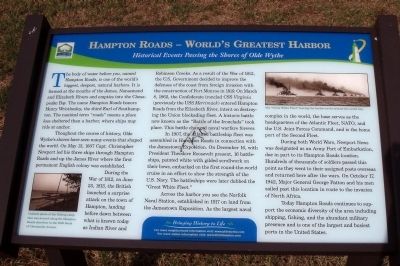
Thoughout the course of history, Olde Wythe’s shores have seen many events that shaped the world. On May 13, 1607 Capt. Christopher Newport led his three ships through Hampton Roads and up the James River where the first permanent English colony was established.
During the War of 1812, on June 25, 1813, the British launched a surprise attack on the town of Hampton, landing before dawn between what is known today as Indian River and Robinson Creeks. As a result of the War of 1812, the U.S. Government decided to improve the defenses of the coast from foreign invasion with the construction of Fort Monroe in 1819. On March 8, 1862, the Confederate ironclad CSS Virginia (previously the USS Merrimack) entered Hampton
this page online
In 1907, the Atlantic battleship fleet was assembled in Hampton Roads in connection with the Jamestown Exposition. On December 16, with President Theodore Roosevelt present, 16 battleships, painted white with gilded scrollwork on their bows, embarked on the first round-the-world cruise in an effort to show the strength of the U.S. Navy. The battleships were later dubbed the “Great White Fleet.”
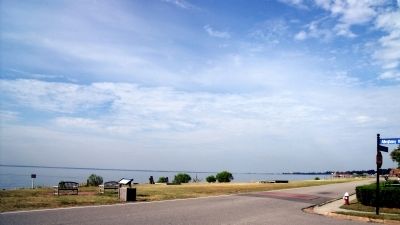
Across the harbor you see the Norfolk Naval Station, established in 1917 on land from the Jamestown Exposition. As the largest naval complex in the world, the base serves as the headquarters of the Atlantic Fleet, NATO, and the U.S. Joint Forces Command, and is the home port of the Second Fleet.
During both World Wars, Newport News was designated as an Army Port of Embarkation, due in part to its Hampton Roads location. Hundreds of thousands of soldiers passed this point as they went to their assigned posts overseas
Photographed by Bernard Fisher, July 31, 2010
2. Chesapeake Ave & Alleghany Rd
Today Hampton Roads continues to support the economic diversity of the area including shipping, fishing, and the abundant military presence and is one of the largest and busiest ports in the United States.
Bringing History to Life
For more neighborhood information visit: www.oldewythe.com
For more visitor information visit: www.VisitHampton.com
In partnership with Virginia Civil War Trails, www.civilwartrails.org
Erected by Olde Wythe Neighborhood Association.
Topics and series. This historical marker is listed in these topic lists: Industry & Commerce • Military • Natural Resources • War of 1812 • War, US Civil • War, World I • War, World II • Waterways & Vessels. In addition, it is included in the Former U.S. Presidents: #26 Theodore Roosevelt series list. A significant historical month for this entry is March 1820.
Location. 37° 0.042′ N, 76° 22.049′ W. Marker is in Hampton, Virginia. It is in Wythe. It is on Chesapeake Avenue (Virginia Route 167) near Alleghany Road, on the left when traveling south. Touch for map. Marker is in this post office area: Hampton VA 23661, United States of America. Touch for directions.

Regionally, this marker is on Virginia’s Peninsula and in Coastal Virginia. It is also in the American South, specifically in the Upper South, in the Tidewater, and on the Eastern Seaboard. Globally, it is in the North Atlantic Region, North America, the Western Hemisphere, the Western World, and the Anglosphere. Historically, it finds itself in what was once the territory of the Mississippian Culture, one of the original Thirteen Colonies, one of the Confederate States of America, and the Antebellum South.
Other nearby markers. At least 8 other markers are within walking distance of this marker: Admiral Sir George Cockburn on the Chesapeake / The War of 1812 (here, next to this marker); Olde Wythe During Colonial Times (about 500 feet away, measured in a direct line); The Hampton Roads Golf And Country Club (about 500 feet away); The Development Of Olde Wythe (approx. 0.2 miles away); Fertile Hunting Grounds For The Indians (approx. ¼ mile away); Indian River Park – In The Heart Of Olde Wythe (approx. 0.3 miles away); 1813 Landing of British Forces (approx. 0.3 miles away); Sack of Hampton / The War of 1812 (approx. 0.3 miles away). Touch for a list and map of all markers in Hampton.
More about this marker. On the lower left is an "Undated photo of the fishing camp that was located along Hampton Roads shoreline in the 2200 block of Chesapeake Avenue."
On the upper right is a photo of The "Great White Fleet" leaving the harbor on its around the world trip."
Also see . . .
1. Olde Wythe Neighborhood Association. (Submitted on August 2, 2010, by Bernard Fisher of Richmond, Virginia.)
2. Memories and History of Hampton Virginia’s Olde Wythe Neighborhood. (Submitted on August 2, 2010, by Bernard Fisher of Richmond, Virginia.)
3. Hampton Convention & Visitor Bureau. (Submitted on August 2, 2010, by Bernard Fisher of Richmond, Virginia.)
4. Virginia Civil War Trails. (Submitted on August 2, 2010, by Bernard Fisher of Richmond, Virginia.)
Credits. This page was last revised on February 1, 2023. It was originally submitted on August 2, 2010, by Bernard Fisher of Richmond, Virginia. This page has been viewed 3,521 times since then and 200 times this year. Photos: 1, 2. submitted on August 2, 2010, by Bernard Fisher of Richmond, Virginia.
