Near Amherstburg in Essex County, Ontario — Central Canada (North America)
Skirmishes at the Canard River
⎯⎯⎯
Escarmouches près de la Rivière Canard
Photographed by Dale K. Benington, August 9, 2010
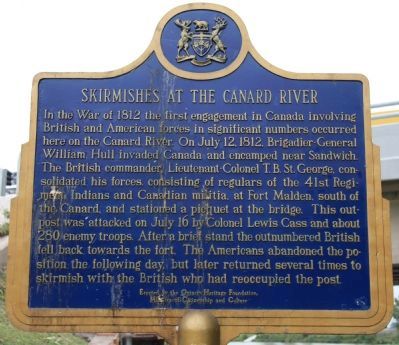
1. Skirmishes at the Canard River Marker
View of the side of the historical marker where the text is written in English.

Skirmishes at the Canard River
In the War of 1812, the first engagement in Canada involving British and American forces in significant numbers occurred here on the Canard River. On July 12, 1812, Brigadier-General William Hull invaded Canada and encamped near Sandwich. The British commander, Lieutenant-Colonel T.B. St. George, consolidated his forces, consisting of regulars of the 41st Regiment, Indians and Canadian militia, at Fort Malden, south of the Canard, and stationed a picquet at the bridge. This outpost was attacked on July 16 by Colonel Louis Cass and about 280 enemy troops. After a brief stand the outnumbered British fell back towards the fort. The Americans abandoned the position the following day, but later returned several times to skirmish with the British who had reoccupied the post.
Escarmouches près de la Rivière Canard
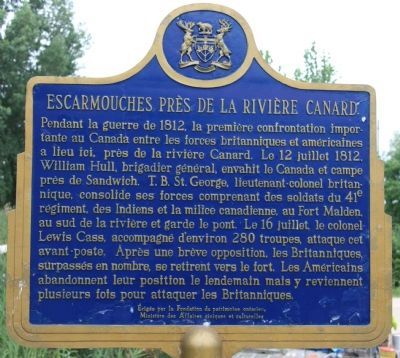
Pendant la guerre de 1812, la première confrontation importante au Canada entre les forces britanniques et américaines a lieu ici, près de la rivière Canard. Le 12 juillet 1812, William Hull, brigadier général, envahit le Canada et campe près de
this page online
Erected 1987 by Ontario Heritage Foundation.
Topics and series. This historical marker is listed in these topic lists: War of 1812 • Waterways & Vessels. In addition, it is included in the Canada, Ontario Heritage Trust series list. A significant historical month for this entry is July 1849.
Location. 42° 10.148′ N, 83° 5.882′ W. Marker is near Amherstburg, Ontario, in Essex County. It is on Front Street North (Provincial Highway 20) north of North Side Road, on the right when traveling south. This historic marker is located on the west side of the north end of the Canard River Bridge. It cannot be seen from the main
Photographed by Dale K. Benington, August 9, 2010
2. Skirmishes at the Canard River Marker
View of the side of the historical marker where the text is written in French.

Regionally, this marker is in the Southwest Ontario Area and in Southwestern Ontario. It is also in Central Canada. Globally, it is in North America, on the Great Lakes, in the Western Hemisphere, in the Western World, and in the Anglosphere. Historically, it finds itself in what was once a British colony, the Viceroyalty of New France, the Haudenosaunee (Iroquois) Confederacy, and Rupert’s Land.
Other nearby markers. At least 8 other markers are within 6 kilometers of this marker, measured as the crow flies: River Canard Bridge / Pont de la Rivière aux Canards (approx. 3 kilometers away); a different marker also named River Canard Bridge / Pont de la Rivière aux Canards (approx. 3 kilometers away); The Wyandot (approx. 3 kilometers away); Mansion House and Survey Tree
Photographed by Dale K. Benington, August 9, 2010
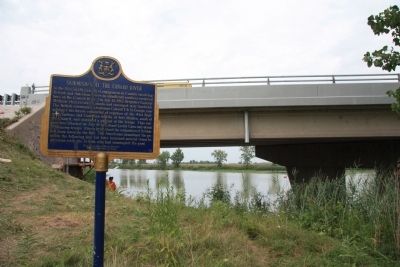
3. Skirmishes at the Canard River Marker
View looking east, of the historical marker with both the Front Street Bridge and the Canard River in the background.
Related markers. Click here for a list of markers that are related to this marker. To better understand the relationship, study each marker in the order shown.
Photographed by Dale K. Benington, August 9, 2010
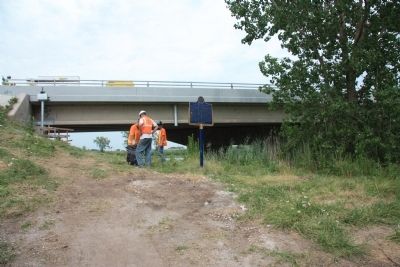
4. Skirmishes at the Canard River Marker
View of the historical marker on a small rise at the base of the bridge that is above the river, but well below the street level of the bridge.
Photographed by Dale K. Benington, August 9, 2010
5. Skirmishes at the Canard River Marker
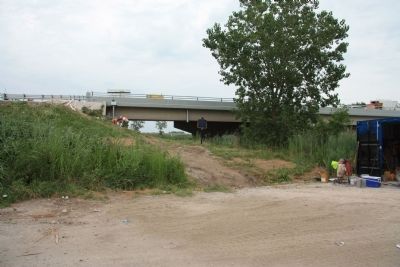
A more distant view from the side street that runs along the northwest side of the bridge. The historical marker is midway between the tree on the right of the picture and the bridge foundation that is on the left.
Photographed by Dale K. Benington, August 9, 2010
6. Skirmishes at the Canard River
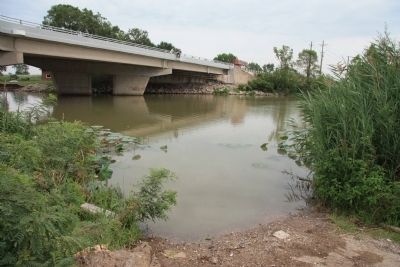
View looking south across the Canard River, from what would have been the American forces position towards what would have been the British forces position.
Photographed by Dale K. Benington, August 9, 2010
7. Skirmishes at the Canard River
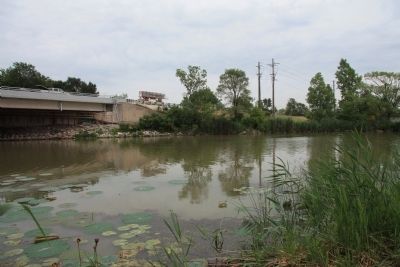
Another view, looking south across the Canard River, of the site of the skirmishes between the British and American forces.
Internet Archive
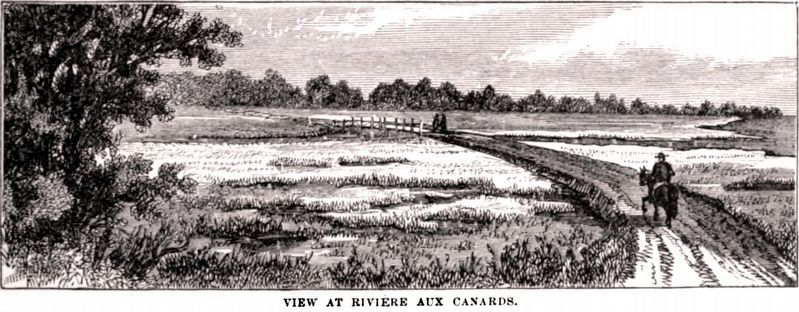
8. Ta-ron-tee, or Rivière aux Canards
From Harper's Encyclopædia of United States History from 458 A.D. to 1905 by Benson John Lossing and Woodrow Wilson, 1905, Vol 9, Page 17.
Credits. This page was last revised on July 31, 2026. It was originally submitted on August 12, 2010, by Dale K. Benington of Toledo, Ohio. This page has been viewed 2,524 times since then and 105 times this year. Photos: 1, 2, 3, 4, 5, 6, 7. submitted on August 13, 2010, by Dale K. Benington of Toledo, Ohio. 8. submitted on February 13, 2021, by Allen C. Browne of Silver Spring, Maryland.
