
Near LaGrange in Troup County, Georgia — The American South (South Atlantic)
Famous Indian Path
<------->
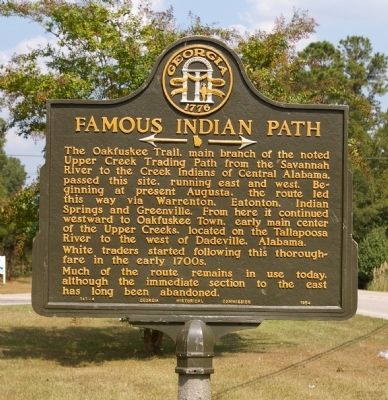
Photographed by David Seibert, September 18, 2010
1. Famous Indian Path Marker
White traders started following this thoroughfare on the early 1700s.
Much of the route remains in use today, although the immediate section to the east has long been abandoned.
Erected 1954 by Georgia Historical Commission. (Marker Number 141-4.)
Topics and series. This historical marker is listed in these topic lists: Indigenous Peoples and Communities • Roads & Vehicles. In addition, it is included in the Georgia Historical Society series list.
Location. 33° 0.444′ N, 85° 6.55′ W. Marker is near LaGrange, Georgia, in Troup County. It is at the intersection of West Point Road (U.S. 29) and Upper Glass Bridge Road, on the right when traveling west on West Point Road. Touch for map. Marker is in this post office area: Lagrange GA 30240, United States of America. Touch for directions.

Regionally, this marker is in Georgia’s Piedmont. It is also in the American South and specifically in the Deep South. Globally, it is in the North Atlantic Region, North America, the Western Hemisphere, the Western World, and the Anglosphere. Historically, it finds itself in what was once the territory of the Mississippian Culture, one of the original Thirteen Colonies, one of the Confederate States of America, and the Antebellum South.
Other nearby markers. At
this page online
Another marker is no longer nearby. The Burnt Village (was approx. 3.9 miles away but has been confirmed missing).
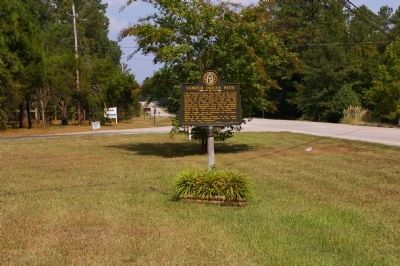
Photographed by David Seibert, September 18, 2010
2. Famous Indian Path Marker
Looking east toward LaGrange; West Point Road (US 29) is on the right, and Upper Glass Bridge Road on the left.
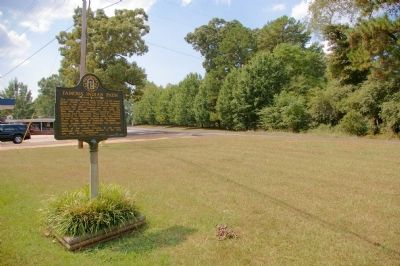
Photographed by David Seibert, September 18, 2010
3. Famous Indian Path Marker
Looking west on Upper Glass Bridge Road, a section of the Oakfuskee Trail. The Glass Bridge was a covered bridge over the Chattahoochee River built by Horace King.
Credits. This page was last revised on June 16, 2016. It was originally submitted on September 25, 2010, by David Seibert of Sandy Springs, Georgia. This page has been viewed 2,145 times since then and 56 times this year. Photos: 1, 2, 3. submitted on September 25, 2010, by David Seibert of Sandy Springs, Georgia. • Craig Swain was the editor who published this page.
