Attalla in Etowah County, Alabama — The American South (East South Central)
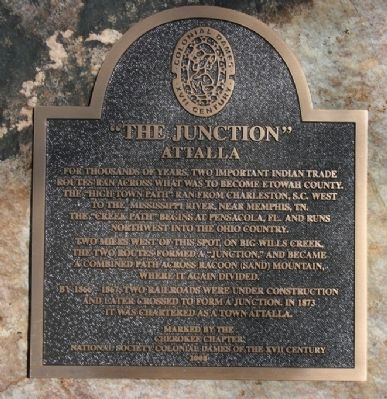
“The Junction”
Attalla
Photographed by Tim & Renda Carr, April 10, 2010
1. “The Junction” Attalla Marker
Two miles west of this spot, on Big Wills Creek, the two routes formed a “Junction,” and became a combined path across Racoon (Sand) Mountain, where it again divided.
By 1866-1867, two railroads were under construction and later crossed to form a junction. In 1873 it was chartered as a Town Attalla.
Erected 2008 by Cherokee Chapter National Society Colonial Dames of the XVII Century.
Topics and series. This historical marker is listed in these topic lists: Indigenous Peoples and Communities • Railroads & Streetcars • Roads & Vehicles. In addition, it is included in the The Colonial Dames XVII Century, National Society series list. A significant historical year for this entry is 1873.
Location. 34° 1.156′ N, 86° 5.127′ W. Marker is in Attalla, Alabama, in Etowah County. It is at the intersection
this page online

Regionally, this marker is in North Alabama. It is also in the American South, specifically in the Deep South, in Appalachia, and specifically in Southern Appalachia. Globally, it is in North America, a Gulf of Mexico state, the Western Hemisphere, the Western World, and the Anglosphere. Historically, it finds itself in what was once the original Cherokee Nation, the territory of the Mississippian Culture, one of the Confederate States of America, and the Antebellum South.
Other nearby markers. At least 8 other markers are within 3 miles of this marker, measured as the crow flies: Camp Wills (here, next to this marker); Electricity for the City of Attalla (approx. 0.3 miles away); First United Methodist Church Of Attalla (approx. 0.3 miles away); William Patrick Lay (approx. 1.8 miles away); Camp Sibert (approx. 1.9 miles away); Alabama City, Alabama (approx. 2.3 miles away); Alabama City World War II Veterans Monument
Photographed by Tim & Renda Carr, April 10, 2010
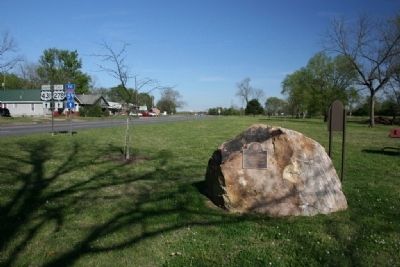
2. “The Junction” Attalla Marker
Photographed by Tim & Renda Carr, April 10, 2010
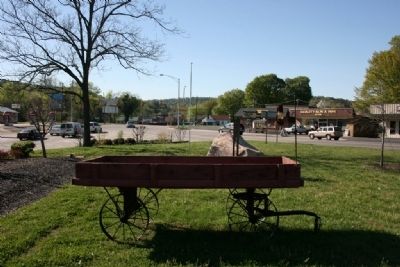
3. “The Junction” Attalla Marker and Camp Wills Marker
Photographed by Tim & Renda Carr, April 10, 2010
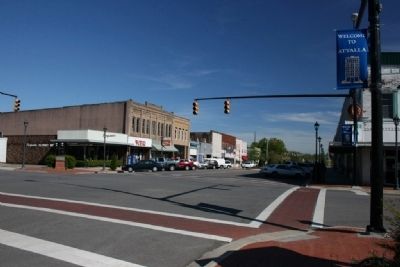
4. Downtown Attalla, Alabama
Credits. This page was last revised on June 16, 2016. It was originally submitted on December 21, 2010, by Timothy Carr of Birmingham, Alabama. This page has been viewed 2,378 times since then and 82 times this year. Photos: 1, 2, 3, 4. submitted on December 21, 2010, by Timothy Carr of Birmingham, Alabama. • Syd Whittle was the editor who published this page.
