Fort Larned National Historic Site in Pawnee County, Kansas — The American Midwest (Upper Plains)
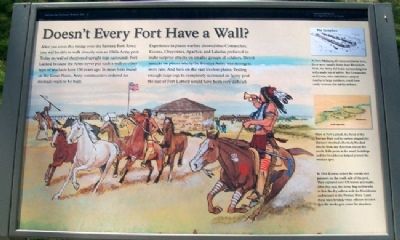
Doesn't Every Fort Have a Wall?
Photographed by William Fischer, Jr., September 19, 2010
1. Doesn't Every Fort Have a Wall? Marker
After you cross this bridge over the Pawnee Fork River, you will be able to walk directly into an 1860s Army post. Today no wall of sharpened upright logs surrounds Fort Larned because the Army never put such a wall or other type of stockade here 150 years ago. In most forts found on the Great Plains, Army commanders ordered no stockade walls to be built.
Experience in plains warfare showed that Comanches, Kiowas, Cheyennes, Apaches, and Lakotas preferred to make surprise attacks on smaller groups of soldiers. Direct assaults on places where the frontier Army was strongest were rare. And here on the vast treeless plains, finding enough large logs to completely surround an Army post the size of Fort Larned would have been very difficult.
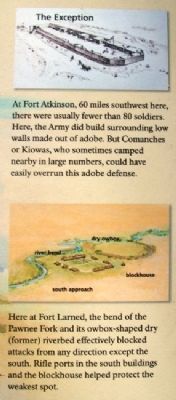
Here at Fort Larned, the bend of the Pawnee Fork and its owbox- [sic - oxbow-]shaped dry (former) riverbed effectively blocked attacks from any direction except the south. Rifle ports in the south buildings and the blockhouse helped protect the weakest spot.
In 1864 Kiowas raided the corrals and pastures on the south side of the post. They captured over 170 horses and mules. After this
this page online
The Exception
At Fort Atkinson, 60 miles southwest [of] here, there were usually fewer than 80 soldiers. Here, the Army did build surrounding low walls made out of adobe. But Comanches or Kiowas, who sometimes camped nearby in large numbers, could have easily overrun this adobe defense.
Erected by National Park Service.
Topics. This historical marker is listed in these topic lists: Forts and Castles • Indigenous Peoples and Communities • Wars, US Indian. A significant historical year for this entry is 1864.
Location. 38° 10.953′ N, 99° 13.257′ W. Marker is in Fort Larned National Historic Site, Kansas, in Pawnee County. It can be reached from K-242. Touch for map. Marker is at or near this postal address: 1767 Kansas Highway 156, Larned KS 67550, United States of America. Touch for directions.

Regionally, this marker is in Central Kansas. It is also in the American Midwest, in the Corn Belt, on the prairies, on the Southern
Photographed by William Fischer, Jr., June 14, 2016
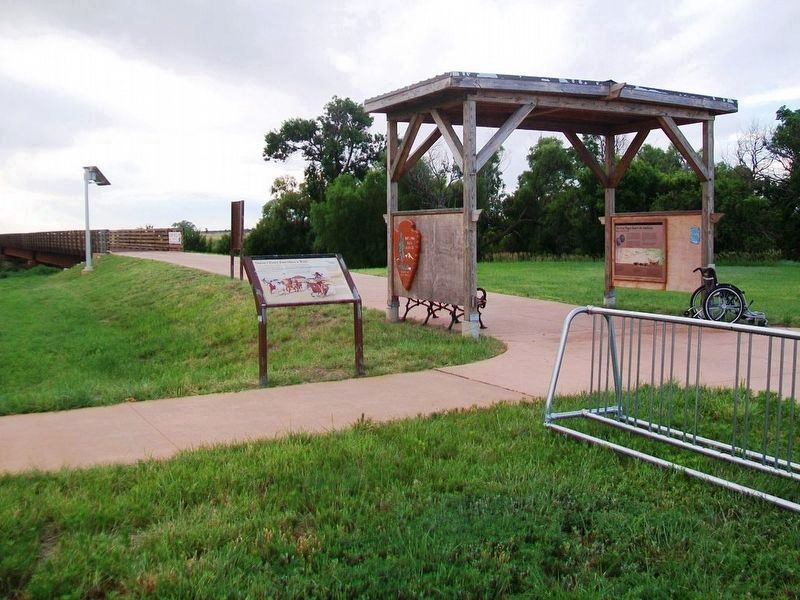
2. Doesn't Every Fort Have a Wall? Marker
Other nearby markers. At least 8 other markers are within walking distance of this marker: A Soldier Town (a few steps from this marker); Well, Adobe Hospital and Hospital Steward's Quarters (about 700 feet away, measured in a direct line); The Great Wagon Road to the Southwest (approx. 0.2 miles away); Soldiers Who Died At Fort Larned (approx. ¼ mile away); Third Infantry Honored Dead (approx. ¼ mile away); Santa Fe Trail (approx. 0.4 miles away); Fort Larned (approx. 0.4 miles away); The Frontier Army and the U.S. Mail (approx. 0.4 miles away). Touch for a list and map of all markers in Fort Larned National Historic Site.
More about this marker. Marker was located adjacent to the kiosk that was at the entrance parking lot, which no longer exists. The marker was at 38.185151N 99.219165W.
Also see . . .
1. Fort Larned National Historic Site. (Submitted on February 8, 2011, by William Fischer, Jr. of Reynoldsburg, Ohio.)
2. Santa Fe National Historic Trail.
Photographed by William Fischer, Jr., September 19, 2010
3. Former Location of the Doesn't Every Fort Have a Wall? Marker
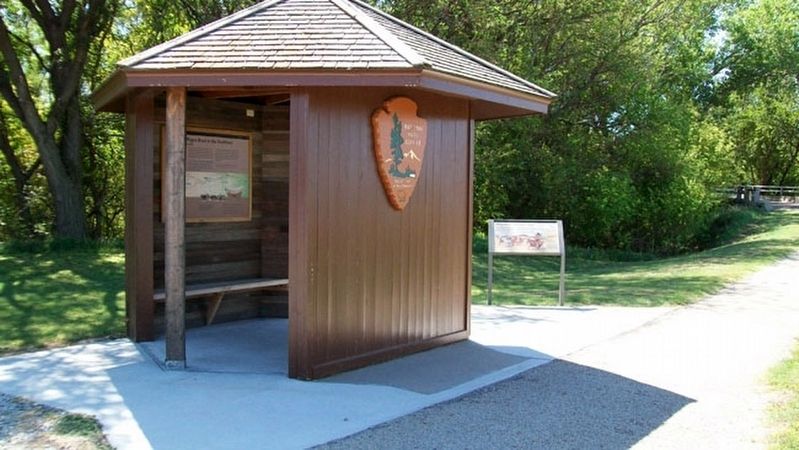
Marker seen beyond the kiosk. The marker has been moved and the kiosk no longer exists.
3. Frontier Forts in Kansas. (Submitted on February 8, 2011, by William Fischer, Jr. of Reynoldsburg, Ohio.)
Photographed by William Fischer, Jr., September 19, 2010
4. Doesn't Every Fort Have a Wall? Detail
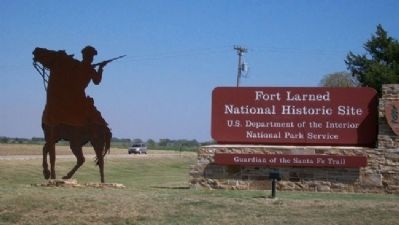
Photographed by William Fischer, Jr.
5. Fort Larned Entrance Sign
Credits. This page was last revised on July 14, 2016. It was originally submitted on February 8, 2011, by William Fischer, Jr. of Reynoldsburg, Ohio. This page has been viewed 884 times since then and 34 times this year. Photos: 1. submitted on February 8, 2011, by William Fischer, Jr. of Reynoldsburg, Ohio. 2. submitted on July 14, 2016, by William Fischer, Jr. of Reynoldsburg, Ohio. 3, 4. submitted on February 8, 2011, by William Fischer, Jr. of Reynoldsburg, Ohio. 5. submitted on February 6, 2011, by William Fischer, Jr. of Reynoldsburg, Ohio.
