Manchester in Richmond, Virginia — The American South (Mid-Atlantic)
Transitions
| — | Richmond Slave Trail | — |
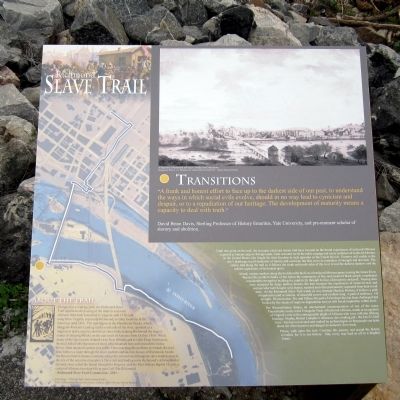
Photographed by Bernard Fisher, April 20, 2011
1. Transitions Marker
“A frank and honest effort to face up to the darkest side of our past, to understand the ways in which social evils evolve, should in no way lead to cynicism and despair, or to a repudiation of our heritage. The development of maturity means a capacity to deal with truth.”
David Brion Davis, Sterling Professor of History Emeritus, Yale University, and pre-eminent scholar of slavery and abolition.
Until this point on the trail, the accounts cited and stories told have focused on the brutal experiences of enslaved Africans exported as human cargo to foreign lands. Later accounts recite the noble courage and steely resilience of enslaved Africans in the United States who fought for their freedom in such episodes as the Creole Revolt. Features still visible in the city’s landscape recall memories of misery and coercion, but also serve as reminders of strength and devotion. The stories told along the trail as it follows the south and north sides of the river reveal the darkest shadows and the noblest aspirations of the human spirit.
Ahead, various markers along the trail describe the lives of enslaved Africans
this page online
The Reconciliation Statue, an international commemoration of one of the many Transatlantic routes in the Triangular Trade of Enslaved Africans, stands in recognition of Virginia’s role in the unimaginable plight of Africans who were sold into lifelong bondage. Nearby, Robert Lumpkin’s infamous slave trading jail — the Devil’s Half Acre — has been excavated
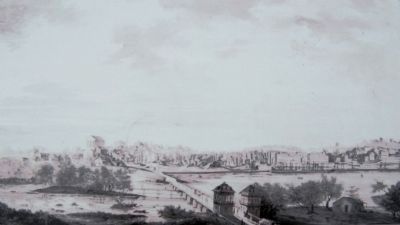
2. A Depiction of Richmond and Mayo’s Bridge from Manchester
Bouqueta de Woiseri, J. L. Pinting, View of Richmond First half 19th C., Virginia Historical Society
Please, walk upon this trail. Continue this journey and accept the history revealed, for it is our history. May every step lead us all to a brighter future.
About the Trail
Designed as a walking path, the Richmond Slave Trail chronicles the history of the trade in enslaved Africans from their homeland to Virginia until 1778, and away from Virginia, especially Richmond, to other locations in the Americas until 1865. The trail begins at the Manchester Docks, which, alongside Rocketts Landing on the north side of the river, operated as a major port in the massive downriver slave trade, making Richmond the largest source of enslaved blacks on the east coast of America from 1830 to 1860. While many of the slaves were shipped on to New Orleans and to other Deep South ports, the trail follows the footsteps of those who remained here and crossed the James River, often chained together in a coffle. Once reaching the northern riverbank, the trail then follows a route through the slave markets and auction houses of Richmond,
Photographed by Bernard Fisher, April 20, 2011
3. Transitions Marker
Title image: “After the Sale: Slaves Going South”, 1853, Painted from live by Eyre Crowe, courtesy the Chicago History Museum
Erected 2011 by Richmond Slave Trail Commission. (Marker Number 8.)
Topics. This historical marker is listed in these topic lists: Abolition & Underground RR • African Americans. A significant historical year for this entry is 1778.
Location. This marker has been replaced by another marker nearby. It was located near 37° 31.622′ N, 77° 26.114′ W. Marker was in Richmond, Virginia. It was in Manchester. It could be reached from Hull Street (U.S. 360) north of Manchester Road, on the left when traveling north. Touch for map. Marker was at or near this postal address: 1 Hull Street, Richmond VA 23224, United States of America.
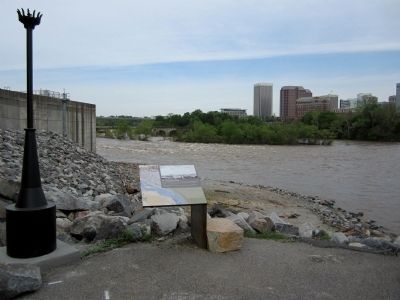
Photographed by Bernard Fisher, April 20, 2011
4. Transitions Marker facing upriver

Regionally, this marker was in Central Virginia. It was also in the American South and specifically in the Upper South. Globally, it was in North America, the Western Hemisphere, the Western World, and the Anglosphere. Historically, it found itself in what was once the territory of the Mississippian Culture, one of the original Thirteen Colonies, one of the Confederate States of America, and the Antebellum South.
Other nearby markers. At least 8 other markers are within walking distance of this location: A different marker also named Transitions (here, next to this marker); Diversity Park (within shouting distance of this marker); Manchester Canal (within shouting distance of this marker); Mayo's Bridge (approx. 0.2 miles away); Richmond's Burgeoning Trade (approx. ¼ mile away); Manchester Lodge No. 14 (approx. ¼ mile away); John Mayo (approx. 0.3 miles away); Slavery Challenged (approx. 0.4 miles away). Touch for a list and map of all markers in Richmond.
Related marker. Click here for another marker that is related to this marker. This marker has been replaced with the linked marker. There
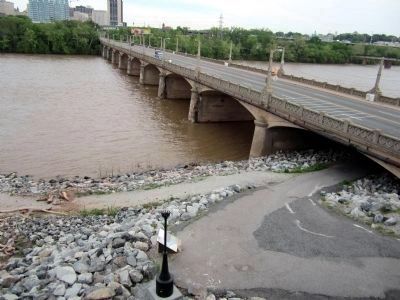
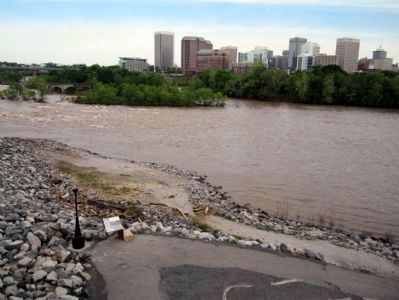
Photographed by Bernard Fisher, April 20, 2011
5. Transitions Marker facing downriver
Credits. This page was last revised on September 8, 2024. It was originally submitted on April 21, 2011, by Bernard Fisher of Richmond, Virginia. This page has been viewed 864 times since then and 26 times this year. Photos: 1, 2, 3, 4, 5. submitted on April 21, 2011, by Bernard Fisher of Richmond, Virginia.
