Araby View near Frederick in Frederick County, Maryland — The American Northeast (Mid-Atlantic)
Monocacy National Battlefield
Photographed by Bill Coughlin, April 12, 2011
1. Monocacy National Battlefield Marker
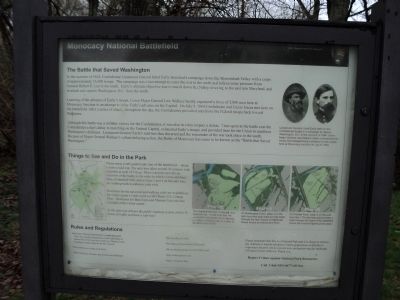
The Battle that Saved Washington
In the summer of 1864, Confederate Lieutenant General Jubal Early launched a campaign down the Shenandoah Valley with a corps of approximately 15,000 troops. The campaign was a last attempt to carry the war to the north and relieve some pressure from General Robert E. Lee in the south. Early’s ultimate objective was to march down the Valley, to swing to the east into Maryland, and to attack and capture Washington, D.C. from the north.
Learning of the advance of Early’s troops, Union Major General Lew Wallace hastily organized a force of 5,800 men here at Monocacy Junction in an attempt to delay Early’s advance on the Capital. On July 9, 1864 Confederate and Union forces met here on the battlefield. After a series of attacks throughout the day, the Confederates prevailed and drove the Federal troops back toward Baltimore.
Although this battle was a victory for the Confederates, it was also in a key respect a defeat. Time spent at the battle cost the Confederates a day’s delay in marching on the Federal Capital, exhausted Early’s troops, and provided time for the Union to reinforce Washington’s
this page online
Things to See and Do in the Park
Please enjoy a self-guided auto tour of the battlefield – about 6 miles round trip. The auto tour takes about 30 minutes with waysides at each of 5 stops. These waysides provide an overview of the battle in the order in which events unfolded. Here at Gambrill Mill, and at stops 3 and 4 on the auto tour, are walking trails to enhance your visit.
Erected by National Park Service.
Topics. This historical marker is listed in this topic list: War, US Civil. A significant historical month for this entry is July 1876.
Location. This marker has been replaced by another marker nearby. It was located near 39° 22.045′ N, 77° 23.244′ W. Marker was near Frederick, Maryland, in Frederick County. It was in Araby View. It could be reached from Urbana Pike (Maryland Route 355), on the right when traveling north. Marker is located at the east end of the parking lot, near
Photographed by Bill Coughlin, April 12, 2011
2. Markers on the Monocacy National Battlefield
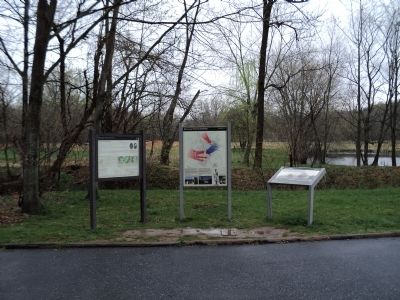
Several markers are found at this location. The Monocacy National Battlefield marker is seen here on the left.

Regionally, this marker was in the Washington Metropolitan Area and in Central Maryland. It was also in the American Mid-Atlantic. Globally, it was in North America, the Western Hemisphere, the Western World, and the Anglosphere. Historically, it found itself in what was once one of the original Thirteen Colonies and also the Antebellum South.
Other nearby markers. At least 8 other markers are within walking distance of this location: Monocacy Battlefield (within shouting distance of this marker); a different marker also named A Bold Plan (within shouting distance of this marker); Edgewood (about 300 feet away); Retreat (about 700 feet away); Burning the Bridge (approx. 0.2 miles away); Desperate Escape (approx. 0.2 miles away); CPL Kirk J Bosselmann (approx. ¼ mile away); Caring for the River (approx. 0.3 miles away). Touch for a list and map of all markers in Frederick.
Other markers no longer nearby. Monocacy National Battlefield (has been replaced with this marker); Gambrill Mill (was here, next to this marker but has been replaced with another marker now near it); A Bold Plan (was within shouting distance of this marker but has been replaced with another marker now near it); Gambrill House (was about 300 feet away, measured in a direct line but has been permanently removed); Burning of the Bridge (was about 700 feet away but has been replaced with another marker now near it); Bush Creek Crossing (was about 700 feet away but has been reported to have been replaced with another marker now near it); Fleeing for Their Lives (was about 700 feet away but has been replaced with another marker now near it).
More about this marker. Portraits of Generals Early and Wallace appear at the top right of the marker. They have a caption of “Lieutenant General Jubal Early (left) led the Confederate forces in a campaign to capture Washington, D.C. in the summer of 1864. Union Major General Lew Wallace (right) commanded the troops that delayed Early’s advance on the capital here at Monocacy Junction on July 9, 1864.”
Below this are maps of three of the auto tour stops and the walking trails located at each. These have the following captions: “The Gambrill Mill trail to the left, is a relatively flat 1/2 –mile loop trail. An accessible boardwalk (in red above), provides a wooded path to a view of the Monocacy River.”; “At Worthington Farm, (stop 3 on the auto tour) two loop trails provide walks through the farm where Confederate forces forded the Monocacy River.”; and “At Thomas Farm, (stop 4 on the auto tour) the 1.75 loop trail provides a walk through the heart of the battlefield where the heaviest fighting took place.”
Also see . . . Monocacy National Battlefield. National Park Service website. (Submitted on April 23, 2011, by Bill Coughlin of Woodland Park, New Jersey.)
Credits. This page was last revised on January 8, 2023. It was originally submitted on April 23, 2011, by Bill Coughlin of Woodland Park, New Jersey. This page has been viewed 1,065 times since then and 32 times this year. Photos: 1, 2. submitted on April 23, 2011, by Bill Coughlin of Woodland Park, New Jersey.
