Near Diamond in Newton County, Missouri — The American Midwest (Upper Plains)
Birthplace of George Washington Carver
Photographed by William Fischer, Jr., January 22, 2011
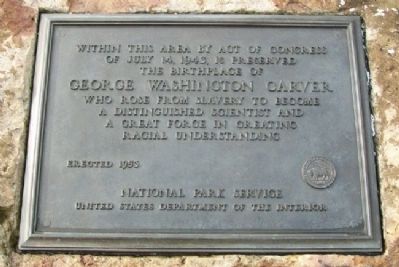
1. Birthplace of George Washington Carver Marker
of July 14, 1943, is preserved
the birthplace of
George Washington Carver
who rose from slavery to become
a distinguished scientist and
a great force in creating
racial understanding
Erected 1953 by National Park Service.
Topics and series. This historical marker is listed in these topic lists: African Americans • Civil Rights • Education • Science & Medicine. In addition, it is included in the George Washington Carver series list. A significant historical month for this entry is July 1855.
Location. 36° 59.221′ N, 94° 21.299′ W. Marker is near Diamond, Missouri, in Newton County. It can be reached from Carver Road. Marker is along the nature trail at George Washington Carver National Monument. Touch for map. Marker is at or near this postal address: 5646 Carver Road, Diamond MO 64840, United States of America. Touch for directions.

Regionally, this marker is in Southwest Missouri. It is also in the American Ozarks, in the Lewis & Clark Corridor, and in the Corn Belt. Globally, it is in North America, the Western Hemisphere, the Western World, and the Anglosphere.
this page online
Other nearby markers. At least 8 other markers are within walking distance of this marker: What an Orphan Chooses to Forget - and Remember (a few steps from this marker); Why a National Monument? (within shouting distance of this marker); Take a Walk in Carver's Woods (within shouting distance of this marker); Special Moments in the Woods (within shouting distance of this marker); The Plant Doctor (within shouting distance of this marker); George Washington Carver's Thoughts (about 300 feet away, measured in a direct line); a different marker also named George Washington Carver's Birthplace (about 300 feet away); a different marker also named George Washington Carver National Monument (about 300 feet away). Touch for a list and map of all markers in Diamond.
Other markers no longer nearby. George Washington Carver's Birthplace (was about 300 feet away but has been replaced with another marker now near it); George Washington Carver National Monument (was about 300 feet away but has
Photographed by William Fischer, Jr., January 22, 2011
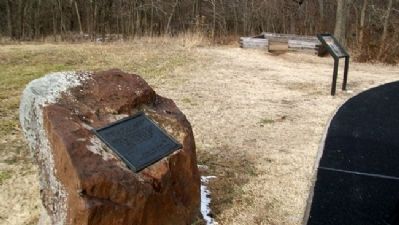
2. Birthplace of George Washington Carver Marker
Looking north
Related marker. Click here for another marker that is related to this marker.
Also see . . .
1. George Washington Carver National Monument. National Park Service website entry (Submitted on April 27, 2011, by William Fischer, Jr. of Reynoldsburg, Ohio.)
2. George Washington Carver. Historic Missourian website entry (Submitted on April 27, 2011, by William Fischer, Jr. of Reynoldsburg, Ohio.)
3. Tuskegee Institute National Historic Site. National Park Service website entry (Submitted on April 27, 2011, by William Fischer, Jr. of Reynoldsburg, Ohio.)
Photographed by Allen C. Browne, August 9, 2015
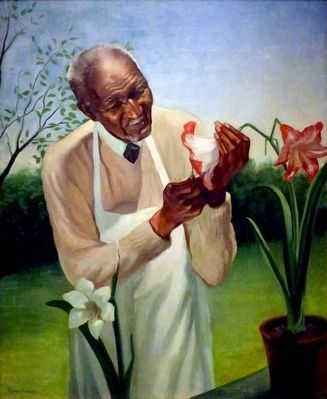
3. George Washington Carver
This 1942 portrait of George Washington Carver by Betsy Graves Reyneau hangs in the National Portrait Gallery in Washington DC.
“Born Diamond Grove (formerly Diamond), Missouri. Born into slavery, George Washington Carver overcame the obstacles of slender means and racial discrimination to seek an education. He believed that "when you can do the common things of life in an uncommon way, you will command the attention of the world." These words, coupled with his lifelong goal to help poor black farmers trapped in sharecropping and dependency on cotton as a crop, pervaded his work at Alabama's Tuskegee Institute, where he was director of agricultural teaching and research for nearly forty years. Carver's laboratory investigations led to the discovery of more than 450 new commercial products-ranging from margarine to library paste-that could be extracted from previously untapped sources such as the peanut and sweet potato. He demonstrated for southern farmers the wisdom of diversifying crops, instead of relying mainly on the soil-exhausting crop of cotton.” — National Portrait Gallery
“Born Diamond Grove (formerly Diamond), Missouri. Born into slavery, George Washington Carver overcame the obstacles of slender means and racial discrimination to seek an education. He believed that "when you can do the common things of life in an uncommon way, you will command the attention of the world." These words, coupled with his lifelong goal to help poor black farmers trapped in sharecropping and dependency on cotton as a crop, pervaded his work at Alabama's Tuskegee Institute, where he was director of agricultural teaching and research for nearly forty years. Carver's laboratory investigations led to the discovery of more than 450 new commercial products-ranging from margarine to library paste-that could be extracted from previously untapped sources such as the peanut and sweet potato. He demonstrated for southern farmers the wisdom of diversifying crops, instead of relying mainly on the soil-exhausting crop of cotton.” — National Portrait Gallery
Credits. This page was last revised on March 9, 2022. It was originally submitted on April 27, 2011, by William Fischer, Jr. of Reynoldsburg, Ohio. This page has been viewed 1,246 times since then and 45 times this year. Photos: 1, 2. submitted on April 27, 2011, by William Fischer, Jr. of Reynoldsburg, Ohio. 3. submitted on August 12, 2015, by Allen C. Browne of Silver Spring, Maryland.
