Coosawhatchie in Jasper County, South Carolina — The American South (South Atlantic)
Coosawhatchie
Photographed by Michael Stroud, November 15, 2007
1. Side 1
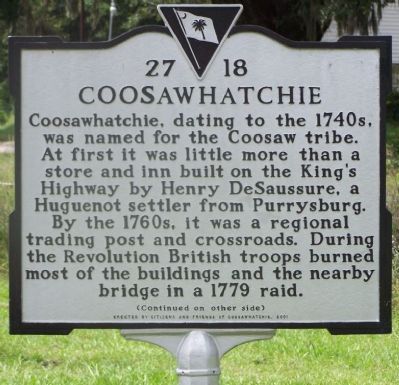
Coosawhatchie, dating to the 1740s, was named for the Coosaw Tribe. At first it was little more than a store and inn built on the King's Highway by Henry De Saussure, a Huguenot settler from Purrysburg. By the 1760s, it was a regional trading post and crossroads. During the Revolution British troops burned most of the buildings and the nearby bridge in a 1779 raid.
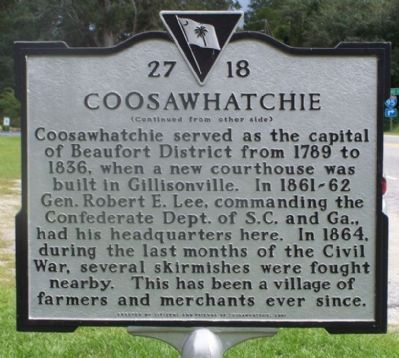
Coosawatchie served as the capital of Beaufort District from 1789 to 1836, when a new courthouse was built in Gillisonville. In 1861-62 Gen. Robert E. Lee, commanding the Confederate Dept. of S.C. and Ga., had his headquarters here. In 1864, during the last months of the Civil War, several skirmishes were fought nearby. This has been a village of farmers and merchants ever since.
Erected 2001 by South Carolina Department of Archives and History; sponsored by Citizens and Friends of Coosawhatchie. (Marker Number 27 18.)
Topics. This historical marker is listed in these topic lists: Colonial Era • Settlements & Settlers • War, US Civil • War, US Revolutionary. A significant historical year for this entry is 1779.
Location. 32° 35.325′ N, 80° 55.775′ W.
this page online

Regionally, this marker is in the Lowcountry. It is also in the American South, specifically in the Deep South, and on the Eastern Seaboard. Globally, it is in the North Atlantic Region, North America, the Western Hemisphere, the Western World, and the Anglosphere. Historically, it finds itself in what was once New Spain, the territory of the Mississippian Culture, one of the original Thirteen Colonies, one of the Confederate States of America, and the Antebellum South.
Other nearby markers. At least 8 other markers are within 5 miles of this marker, measured as the crow flies: Battle of Coosawhatchie (approx. 0.2 miles away); Battle at the Tulifinny Crossroads (approx. 1.4 miles away); General Robert E. Lee / Fighting Near Coosawhatchie (approx.
Photographed by Michael Stroud, November 15, 2007
2. Side 2
Part of the Civil War "Frampton Lines"
Regarding Coosawhatchie. Local landmarks include Coosawhatchie Church, Coosawhatchie School , Little Bees Creek, and Saint Paul's Church.
Coosawhatchie is a settlement is 487 miles from the US capital Washington, DC.
Also see . . . Expedition to Coosawhatchie. Account of one of the Civil War incidents that occurred nearby. (Submitted on December 18, 2007, by Craig Swain of Leesburg, Virginia.)
Additional commentary.
1. Gillisonville
Nearby Gillisonville, mentioned on the marker, was among many communities to suffer with the passing of General Sherman's Army during the Carolinas Campaign. Every building except the Baptist Church and a single residential home were destroyed in 1865.
— Submitted December 18, 2007, by Craig Swain of Leesburg, Virginia.
Photographed by Michael Stroud, November 15, 2007
3. Todays Railroad crossing
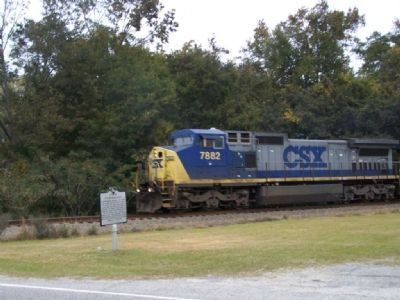
This is the Hurricane evacuation Route, inland North and West for several thousand families in the lower section of the Lowcountry serving Jasper and Beaufort Counties
Photographed by Michael Stroud, January 8, 2008
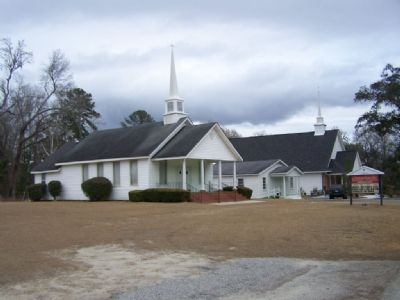
4. Coosawhatchie Baptist Church, Today
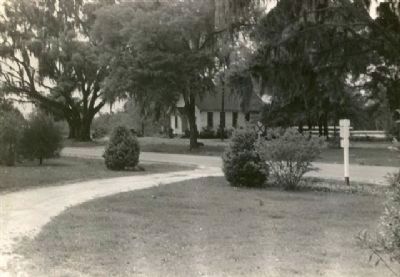
Photographed by Linda Hutton, circa 1950/1960
5. Old Coosawhatchie Baptist Church
Credits. This page was last revised on May 31, 2026. It was originally submitted on December 18, 2007, by Mike Stroud of Bluffton, South Carolina. This page has been viewed 6,969 times since then and 219 times this year. Last updated on May 27, 2025, by James L. Harvey, Jr. of Lexington, South Carolina. Photos: 1, 2, 3. submitted on December 18, 2007, by Mike Stroud of Bluffton, South Carolina. 4. submitted on January 9, 2008, by Mike Stroud of Bluffton, South Carolina. 5. submitted on November 27, 2009, by Linda Hutton of Germantown, Maryland. • Devry Becker Jones was the editor who published this page.
Editor’s want-list for this marker. Photos of Coosawhatchie School , Little Bees Creek, and Saint Paul's Church. • Can you help?
