Sedalia in Guilford County, North Carolina — The American South (South Atlantic)
Dr. Charlotte Hawkins Brown, 1883 - 1961
Photographed by Patrick G. Jordan, June 4, 2011
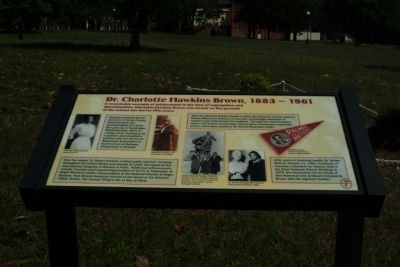
1. Dr. Charlotte Hawkins Brown, 1883 - 1961 Marker
A remarkable example of achievement in the face of segregation and discrimination, Charlotte Hawkins Brown was buried on the grounds of the school she led for fifty years.
Charlotte Hawkins Brown was born in Vance County, North Carolina, the granddaughter of a slave. She grew up in Cambridge, Massachusetts. While in college there, training to be a teacher, she accepted a position with the American Missionary Association to teach school at Bethany Church here in Sedalia.
Over her career, Dr. Brown became a noted public speaker, traveling throughout the United States and abroad. In 1945, she spoke at the International Congress of Women in Paris. Additional achievements include: Founder and long-serving president of the N.C. Federation of Negro Women's Clubs; Vice-president of the National Council of Negro Women; First African American elected to the board of the National YWCA; Author, The Correct Thing to Do, to Say, to Wear.
After the Bethany School closed in 1902, this dynamic woman opened Palmer Memorial Institute on this site, setting high standards of conduct and achievement for students. Through her determination,
this page online
After years of declining health, Dr. Brown died on January 11, 1961. Hundreds of mourners attended her funeral, held in the Alice Freeman Palmer Building. In 1976, the Association for the Study of Afro-American Life & History honored Dr. Brown with the adjacent marker.
(Marker Number 7.)
Topics and series. This historical marker is listed in these topic lists: African Americans • Cemeteries & Burial Sites • Education • Women. In addition, it is included in the Historically Black Colleges and Universities series list. A significant historical month for this entry is January 1857.
Location. This marker has been replaced by another marker nearby. It was located near 36° 4.062′ N, 79° 37.392′ W. Marker was in Sedalia, North Carolina, in Guilford County. It could be reached from Burlington Road (U.S. 70) west of Palmer Farm Road, on the right when traveling east. The marker is on the grounds of the Charlotte Hawkins Brown Historic Site. Touch for map. Marker was at or near this postal address: 6136 Burlington Road,
Photographed by Patrick G. Jordan, June 4, 2011
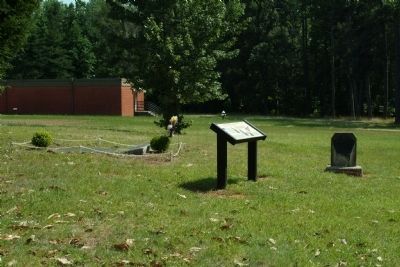
2. Dr. Charlotte Hawkins Brown, 1883 - 1961 Marker (center)

Regionally, this marker was in the Piedmont and specifically in Piedmont Triad. It was also in the American South and specifically in the Upper South. Globally, it was in North America, the Western Hemisphere, the Western World, and the Anglosphere. Historically, it found itself in what was once the territory of the Mississippian Culture, one of the original Thirteen Colonies, one of the Confederate States of America, and the Antebellum South.
Other nearby markers. At least 8 other markers are within walking distance of this location: In Memory of Dr. Charlotte Hawkins Brown (here, next to this marker); a different marker also named Dr. Charlotte Hawkins Brown (a few steps from this marker); N.C. Federation of Colored Women's Clubs (a few steps from this marker); Charlotte Hawkins Brown Gravesite & Memorial (a few steps from this marker); Meditation Altar (within shouting distance of this marker); Alice Freeman Palmer Building (within shouting distance of this marker); Devastating Fire (within shouting distance of this marker); Palmer Memorial Institute (within shouting distance of this marker). Touch for a list and map of all markers in Sedalia.
Another marker is no longer nearby. Canary Cottage (was within shouting distance of this marker but has been replaced with another marker now near it).
Credits. This page was last revised on January 26, 2026. It was originally submitted on June 10, 2011, by Patrick G. Jordan of Graham, North Carolina. This page has been viewed 1,124 times since then and 36 times this year. Photos: 1, 2. submitted on June 10, 2011, by Patrick G. Jordan of Graham, North Carolina. • Bill Pfingsten was the editor who published this page.
