West Columbia in Lexington County, South Carolina — The American South (South Atlantic)
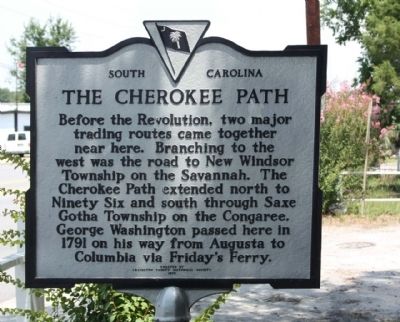
The Cherokee Path
Photographed by Mike Stroud, 2011
1. The Cherokee Path Marker
Erected 1970 by South Carolina State Historic Preservation Office, sponsored by Lexington County Historical Society. (Marker Number 32-7.)
Topics and series. This historical marker is listed in these topic lists: Colonial Era • Roads & Vehicles. In addition, it is included in the Former U.S. Presidents: #01 George Washington, the George Washington Slept Here, and the South Carolina Historical Markers series lists. A significant historical year for this entry is 1791.
Location. 33° 59.061′ N, 81° 5.538′ W. Marker is in West Columbia, South Carolina, in Lexington County. It is on Augusta Road (U.S. 1), on the right when traveling north. Located between Alexandria Street and Manning Drive, opposite Hook Avenue intersection. Touch for map. Marker is in this post office area:
this page online

Regionally, this marker is in the Midlands and in the Greater Columbia Area. It is also in the American South and specifically in the Deep South. Globally, it is in North America, the Western Hemisphere, the Western World, and the Anglosphere. Historically, it finds itself in what was once the territory of the Mississippian Culture, one of the original Thirteen Colonies, one of the Confederate States of America, and the Antebellum South.
Other nearby markers. At least 8 other markers are within 2 miles of this marker, measured as the crow flies: Lakeview School (approx. one mile away); Lakeview High School (approx. one mile away); Cayce Colored School / Cayce Negro Elementary School (approx. 1½ miles away); Saluda Factory Cemetery (approx. 1.7 miles away); A Wild Look Back (approx. 1.7 miles away); The Post at the Congarees (approx. 1.8 miles away); Emily Geiger (approx. 1.8 miles away); Shelling of Columbia (approx. 1.9 miles away). Touch for a list and map of all markers in West Columbia.
Another marker is no longer nearby. Saluda Factory
Photographed by Mike Stroud, June 26, 2011
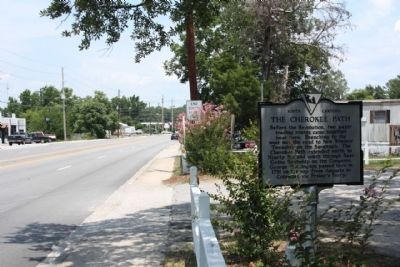
2. The Cherokee Path Marker, looking northeast along Augusta Road
Additional commentary.
1. The Cherokee Path
(also Keowee path) was the primary route from Charleston to Columbia, South Carolina in Colonial America, connecting all of the Cherokee territories. The path was mapped in 1730 by George Hunter, the Surveyor-General of the Province of South Carolina. It ran 130 miles (210 km) from Charlestown to the colonial settlement of Ninety Six, then to Fort Prince George and the Cherokee village of Keowee, the principal town of the Cherokee Lower settlements (in present day Oconee, Greenville, Pickens and Anderson counties).
From Keowee, the path branched out into the Unaka Mountains, usually following streams and valleys, to Clayton, Georgia and up to Franklin and Murphy in North Carolina (the Middle settlements) and across to the Cherokee towns in Tennessee (the Overhill settlements) and Fort Loudoun which had been constructed by South Carolina troops in 1756.
In the 17th century it was used by English and French fur traders, and later used as a military road during the American Revolution. South Carolina Highway 11 (the Cherokee
Photographed by Mike Stroud, June 26, 2011
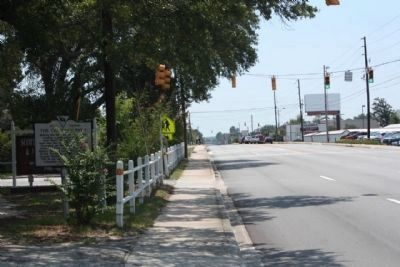
3. The Cherokee Path Marker, looking southwest along Highway US-1 ( Augusta Road)
— Submitted June 28, 2011, by Mike Stroud of Bluffton, South Carolina.
Photographed by Mike Stroud, June 26, 2011
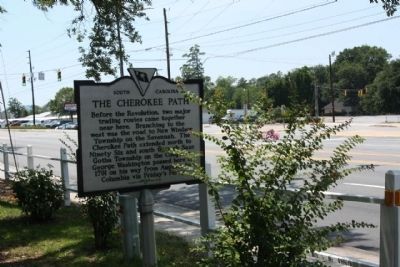
4. The Cherokee Path Marker seen near the intersection of US-1 and Hook Avenue
Credits. This page was last revised on January 19, 2026. It was originally submitted on June 26, 2011, by Mike Stroud of Bluffton, South Carolina. This page has been viewed 2,275 times since then and 89 times this year. Photos: 1, 2, 3, 4. submitted on June 27, 2011, by Mike Stroud of Bluffton, South Carolina.
