Chester Park in Duluth in Saint Louis County, Minnesota — The American Midwest (Upper Plains)
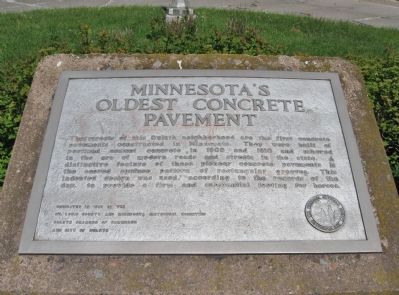
Minnesota's Oldest Concrete Pavement
Photographed by Keith L, June 12, 2011
1. Minnesota's Oldest Concrete Pavement Marker
Dedicated in 1959 by the
St. Louis County and Minnesota Historical Societies
Duluth Chamber of Commerce
and City of Duluth
Erected 1959 by the St. Louis County and Minnesota Historical Societies, Duluth Chamber of Commerce, and City of Duluth.
Topics and series. This historical marker is listed in this topic list: Roads & Vehicles. In addition, it is included in the Minnesota Historical Society series list. A significant historical year for this entry is 1909.
Location. 46° 48.941′ N, 92° 4.478′ W. Marker is in Duluth, Minnesota, in Saint Louis County. It is in Chester Park. It is at the intersection of East 7th Street
this page online

Regionally, this marker is in the Arrowhead Region and in the Iron Range. It is also in the American Midwest and in the Corn Belt. Globally, it is in North America, in the Great North Woods, on the Great Lakes, in the Western Hemisphere, in the Western World, and in the Anglosphere. Historically, it finds itself in what was once the Viceroyalty of New France, Rupert’s Land, the territory of the Mississippian Culture, and the Northwest Territory.
Other nearby markers. At least 8 other markers are within one mile of this marker, measured as the crow flies: West Gate (approx. one mile away); Glensheen (approx. 1.1 miles away); Stone Bridge & Trails (approx. 1.1 miles away); Bent Brook (approx. 1.1 miles away); Servant's Courtyard (approx. 1.1 miles away); Tischer Creek (approx. 1.1 miles away); Glensheen Restoration (approx. 1.1 miles away); The Landscape (approx. 1.1 miles away). Touch for a list and map of all markers in
Photographed by Keith L, June 12, 2011
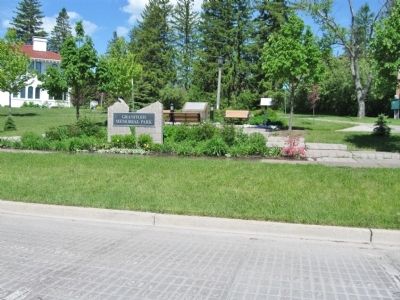
2. Minnesota's Oldest Concrete Pavement and Marker
Photographed by Keith L, June 12, 2011
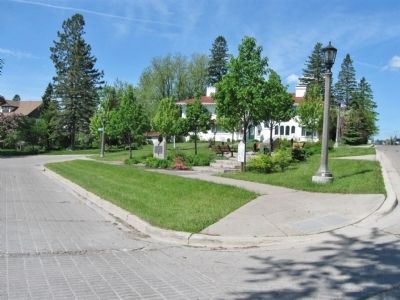
3. Minnesota's Oldest Concrete Pavement and Marker
Photographed by Keith L, June 12, 2011
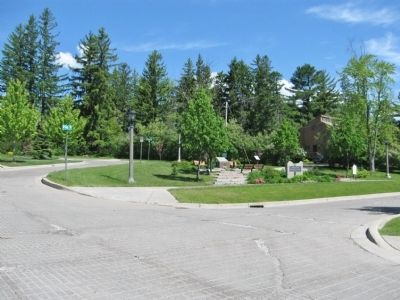
4. Minnesota's Oldest Concrete Pavement and Marker
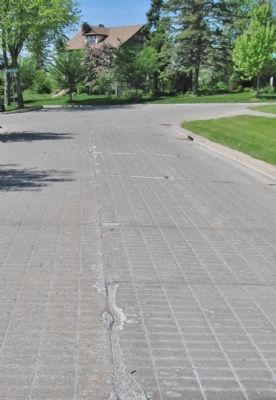
Photographed by Keith L, June 12, 2011
5. Minnesota's Oldest Concrete Pavement
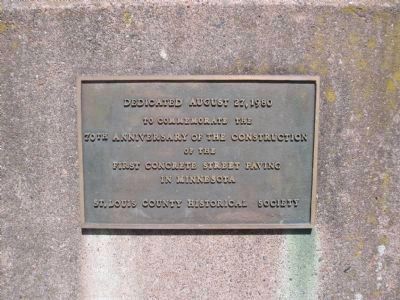
Photographed by Keith L, June 12, 2011
6. Dedication Plaque on Marker Pedestal
Dedicated August 27, 1980 to commemorate the 70th anniversary of the construction of the first concrete street paving in Minnesota.
St. Louis County Historical Society
Photographed by Keith L, June 12, 2011
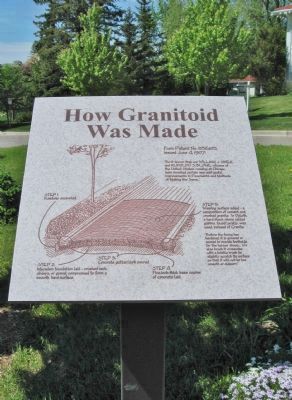
7. How Granitoid Was Made
From Patent No. 856,105, issued June 4, 1907:
"Be it known that we, William J. Sinek and Rudolph S. Blome, citizens of the United States, residing at Chicago, have invented certain new and useful improvements in Pavements and Methods of Making the Same..."
Step 1: Roadway excavated.
Step 2: Macadam foundation laid - crushed rock, cinders, or gravel, compressed to form a smooth, hard surface.
Step 3: Concrete gutter/curb poured.
Step 4: Five-inch-thick base course of concrete laid.
Step 5: Wearing surface added - a composition of cement and crushed granite. In Duluth, a hard black stone called gabbro, found locally, was used, instead of Granite.
"Before the facing has hardened, it is grooved or scored to provide footholds for the horses' shoes... We also brush it crosswise with a bristle brush to slightly scratch its surface so that it will not be too smooth or slippery."
"Be it known that we, William J. Sinek and Rudolph S. Blome, citizens of the United States, residing at Chicago, have invented certain new and useful improvements in Pavements and Methods of Making the Same..."
Step 1: Roadway excavated.
Step 2: Macadam foundation laid - crushed rock, cinders, or gravel, compressed to form a smooth, hard surface.
Step 3: Concrete gutter/curb poured.
Step 4: Five-inch-thick base course of concrete laid.
Step 5: Wearing surface added - a composition of cement and crushed granite. In Duluth, a hard black stone called gabbro, found locally, was used, instead of Granite.
"Before the facing has hardened, it is grooved or scored to provide footholds for the horses' shoes... We also brush it crosswise with a bristle brush to slightly scratch its surface so that it will not be too smooth or slippery."
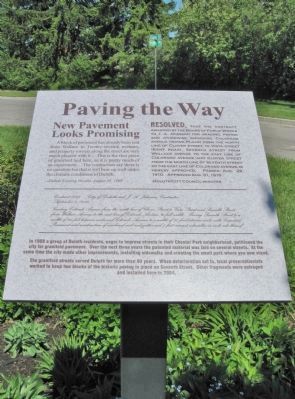
Photographed by Keith L, June 12, 2011
8. Paving the Way
[newspaper article, council minutes, paving contract]
In 1908 a group of Duluth residents, eager to improve streets in their Chester Park neighborhood, petitioned the city for granitoid pavement. Over the next three years the patented material was laid on several streets. At the same time the city made other improvements, installing sidewalks and creating the small park where you now stand.
The granitoid streets served Duluth for more than 90 years. When deterioration set in, local preservationists worked to keep two blocks of the historic paving in place on Seventh Street. Other fragments were salvaged and installed here in 2004.
In 1908 a group of Duluth residents, eager to improve streets in their Chester Park neighborhood, petitioned the city for granitoid pavement. Over the next three years the patented material was laid on several streets. At the same time the city made other improvements, installing sidewalks and creating the small park where you now stand.
The granitoid streets served Duluth for more than 90 years. When deterioration set in, local preservationists worked to keep two blocks of the historic paving in place on Seventh Street. Other fragments were salvaged and installed here in 2004.
Credits. This page was last revised on February 12, 2023. It was originally submitted on July 3, 2011, by Keith L of Wisconsin Rapids, Wisconsin. This page has been viewed 3,072 times since then and 151 times this year. Photos: 1, 2, 3, 4, 5, 6, 7, 8. submitted on July 3, 2011, by Keith L of Wisconsin Rapids, Wisconsin.
