Near Manteo in Dare County, North Carolina — The American South (South Atlantic)
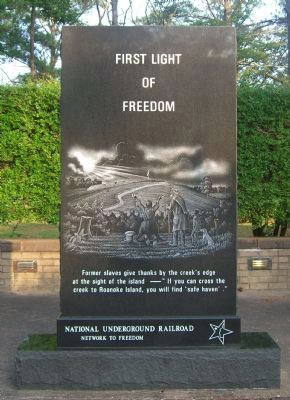
First Light of Freedom
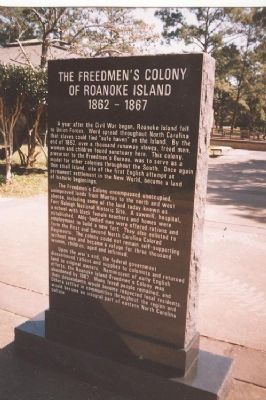
The Freedmen’s Colony of Roanoke Island
| — | National Underground Railroad - Network To Freedom | — |
Photographed by Kevin W., July 22, 2008
1. First Light of Freedom Marker
[obverse:]
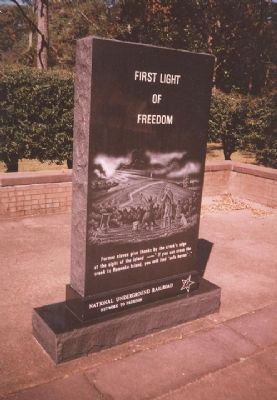
Former slaves give thanks by the creek’s edge
at the sight of the island - “If you can cross the
creek to Roanoke Island, you will find ‘safe haven’.”
[rendering of Edwin Forbes' "The Sanctuary"]
[reverse:]
1862–1867
A year after the Civil War began, Roanoke Island fell to Union Forces. Word spread throughout North Carolina that slaves could find “safe haven” on the Island. By the end of 1862, over a thousand runaway slaves, freed men, women and children found sanctuary here. This colony, precursor to the Freedmen's Bureau, was to serve as a model for other colonies throughout the South. Once again this small island, site of the first English attempt at permanent settlement in the New World, became a land of historic beginnings.
The Freedmen's Colony encompassed unoccupied, unimproved lands from Manteo to the north and west shores, including some of the land today known as Fort Raleigh National Historic Site. A sawmill, hospital, a school for black female teachers, and homes were established. Able-bodied men were offered
this page online
Upon the war's end, the federal government discontinued rations and supplies to colonists and returned land to original owners. Reminiscent of early English efforts, the Roanoke Island Freedmen's colony was abandoned in 1867. Many freed people remained and their descendants would become respected local residents. Others settled in communities throughout the region and would become an integral part of eastern North Carolina culture.
Erected 2001 by National Underground Railroad Network to Freedom.
Topics and series. This historical marker is listed in these topic lists: Abolition & Underground RR • African Americans • Settlements & Settlers • War, US Civil. In addition, it is included in the Network to Freedom series list. A significant historical year for this entry is 1867.
Location. 35° 56.214′ N, 75° 42.558′ W. Marker is near Manteo, North Carolina, in Dare County.
Photographed by Richard E. Miller
2. The Freedmen's Colony of Roanoke Island 1862-1867 Marker

Regionally, this marker is in the Coastal Plain and on the Outer Banks. It is also in the American South, specifically in the Upper South, in the Tidewater, and on the Eastern Seaboard. Globally, it is in the North Atlantic Region, North America, the Western Hemisphere, the Western World, and the Anglosphere. Historically, it finds itself in what was once the territory of the Mississippian Culture, one of the original Thirteen Colonies, one of the Confederate States of America, and the Antebellum South.
Other nearby markers. At least 8 other markers are within walking distance of this marker: A Civil War Refuge (here, next to this marker); A Legacy of Freedom (here, next to this marker); The New Fort in Virginia / Virginia Dare (within shouting distance of this marker); Exploring the Unknown (about 400 feet away, measured in a direct line); Welcome to Fort Raleigh National Historic Site (about 500 feet away); English Explorers' Earthwork (about 500 feet away); Reconstructed Past (about 500 feet away); Join the Exploration Party (about 600 feet away). Touch for a list and map of all markers in Manteo.
Also see . . .
1. Fort Raleigh National Historic Site. (Submitted on January 8, 2008, by Richard E. Miller of Oxon Hill, Maryland.)
2. Website dedicated to the Roanoke Island Freedmen’s Colony. Site includes a short history of the Roanoke Island Freedmen’s Colony. (Submitted on January 8, 2008, by Kevin W. of Stafford, Virginia.)
3. Edwin Forbes - The Sanctuary.
Photographed by Richard E. Miller, October 2003
3. First Light of Freedom Marker
Additional keywords. United States Colored Troops [USCT]
Photographed by Kevin W., July 22, 2008
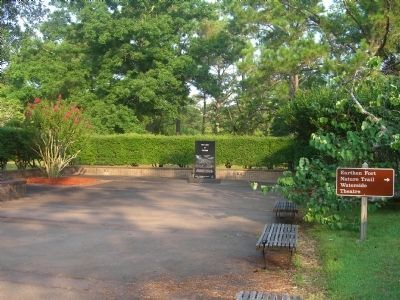
4. First Light of Freedom Marker
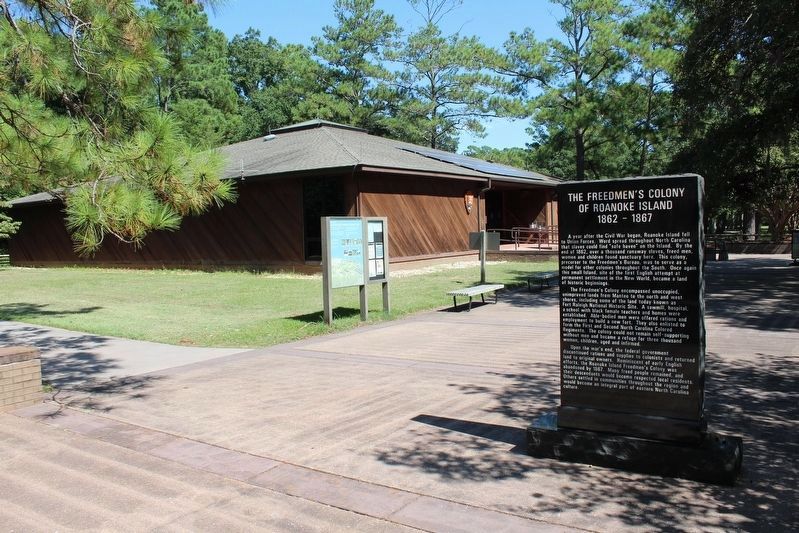
Photographed by Tom Bosse, September 18, 2021
5. First Light of Freedom Marker
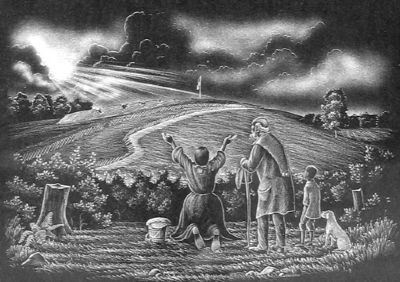
Photographed by Mark Grimsley, August 16, 2006
6. The Sanctuary on the First Light of Freedom Marker
Credits. This page was last revised on January 24, 2022. It was originally submitted on January 8, 2008, by Richard E. Miller of Oxon Hill, Maryland. This page has been viewed 4,203 times since then and 70 times this year. Last updated on September 10, 2011, by Richard E. Miller of Oxon Hill, Maryland. Photos: 1. submitted on July 22, 2008, by Kevin W. of Stafford, Virginia. 2, 3. submitted on January 8, 2008, by Richard E. Miller of Oxon Hill, Maryland. 4. submitted on July 22, 2008, by Kevin W. of Stafford, Virginia. 5. submitted on January 22, 2022, by Tom Bosse of Jefferson City, Tennessee. 6. submitted on January 8, 2008, by Kevin W. of Stafford, Virginia. • Bill Pfingsten was the editor who published this page.
