
Shockoe Bottom in Richmond, Virginia — The American South (Mid-Atlantic)
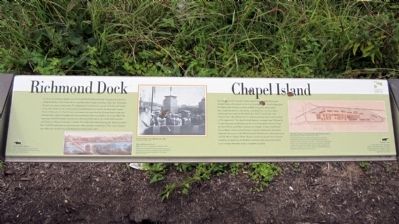
Richmond Dock
⎯⎯⎯
Chapel Island
Photographed by Bernard Fisher, September 20, 2011
1. Richmond Dock / Chapel Island Marker
Richmond Dock
In 1816, the Virginia legislature chartered the Richmond Dock Company. It operated independently of the James River and Kanawha Canal until 1854, when the Tidewater Connection was constructed. The Tidewater Connection, a series of locks and basins from 17th Street to the Canal Basin, joined Richmond Dock to the Kanawha Canal. Much of the labor to build these waterways was provided by African Americans and immigrants, whose strength and toil moved the earth and hauled the stone. With the opening of the Tidewater Connection, the long-held vision of a canal link from the mountains to the sea became a reality. The canal flourished during the 1850s, but after the Civil War railroad cars proved more efficient than canal boats. The canal towpath was taken for the Richmond & Alleghany Railroad in 1880.
Chapel Island
Across the canal is Chapel Island, named for the early Episcopal chapel there, active prior to the 1741 founding of St. John’s Episcopal Church (north of here on Church Hill). For many years, when the island was lower in elevation, a good portion of it was often submerged and used as the Sandy
this page online
Erected 2011 by Virginia Capital Trail.
Topics. This historical marker is listed in these topic lists: Industry & Commerce • Waterways & Vessels. A significant historical year for this entry is 1816.
Location. 37° 31.673′ N, 77° 25.384′ W. Marker is in Richmond, Virginia. It is in Shockoe Bottom. It is on Dock Street 0.2 miles east of South 22nd Street, on the right when traveling east. Touch for map. Marker is in this post office area: Richmond VA 23223, United States of America. Touch for directions.

Regionally, this
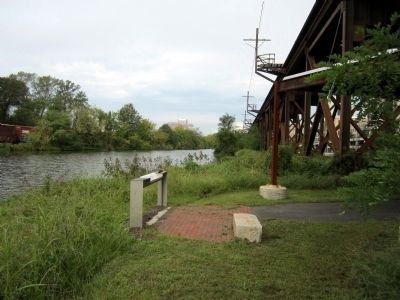
Photographed by Bernard Fisher, September 20, 2011
2. Richmond Dock / Chapel Island Marker
Other nearby markers. At least 8 other markers are within walking distance of this marker: Tobacco Row (within shouting distance of this marker); Norfolk and Southern Bridge (about 500 feet away, measured in a direct line); Water Quality in the James (about 600 feet away); Here Stood the Trigg Shipyard (about 600 feet away); Capital Trees / The Low Line (about 600 feet away); a different marker also named Capital Trees / The Low Line (about 700 feet away); a different marker also named Capital Trees / The Low Line (about 700 feet away); 28th St Draw Bridge / Great Shiplock Canal (about 700 feet away). Touch for a list and map of all markers in Richmond.
More about this marker. Photo captions:
The launching of the USS Decatur, 1900
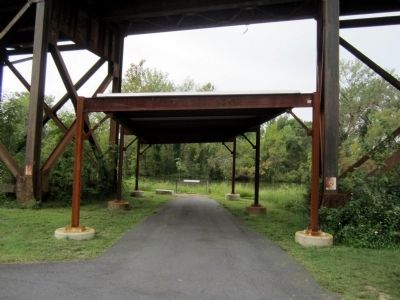
Photographed by Bernard Fisher, September 20, 2011
3. Richmond Dock / Chapel Island Marker
View of Richmond (detail)
Watercolor by J.L. Bouqueta de Woiseri, 1822. The view from Mayo’s Island shows a cluster of schooners in the just-completed Richmond Dock and the retaining wall that held in the water. Virginia Historical Society
The Trigg shipyard on Chapel Island and Richmond Dock
Lithograph by A. Hoen, Richmond, ca. 1900. The shipyard had its own basin and lock, which allowed vessels to be launched into the James River. There is still a remnant of one of the ship lock gates on the island. Richmond Dock could accommodate schooners and steamers, but the bridges that carried city streets over the canal allowed only low-rise canal boats to continue west to the James River and Kanawha Canal. Valentine Richmond History Center
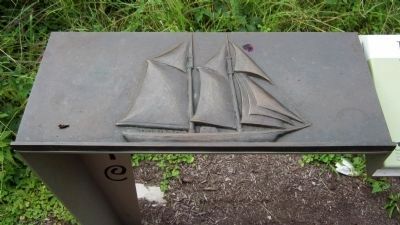
Photographed by Bernard Fisher, September 20, 2011
4. Two-masted schooner
This was the most commonly seen cargo ship at Richmond Docks during the mid to late 1800s.
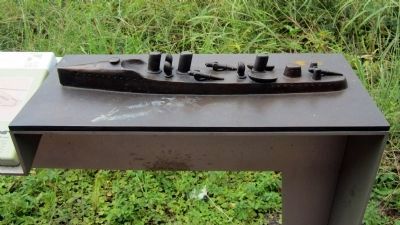
Photographed by Bernard Fisher, September 20, 2011
5. Torpedo boat
In 1900-1902, Trigg’s shipyard built three torpedo boats, the USS Shubrick, the USS Stockton and the USS Thornton. They were used to patrol the U.S. coast.
Credits. This page was last revised on February 1, 2023. It was originally submitted on September 21, 2011, by Bernard Fisher of Richmond, Virginia. This page has been viewed 3,232 times since then and 74 times this year. Photos: 1, 2, 3, 4, 5. submitted on September 21, 2011, by Bernard Fisher of Richmond, Virginia.
