St. Augustine in St. Johns County, Florida — The American South (South Atlantic)
King's Road
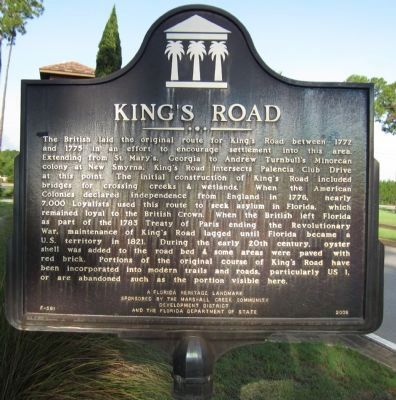
Photographed by Craig Swain, August 3, 2011
1. King's Road Marker
Erected 2006 by The Marshall Creek Community Development District and the Florida Department of State. (Marker Number F-591.)
Topics.
this page online
Location. 30° 0.797′ N, 81° 23.482′ W. Marker is in St. Augustine, Florida, in St. Johns County. It is at the intersection of Palencia Village Drive and Dixie Highway (U.S. 1), on the right on Palencia Village Drive. Touch for map. Marker is at or near this postal address: 116 Palencia Village Dr, Saint Augustine FL 32095, United States of America. Touch for directions.

Regionally, this marker is in First Coast and in Greater Jacksonville. It is also in the American South and on the Eastern Seaboard. Globally, it is in the North Atlantic Region, North America, a Gulf of Mexico state, the Western Hemisphere, the Western World, and the Anglosphere. Historically, it finds itself in what was once New Spain, the territory of the Mississippian Culture, one of the Confederate States of America, and the Antebellum South.
Other nearby markers. At least 8 other markers are within 7 miles of this marker, measured as the crow flies: Nine Mile Road (approx. 0.6 miles away); Governor Grant's Plantations
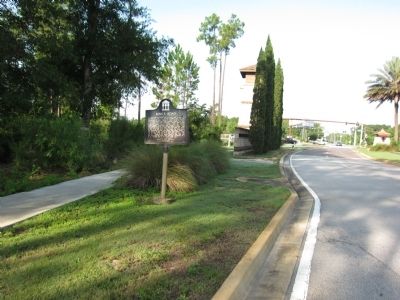
Photographed by Craig Swain, August 3, 2011
2. King's Road Marker
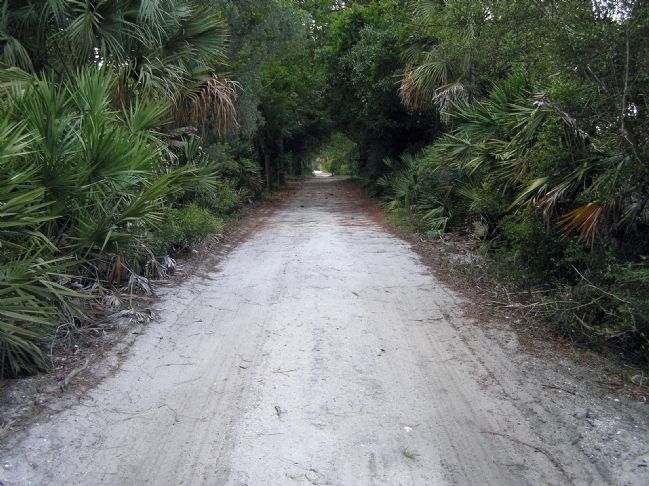
Photographed by Paul Crumlish, May 21, 2006
3. Section of King's Road
One of the last remaining unpaved or modernized stretches of the original King's Road. Located in northern Volusia County, it had been by-passed by a wider, straighter modern highway.
Credits. This page was last revised on January 2, 2019. It was originally submitted on September 27, 2011, by Craig Swain of Leesburg, Virginia. This page has been viewed 1,909 times since then and 102 times this year. Photos: 1, 2. submitted on September 27, 2011, by Craig Swain of Leesburg, Virginia. 3. submitted on March 7, 2012, by PaulwC3 of Northern, Virginia.
