Gambles Hill in Richmond, Virginia — The American South (Mid-Atlantic)
President Lincoln Visits Richmond
Richmond National Battlefield Park
| — | National Park Service, U.S. Department of the Interior | — |
Photographed by Kevin W., January 3, 2008
1. President Lincoln Visits Richmond Marker
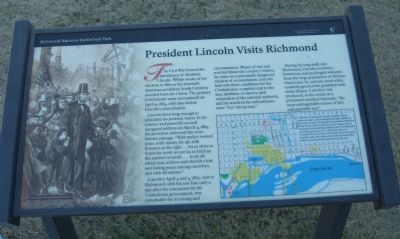
Lincoln lived long enough to articulate his postwar vision. In his concise and powerful second inaugural address on March 4, 1865, the president delivered this now-famous passage; “With malice toward none; with charity for all; with firmness in the right…let us strive to finish the work we are in; to bind up the nation’s wounds…to do all which may achieve and cherish a just and lasting peace among ourselves, and with all nations.”
Lincoln’s April 4 and 5, 1865, visit to Richmond, with his son Tad, only a day after the evacuation by the Confederate government, was remarkable for its timing and circumstances. Weary of war and worried about the country’s future, he came on a potentially dangerous mission of reconciliation. Lincoln had only three conditions for the Confederacy: complete end to the war; abolition of slavery; and his words to his subordinates were “Let ‘em up easy.”
During his long walk into Richmond, Lincoln received a boisterous and
this page online
Erected by National Park Service, U.S. Department of the Interior.
Topics and series. This historical marker is listed in this topic list: War, US Civil. In addition, it is included in the Former U.S. Presidents: #16 Abraham Lincoln series list. A significant historical date for this entry is March 4, 1865.
Location. Marker has been reported missing. It was located near 37° 32.138′ N, 77° 26.773′ W. Marker was in Richmond, Virginia. It was in Gambles Hill. It could be reached from Tredegar Street. Touch for map. Marker was at or near this postal address: 470 Tredegar Street, Richmond VA 23219, United States of America. Touch for directions.

Regionally, this marker was in Central Virginia. It was also in the American South and specifically in the Upper South. Globally, it was in North America, the Western Hemisphere, the Western World, and the Anglosphere. Historically, it found itself in what was once the territory of the Mississippian Culture, one of the
Photographed by Kevin W., January 3, 2008
2. President Lincoln Visits Richmond Marker
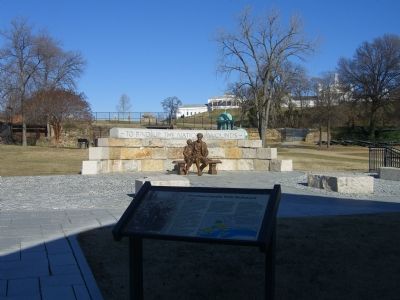
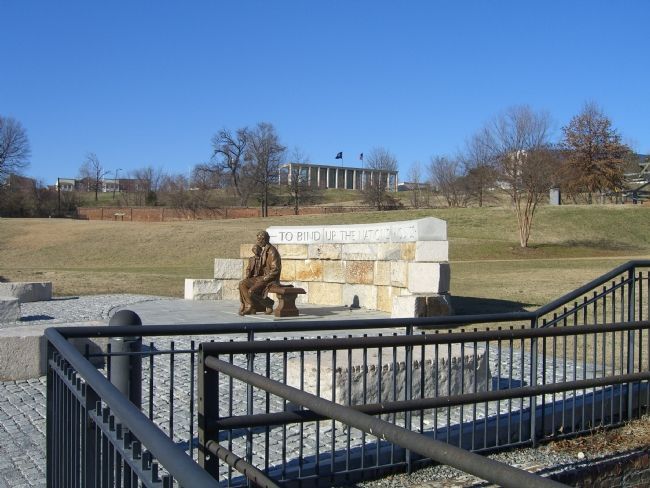
Immediately behind the sculpture of President Abraham Lincoln and his son Tad is a stone wall, with the words "To bind up the nation's wounds."
Other nearby markers. within walking distance of this location: Touch for a list and map of all markers in Richmond.
Other markers no longer nearby. President Lincoln Visits Richmond (was a few steps from this marker but has been permanently removed); Tredegar in 1951 (was a few steps from this marker but has been permanently removed); Belle Isle and Old Dominion Iron and Nail Works (was within shouting distance of this marker but has been permanently removed); Raceways (was within shouting distance of this marker but has been permanently removed); The Bulldozer Press (was within shouting distance of this marker but has been permanently removed); Francis Turbine (was within shouting distance of this marker but has been permanently removed); Adapting Power (was within shouting distance of this marker but has been permanently removed); Early Industrial Patterns (was within shouting distance of this marker but has been permanently removed); Belle Isle Prison (was within shouting distance of this marker but has been permanently removed); Tredegar Spike Mill (was within shouting distance of this marker but has been permanently
Photographed by Kevin W., January 3, 2008
3. President Abraham Lincoln and His Son Tad
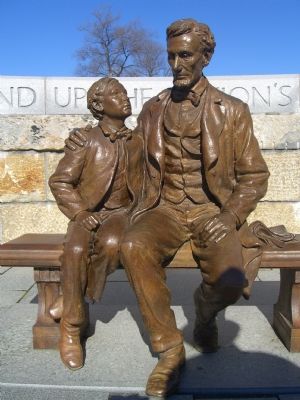
The statue by sculptor David Frech, is lifesized. It was dedicated April 5, 2003, on the 138th anniversary of Lincoln's only visit to Richmond.
More about this marker. On the left of this marker is an artist's rendering of, "President Lincoln entering Richmond."
On the lower right is a map of Richmond in 1865, during the time of Lincoln's visit. Its caption reads, "At Rocketts’ Landing the president stepped ashore without fanfare and unmindful of danger walked to the center of town. Eventually the president visited the White House of the Confederacy and Capital Square and took several carriage rides for more touring of the partially burned-out city. Little of his visit was recorded. The red arrows on the map show some of his possible routes.
December 29, 2007
4. Civil War Visitor Center
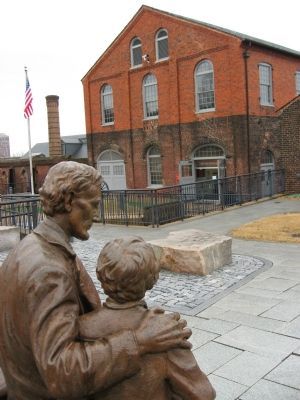
Near the marker is the National Park Service's Civil War Visitor Center. When touring Richmond National Battlefield Park sites, the NPS recommends you start your visit here at Tredegar Iron Works.
Adjacent to this marker is the sculpture titled, "President Abraham Lincoln and His Son Tad." On the bench to Lincoln's left is a newspaper, The Richmond Whig, dated April 5, 1865. Behind the statue is a stone wall, with the words "To bind up the nation's wounds," taken from Lincoln's second inaugural speech. The sculpture was commissioned by the U.S. Historical Society, who donated it to the National Park Service. The sculpture was created by David Frech and is set in front of a granite wall designed by architect Douglas Harnsberger. The sculpture commemorates Lincoln's only visit to the city in April 1865. The sculpture's subject and placement in a park that was the former site of Tredegar Ironworks, where Confederate materials were forged during the Civil War, was controversial.
Regarding President Lincoln Visits Richmond. Abraham Lincoln was a worn and weary fifty-six year old, and his son, Tad, an exhuberant and irrepressible boy, the day that father and son, hand in hand, made history in Richmond. It was April 4, 1865. It was Tad's 12th birthday.
It was also the day the President of the United States entered the city, which, until
Photographed by Kevin W., January 3, 2008
5. President Abraham Lincoln and His Son Tad
Now, the bloody struggle was drawing to a close. Confederate President Jefferson Davis had fled, and the mayor had surrendered the city to Union forces. As one horrified observer recalled, the ruins of Richmond were "still smoking...its devastation complete," set afire by fleeing Confederate soldiers.
Abraham Lincoln was determined to see the grim scene for himself. For more than a week he had been visiting federal military headquarters at nearby City Point, eager to be on hand for the end of the long and bloody Civil War. But not as a conquerer. "They do not know Lincoln," predicted journalist Noah Brooks, "who suppose that he will make a parade of himself at Richmond...or given the character of personal triumph to his entry in the rebel Capital."
And so, on Tuesday morning, April 4, at around 9 a.m., the sixteenth President of the United States, along with Tad, disembarked at Richmond's Rocketts Landing to symbolically reunite his battle-torn country.
"It was the man of the people among the people," marveled an eyewitness. "It was the great deliverer meeting the delivered...such wild indescribable joy I never witnessed. The majority of the thousands who crowded the streets and hindered our advance were slaves. Now they were free, beholding him who had given them their liberty."
But the president himself would not live long enough to lead the new birth of freedom. Just a few days later, he was assasinated. As Tad bravely told a friend: "Pa is dead, and I am only Tad Lincoln now, little Tad, like other boys. I am not a President's son now."
Description courtesy United States Historical Society brochure from statue unveiling and dedication ceremony.
Credits. This page was last revised on November 3, 2024. It was originally submitted on January 18, 2008, by Kevin W. of Stafford, Virginia. This page has been viewed 6,484 times since then and 60 times this year. Photos: 1, 2, 3, 4, 5. submitted on January 18, 2008, by Kevin W. of Stafford, Virginia.
