Near Louisa in Louisa County, Virginia — The American South (Mid-Atlantic)
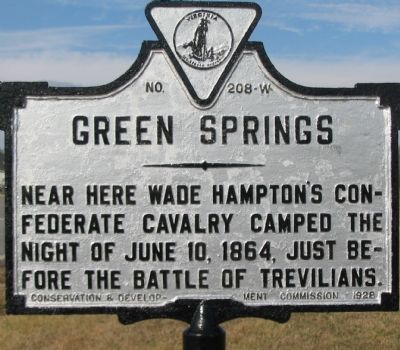
Green Springs
Photographed by Craig Swain, January 12, 2008
1. Green Springs Marker
Erected 1928 by Conservation & Development Commission. (Marker Number W-208.)
Topics and series. This historical marker is listed in this topic list: War, US Civil. In addition, it is included in the Virginia Department of Historic Resources (DHR) series list. A significant historical date for this entry is June 10, 2006.
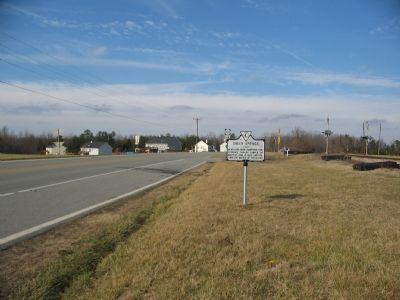
Location. 38° 5.136′ N, 78° 6.686′ W. Marker is near Louisa, Virginia, in Louisa County. It is at the intersection of Spotswood Trail (U.S. 33) and Dunkum Store Road (County Route 636), on the right when traveling west on Spotswood Trail. Touch for map. Marker is in this post office area: Louisa VA 23093, United States of America. Touch for directions.

Regionally, this marker is in the Piedmont and in Central Virginia. It is also in the American South and specifically in the Upper South. Globally, it is in North America, the Western Hemisphere, the Western World, and the Anglosphere. Historically, it finds itself in what was once the territory of the Mississippian Culture, one of
this page online
Other nearby markers. At least 8 other markers are within 4 miles of this marker, measured as the crow flies: Ogg Farm (approx. 1.6 miles away); Battle of Trevilian Station (approx. 3 miles away); Battle of Trevillians (approx. 3 miles away); Railroad Rails (approx. 3.1 miles away); Custer's First Last Stand (approx. 3.2 miles away); Custer Rescued (approx. 3.2 miles away); Bibb's Crossroads (approx. 3.4 miles away); The Netherland's Tavern (approx. 3.7 miles away). Touch for a list and map of all markers in Louisa.
Other markers no longer nearby. Battle of Trevilians (was approx. 3 miles away but has been replaced with another marker now near it); Trevilian Station Battle (was approx. 3.1 miles away but has been confirmed missing).
Regarding Green Springs. This is one of several markers interpreting the Battle of Trevilian Station, June 11-12, 1864. See the Battle of Trevilian Station Virtual Tour by Markers linked below for additional related markers.
Also see . . .
1. Trevilian Station Battlefield Foundation.
Photographed by Craig Swain, January 12, 2008
2. Green Springs Marker
2. Green Springs Rural Historic District. (PDF) In addition to the Civil War history, Green Springs is noted on the National Register of Historic Places. (Submitted on January 20, 2008, by Craig Swain of Leesburg, Virginia.)
3. Battle of Trevilian Station Virtual Tour by Markers. A set of markers that document the Battle of Trevilian Station, June 11-12, 1864. The order of appearance is generally aligned to the Trevilian Station Battlefield Foundation driving tour, with accommodations made for convenience both in the town of Louisa at the beginning of the tour, and on the eastbound side of Route 33 headed back towards the cemetery. Because the C.G. Trevilian House at the 'modern' station does not have its own marker, reviewing this database for accompanying information when reading about the railroad tracks there is recommended for added interpretive value. (Submitted on August 15, 2026, by Evan Dwyer of Richmond, Virginia.)
Additional commentary.
1.
Photographed by Craig Swain, January 12, 2008
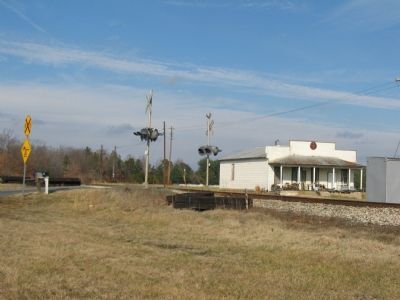
3. Green Springs Railroad Crossing
Hampton was guarding the Central Railroad in the vicinity of Green Springs from Federal cavalry under General Philip Sheridan. Sheridan had struck out from Cold Harbor, Virginia earlier with the intention of destroying the Central Virginia and connections between Richmond and Charlottesville.
By location, the marker seems to be referring to either the general area of Gen. Hampton's divisional camps (spanning about four miles of road from the marker) or specifically the location of the Laurel Brigade (Rosser's) in particular. Neither is particularly close to this site, but the latter seems most likely as accounts from Rosser's brigade indicate a campsite "several miles west" of Trevilian Station, with a member of Chew's Battery (Ashby Virginia Artillery, then under the command of James W. Thompson) stating that unit in particular camped on "the Charlottesville Road" (Route 22) about "five miles west" of the station. Accounting for Wittenberg's post-publication determination that Civil War-era Trevilian Station was at West Crossing, where the Virginia Central Railroad crossed the Fredericksburg Plank Road just south of Netherland Tavern, then "several" miles west for Rosser would put his troops in the area of modern Route 22 south of the Ogg Farm - sensible for their role in the fighting. The Charlottesville Road in 1864 did not follow the exact route of modern Route 22 in the vicinity of Trevilians,
Photographed by Evan Dwyer, August 15, 2026
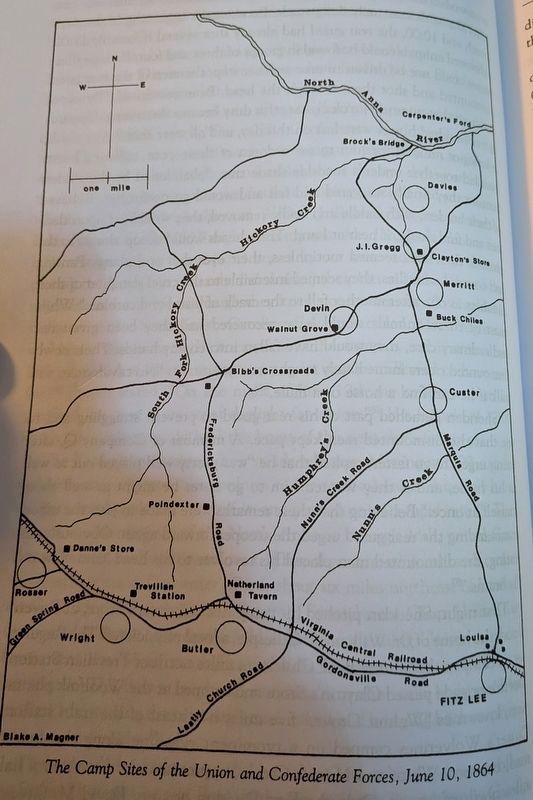
4. Map of Camps Prior to Trevilian Station
This map, from Eric J. Wittenberg's Glory Enough for All: Sheridan's Second Raid and the Battle of Trevilian Station, shows the rough dispositions of Hampton's brigades along the bottom, running from Netherland Tavern west to Green Springs Road (now Poindexter Road).
— Submitted August 15, 2026, by Evan Dwyer of Richmond, Virginia.

Photographed by Unknown
5. 1860 Map of Trevilian Station
From the Library of Congress, seemingly corroborating Eric Wittenberg's assertion that the Civil War-era station was near Netherland Tavern where the railroad was crossed twice by the Gordonsville Road (creating an "East Crossing" and "West Crossing", of which only West Crossing exists today - where Oakland Road meets Route 33).
Credits. This page was last revised on August 15, 2026. It was originally submitted on January 20, 2008, by Craig Swain of Leesburg, Virginia. This page has been viewed 2,460 times since then and 46 times this year. Photos: 1, 2, 3. submitted on January 20, 2008, by Craig Swain of Leesburg, Virginia. 4, 5. submitted on August 15, 2026, by Evan Dwyer of Richmond, Virginia.
