
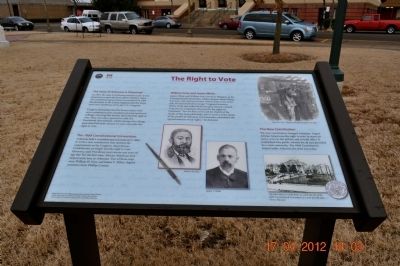
The Right to Vote
The State of Arkansas is Dissolved
In 1867, the state of Arkansas ceased to exist. It was dissolved, as were all states still in rebellion when the Confederate government surrendered in 1865. Readmission to the Union required that the states meet two conditions set by the U.S. Congress.
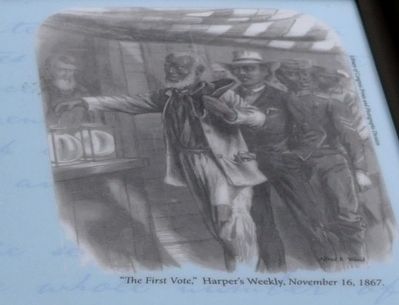
Congress demanded that the former states write new constitutions that included universal manhood suffrage, ensuring that former slaves had the right to vote. They were also required to ratify the Fourteenth Amendment, which among other things guaranteed all male citizens 21 years and older the right to vote.
The 1868 Constitutional Convention
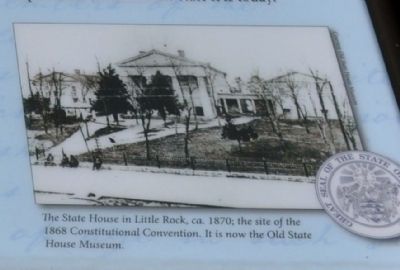
Arkansas held a constitutional convention in 1868 to write a new constitution that satisfied the requirements set by Congress.
Most former Confederates no longer had the right to vote.
However, male Freedmen over twenty-one years of age did.
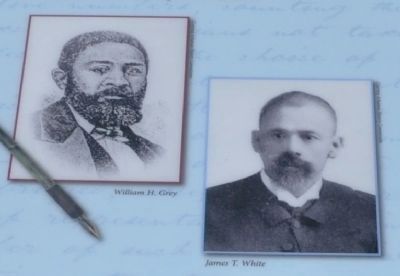
For the first time, African American men helped write laws in Arkansas. Two of those men were William H. Grey and James T. White, Baptist ministers from Phillips County.
William Grey and James White
James White and William Grey served as delegates
this page online
The New Constitution
A new constitution changed Arkansas. It gave African Americans the right to vote, to serve on juries, serve in the militia, and to hold office.
It established free public schools for all and provided for a state university. The 1868 Constitution helped make Arkansas the state it is today.
Topics. This historical marker is listed in these topic lists: African Americans • Civil Rights • War, US Civil. A significant historical year for this entry is 1867.
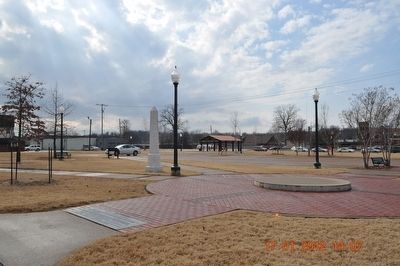
Location. 34° 31.698′ N, 90° 35.209′ W. Marker is in Helena, Arkansas, in Phillips County. It is on Cherry St. just north of Porter Street. Touch for map. Marker is in this post

Regionally, this marker is in the Arkansas Delta, in Crowley’s Ridge, in the Mississippi Alluvial Plain, and in the Quapaw Homeland. It is also in the American South, specifically in the Upper South, in the Mississippi Delta, and in the Great River Road Region. Globally, it is in North America, the Western Hemisphere, the Western World, and the Anglosphere. Historically, it finds itself in what was once the territory of the Mississippian Culture, the Louisiana Purchase, one of the Confederate States of America, and the Antebellum South.
Other nearby markers. At least 8 other markers are within walking distance of this marker: Live at the Opera House (a few steps from this marker); Civil War Comes to Arkansas (within shouting distance of this marker); Seven Confederate Generals (within shouting distance of this marker); Helena, Arkansas (within shouting distance of this marker); West Helena, Arkansas (within shouting distance of this marker); Phillips County, Arkansas (within shouting distance of this marker); Answering a Call for Help (within
Credits. This page was last revised on June 16, 2016. It was originally submitted on January 23, 2012, by Sandra Hughes Tidwell of Killen, Alabama, USA. This page has been viewed 1,050 times since then and 19 times this year. Photos: 1, 2, 3, 4, 5. submitted on January 23, 2012, by Sandra Hughes Tidwell of Killen, Alabama, USA. • Bill Pfingsten was the editor who published this page.
