White Cloud in Doniphan County, Kansas — The American Midwest (Upper Plains)
"the water…contains a half…Glass of ooze"

Photographed by Mark Hilton, July 11, 2024
1. "the water…contains a half…Glass of ooze" Marker
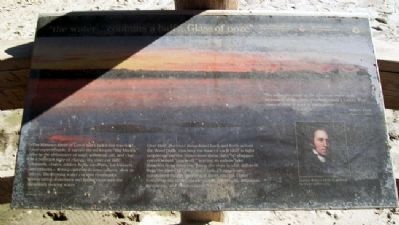
"The water we drink or the Common water of the missourie at this time, contains a half a Comm Wine Glass of ooze or mud to every pint-"
William Clark
June 21, 1804
The Missouri River of Lewis and Clark's era was wild and unpredictable. It earned the nickname "Big Muddy" due to the abundance of sand, sediment, silt, and clay. In a constant state of change, the river cut side channels, chutes, eddies, boils, sandbars, backwaters, and oxbows - strong currents in some places, slow in others. The flowing water cut into riverbanks, undercutting shorelines and felling trees into the constantly moving water.
Over time, the river meandered back and forth across the flood plain, touching the base of each bluff in tight serpantine [sic] curves. Sometimes these tight "u" shapped [sic] curves would "pinch-off," leaving an oxbow lake stranded from the river. Today the river is a bit different from the times of Lewis and Clark. Channels are maintained for navigation and flood control. Dams further up the river provide power generation, irrigation, recreation, and flood control.
Erected by National Park Service.
Topics and series.
this page online
Location. 39° 58.712′ N, 95° 17.641′ W. Marker is in White Cloud, Kansas, in Doniphan County. It is on State Highway 7 near Main Street, on the right when traveling north. Marker is under the pavilion in the riverfront park. Touch for map. Marker is in this post office area: White Cloud KS 66094, United States of America. Touch for directions.

Regionally, this marker is in Eastern Kansas. It is also in the American Midwest, in the Lewis & Clark Corridor, in the Corn Belt, on the prairies, and on the Southern Plains. Globally, it is in North America, the Western Hemisphere, the Western World, and the Anglosphere. Historically, it finds itself in what was once the Louisiana Purchase.
Other nearby markers. At least 8 other markers are within 3 miles of this marker, measured as the crow flies: Homeland of the Kanza Indians (here, next to this marker); The Lewis and Clark Expedition (a few steps
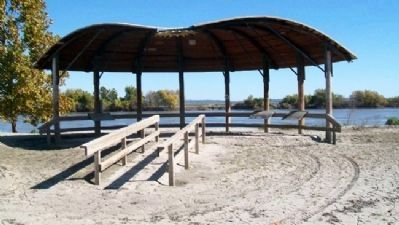
Photographed by William Fischer, Jr., October 1, 2011
2. "the water...contains a half...Glass of ooze" Marker
More about this marker. The marker was underwater for an extended period in the summer/fall of 2011 due to severe flooding caused by record winter snowfall and record late-May rain far upriver.
Also see . . .
1. Sixteen States, 4,900 miles, one Lewis and Clark National Historic Trail. National Park Service National Historic Trail website (Submitted on June 3, 2012, by William Fischer, Jr. of Reynoldsburg, Ohio.)
2. On This Day in Lewis & Clark History. Discovering Lewis and Clark entry (Submitted on June 3, 2012, by William Fischer, Jr. of Reynoldsburg, Ohio.)
3. The Journals of the Lewis and Clark Expedition.

Photographed by Mark Hilton, July 11, 2024
3. "the water…contains a half…Glass of ooze" Marker
Photographed by William Fischer, Jr., October 1, 2011
4. "the water...contains a half...Glass of ooze" Marker
Credits. This page was last revised on July 23, 2024. It was originally submitted on June 3, 2012, by William Fischer, Jr. of Reynoldsburg, Ohio. This page has been viewed 652 times since then and 40 times this year. Photos: 1. submitted on July 23, 2024, by Mark Hilton of Montgomery, Alabama. 2. submitted on June 3, 2012, by William Fischer, Jr. of Reynoldsburg, Ohio. 3. submitted on July 23, 2024, by Mark Hilton of Montgomery, Alabama. 4. submitted on June 3, 2012, by William Fischer, Jr. of Reynoldsburg, Ohio.
