College Hill in Providence in Providence County, Rhode Island — The American Northeast (New England)
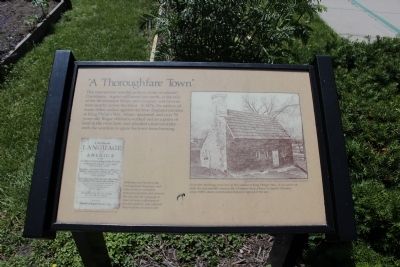
A Thoroughfare Town
Photographed by Bryan Simmons, June 8, 2012
1. A Thoroughfare Town Marker
This intersection was the earliest center of colonial Providence. A grist mill stood just north, at the falls of Moshassuck River, and a tannery and taverns were nearby across the street. In 1676 the natives of many tribes united against the New England colonies in King Philip's War. Alone, unarmed, and over 70 years old, Roger Williams walked out on a point of land in the river here, and pleaded unsuccessfully with the warriors to spare his town from burning.
Williams was fluent in the Narragansett language and often acted as mediator between colonists and natives. His Key Into the Language of America was a collection of phrases, poems and cultural observations on native life.
Topics. This historical marker is listed in these topic lists: Colonial Era • Indigenous Peoples and Communities • Settlements & Settlers • Wars, US Indian. A significant historical year for this entry is 1676.
Location. This marker has been replaced by another marker nearby. It was located near 41° 49.885′ N, 71° 24.643′ W. Marker was in Providence, Rhode Island, in Providence County. It was in College Hill. It was on North Main Street,
this page online

Regionally, this marker was on Rhode Island’s Narragansett Bay. It was also in the American Northeast, in New England, and on the Eastern Seaboard. Globally, it was in the North Atlantic Region, North America, the Western Hemisphere, the Western World, and the Anglosphere. Historically, it found itself in what was once one of the original Thirteen Colonies.
Other nearby markers. At least 8 other markers are within walking distance of this location: Witness to History (here, next to this marker); A Place for Your Ideas (a few steps from this marker); Snowtown Riot 1831 (within shouting distance of this marker); Gabriel Bernon (within shouting distance of this marker); Seasonal Gathering (within shouting distance of this marker); The Cathedral of St. John (within shouting distance of this marker); Roger Williams National Memorial (within shouting distance of this marker); The Wellspring of Providence (about 300 feet away, measured in a direct line). Touch for a list and map
Photographed by Bryan Simmons, June 8, 2012
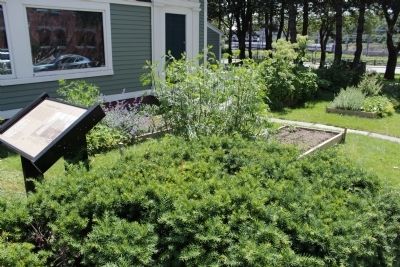
2. A Thoroughfare Town Marker
Another marker is no longer nearby. The Century to Statehood (was a few steps from this marker but has been replaced with another marker now near it).
Credits. This page was last revised on February 8, 2023. It was originally submitted on June 8, 2012, by Bryan Simmons of Attleboro, Massachusetts. This page has been viewed 799 times since then and 15 times this year. Photos: 1, 2. submitted on June 8, 2012, by Bryan Simmons of Attleboro, Massachusetts. • Bill Pfingsten was the editor who published this page.
