Sanford in Seminole County, Florida — The American South (South Atlantic)
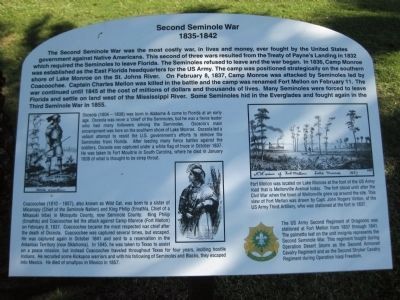
Second Seminole War
1835-1842
Photographed by AGS Media, December 30, 2011
1. Second Seminole War Marker
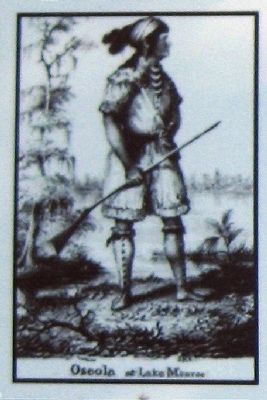
[ Illustration ] • "Oseola at Lake Monroe"
Osceola (1804 - 1838) was born in Alabama & came to Florida at an early age. Osceola was never a "chief" of the Seminoles, but he was a fierce leader
this page online
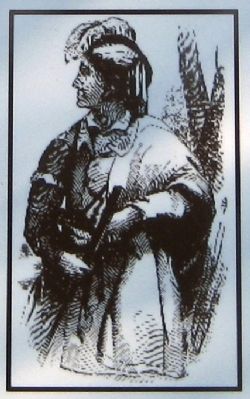
[ Illustration ] • (portrait engraving: Coacoochee)
Coacoochee (1810 -1857), also known as Wild Cat, was born to a sister of Micanopy (Chief of the Seminole Nation) and King Philip (Emathla, Chief of a Mikasuki tribe) in Mosquito County, now Seminole County. King Philip (Emathla) and Coacoochee led the attack against Camp Monroe (Fort Mellon) on February 8, 1837. Coacoochee became the most respected war chief after the death of Osceola. Coacoochee was captured several times, but escaped. He was captured again in October 1841 and sent to a reservation in the Arkansas Territory (now Oklahoma). In 1845, he was taken to Texas to assist on a peace mission, but instead Coacoochee traveled
Photographed by AGS Media, December 30, 2011
2. Second Seminole War Marker
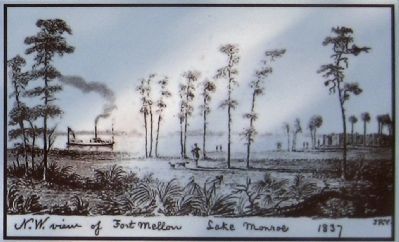
[ Illustration ] •"N.W. view of Fort Mellon, Lake Monroe, 1837" - JRV
Fort Mellon was located on Lake Monroe at the foot of the US Army road that is Mellonville Avenue today. The fort stood until after the Civil War when the town of Mellonville grew up around the site. This view of Fort Mellon was drawn by Capt. John Rogers Vinton, of the US Army Third Artillery, who was stationed at the fort in 1837.
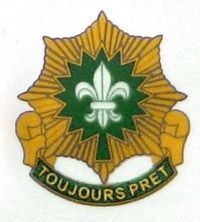
[ Illustration ] • (Distinctive Unit Insignia, US 2nd Cavalry Regiment), "Toujours Pret"
The US Army Second Regiment of Dragoons was stationed at Fort Mellon from 1837 through 1841. The palmetto leaf on the unit insignia represents the Second Seminole War. This regiment fought during Operation Desert Storm as the Second Armored Cavalry Regiment and as the Second Stryker Cavalry Regiment during Operation Iraqi Freedom.
Topics. This historical marker is listed in these topic lists: Forts and Castles • Indigenous Peoples and Communities
Photographed by AGS Media, December 30, 2011
3. Second Seminole War Marker
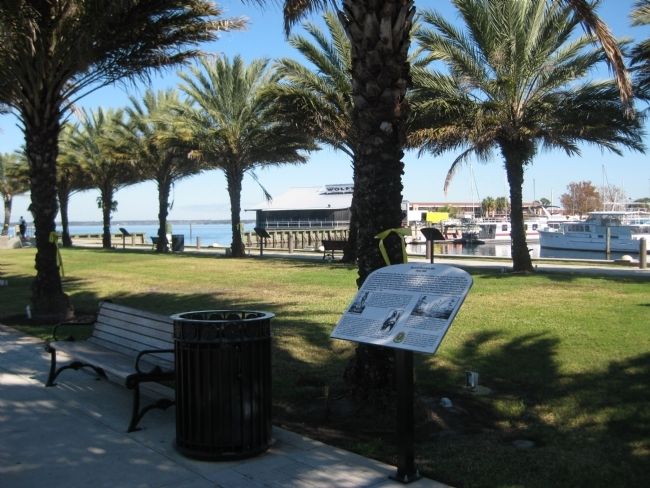
Location. 28° 48.898′ N, 81° 16.087′ W. Marker is in Sanford, Florida, in Seminole County. It is on Seminole Boulevard north of North Park Avenue, on the right when traveling west. The marker is located in the City of Sanford's Veterans Memorial Park, which extends over a pier out into Lake Monroe. The marker is found near the park's entrance at the south end of the pier, along its west boardwalk. Touch for map. Marker is in this post office area: Sanford FL 32771, United States of America. Touch for directions.

Regionally, this marker is in Greater Orlando and in Central Florida. It is also in the American South. Globally, it is in the North Atlantic Region, North America, a Gulf of Mexico state, the Western Hemisphere, the Western World, and the Anglosphere. Historically, it finds itself in what was once New Spain, the territory of the Mississippian Culture, one of the Confederate States of America, and the Antebellum South.
Other nearby markers. At least 8 other markers are within walking
Photographed by AGS Media, December 30, 2011
4. Second Seminole War Marker
Another marker is no longer nearby. Veterans Memorial Park (was a few steps from this marker but has been confirmed missing).
Photographed by AGS Media, December 30, 2011
5. Second Seminole War Marker
Motto: "Toujours Prêt"
(English: "Always Ready")
Photographed by AGS Media, December 30, 2011
6. Second Seminole War Marker
Photographed by Allen C. Browne, August 9, 2015
7. Osceola
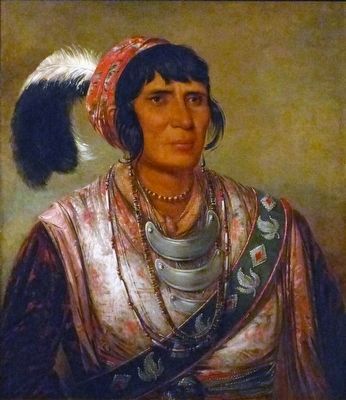
This 1838 portrait of Osceola by George Catlin hangs in the National Portrait Gallery in Washington, DC.
“The Seminole Indians of the Southeast were directly affected by Andrew Jackson's policy of Indian removal, and although a portion of his tribe's leadership gave in to the federal government, Osceola led the resistance. Unlike Black Hawk, who fought the Americans in the West, Osceola did not take on the U.S. military in open battle, but conducted a campaign of guerrilla warfare, harassing federal authorities from the Seminole base in the Everglades. Osceola was captured after the Americans violated a flag of truce. He died in prison shortly thereafter, but the Seminole, famously, never surrendered to the United States.” — National Portrait Gallery
“The Seminole Indians of the Southeast were directly affected by Andrew Jackson's policy of Indian removal, and although a portion of his tribe's leadership gave in to the federal government, Osceola led the resistance. Unlike Black Hawk, who fought the Americans in the West, Osceola did not take on the U.S. military in open battle, but conducted a campaign of guerrilla warfare, harassing federal authorities from the Seminole base in the Everglades. Osceola was captured after the Americans violated a flag of truce. He died in prison shortly thereafter, but the Seminole, famously, never surrendered to the United States.” — National Portrait Gallery
Credits. This page was last revised on April 21, 2023. It was originally submitted on July 15, 2012, by Glenn Sheffield of Tampa, Florida. This page has been viewed 2,091 times since then and 70 times this year. Photos: 1, 2, 3, 4, 5, 6. submitted on July 15, 2012, by Glenn Sheffield of Tampa, Florida. 7. submitted on October 29, 2015, by Allen C. Browne of Silver Spring, Maryland. • Craig Swain was the editor who published this page.
