Jacksonville in Morgan County, Illinois — The American Midwest (Great Lakes)
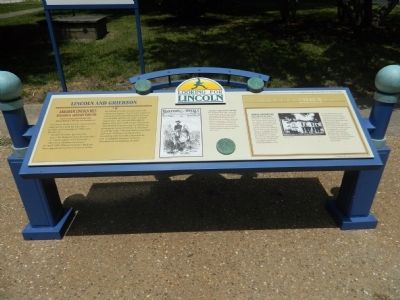
Lincoln and Grierson
Looking for Lincoln
Photographed by Beverly Pfingsten, June 10, 2012
1. Lincoln and Grierson Marker
Abraham Lincoln met Benjamin H. Grierson when the two campaigned for the Republican Party. Grierson, a merchant, music teacher, and musician, even wrote a song for Lincoln's presidential campaign in 1860, with the chorus:
"So clear the track--get out of the way,/ You Democrats have had your day;/ As 'truth is mighty and will prevail,'/ The sons of Abraham cannot fail."
In April 1862, Illinois Governor Richard Yates appointed Grierson Colonel of the 6th Illinois Cavalry, also known as the "Governor's Legion." A year later, Ulysses S. Grant and Lincoln selected the Colonel to lead what turned out to be a critical expedition. He covered 600 miles in sixteen days with 1700 troops. Grierson's raid allowed Grant to capture Vicksburg, prompting General William T. Sherman to call the raid, "The most brilliant expedition of the war." Grierson continued his friendship with Lincoln and noted he had "a delightful interview" with the President on his birthday in 1865.
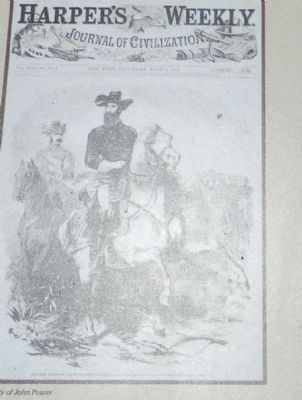
After Grierson's raid, he appeared on the cover of Harper's Weekly astride a horse. As a child, Grierson had a near fatal accident when a horse kicked him in the head. He lay in a coma for two weeks. Ironically, he became the head of a cavalry regiment. After Grierson's Raid, a horse kicked him in the knee. He returned to Jacksonville to recuperate. The town gave him a hero's welcome with speeches, a parade, and gifts including an elegant silver service.
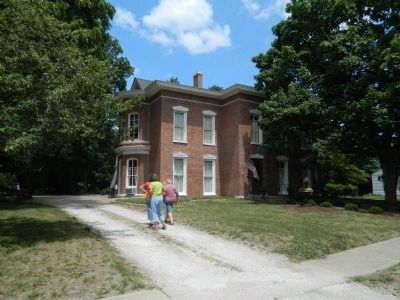
Grierson considered his Jacksonville
this page online
Topics and series. This historical marker is listed in these topic lists: African Americans • War, US Civil • Wars, US Indian. In addition, it is included in the Buffalo Soldiers, the Former U.S. Presidents: #16 Abraham Lincoln, and the Looking for Lincoln series lists. A significant historical month for this entry is April 1862.
Location. 39° 44.056′ N, 90° 12.765′ W. Marker is in Jacksonville, Illinois,
Photographed by Beverly Pfingsten, June 10, 2012
2. Grierson's Home

Regionally, this marker is in the American Midwest and in the Corn Belt. Globally, it is in North America, the Western Hemisphere, the Western World, and the Anglosphere. Historically, it finds itself in what was once the territory of the Mississippian Culture and also the Northwest Territory.
Other nearby markers. At least 8 other markers are within walking distance of this marker: Company C, 1st Missouri Cavalry Fallen (approx. 0.3 miles away); Revolutionary War Patriots (approx. 0.3 miles away); Benjamin Henderson (approx. 0.3 miles away); Whig Rivals and Friends (approx. 0.4 miles away); The Civil War Governor (approx. half a mile away); MacMurray College (approx. 0.6 miles away); Greene Vardiman Black (approx. 0.7 miles away); Lincoln and Jaquess (approx. 0.7 miles away). Touch for a list and map of all markers in Jacksonville.
Photographed by John Power, June 10, 2012
3. Harper's Weekly Cover
Credits. This page was last revised on November 18, 2024. It was originally submitted on July 19, 2012, by Bill Pfingsten of Bel Air, Maryland. This page has been viewed 764 times since then and 34 times this year. Photos: 1, 2, 3. submitted on July 19, 2012, by Bill Pfingsten of Bel Air, Maryland.
