Johnstown in Fulton County, New York — The American Northeast (Mid-Atlantic)
Elizabeth Cady Stanton
1815 - 1902
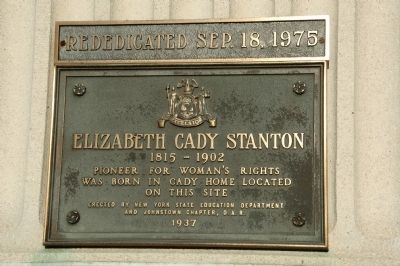
Photographed by Howard C. Ohlhous, September 1, 2012
1. Elizabeth Cady Stanton Marker
Was Born in Cady Home Located
On This Site
Erected By New York State Education Department
And Johnstown Chapter, D.A.R.
1937
Rededicated Sep. 18, 1975
Erected 1937 by New York State Education Department & Johnstown Chapter, D.A.R.
Topics and series. This historical marker is listed in these topic lists: Civil Rights • Women. In addition, it is included in the Daughters of the American Revolution (DAR), and the Elizabeth Cady Stanton series lists. A significant historical date for this entry is September 18, 1923.
Location. 43° 0.392′ N, 74° 22.358′ W. Marker is in Johnstown, New York, in Fulton County. It is on North Market Street near West Main Street (New York State Route 29/67), on the right when traveling north. Marker is mounted on one of the stone pilasters of the Bank of America building. The bank is at 51 West Main Street, but the marker faces N. Market Street. . Touch for map. Marker is in this post office area: Johnstown NY 12095, United States of America. Touch for directions.

Regionally, this marker is in Upstate New York and in the Mohawk Valley. It is also in the American
this page online
Other nearby markers. At least 8 other markers are within walking distance of this marker: Women's Rights (a few steps from this marker); Historic Johnstown (a few steps from this marker); Grave of Sir William Johnson (within shouting distance of this marker); Lest We Forget (within shouting distance of this marker); Founder of Johnstown (within shouting distance of this marker); Superintendent of Indian Affairs (within shouting distance of this marker); A Military Commander (within shouting distance of this marker); A Colonial (within shouting distance of this marker). Touch for a list and map of all markers in Johnstown.
Regarding Elizabeth Cady Stanton. Fulton County's most famous daughter recognized as a child the injustices women in her society had to endure. In Elizabeth's autobiography, she refers to her childhood
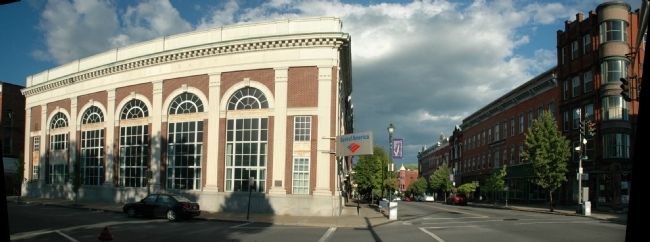
Photographed by Howard C. Ohlhous
2. Elizabeth Cady Stanton Marker
The marker is mounted on the side of the bank, at the base of the second column from the right.
Additional commentary.
1. Elizabeth Cady Stanton
Elizabeth Cady Stanton was a primary architect of the suffrage movement, organizer of the 1848 Women's Rights Convention in Seneca Falls, New York. For the next fifty years following the convention, Elizabeth played a significant leadership role in the women's rights movement. Elizabeth and her husband Anthony founded the National Women Suffrage Association to focus exclusively
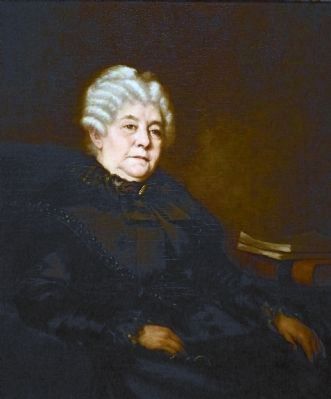
Photographed by Allen C. Browne, January 18, 2014
3. Elizabeth Cady Stanton
This 1889 portrait of Elizabeth Cady Stanton by Anna Elizabeth Klumpke hangs in the National Portrait Gallery in Washington DC.
“Elizabeth Cady Stanton was a feminist from the start, refusing to include ‘Obey’ in her marriage vows to her husband; and when she spoke of God she used the female pronoun. Stanton helped organize the Seneca Falls Convention of 1848, which was the founding moment of the American women's rights movement, and she was the longtime president of the National Woman Suffrage Association. Although Stanton's goal was to give women political power through the ballot, she spearheaded other feminist goals, such as liberalizing divorce laws and reforming child-rearing methods. But unlike other early feminists, she always insisted on the primacy of women's right to vote over other reform objectives, including abolition. She wrote ‘Our “Pathway” is straight to the ballot box with no variableness nor shadow of turning.’” — National Portrait Gallery
“Elizabeth Cady Stanton was a feminist from the start, refusing to include ‘Obey’ in her marriage vows to her husband; and when she spoke of God she used the female pronoun. Stanton helped organize the Seneca Falls Convention of 1848, which was the founding moment of the American women's rights movement, and she was the longtime president of the National Woman Suffrage Association. Although Stanton's goal was to give women political power through the ballot, she spearheaded other feminist goals, such as liberalizing divorce laws and reforming child-rearing methods. But unlike other early feminists, she always insisted on the primacy of women's right to vote over other reform objectives, including abolition. She wrote ‘Our “Pathway” is straight to the ballot box with no variableness nor shadow of turning.’” — National Portrait Gallery
— Submitted October 23, 2012, by Carlesia Young of Benton Harbor, Michgan.
Credits. This page was last revised on July 20, 2020. It was originally submitted on September 3, 2012, by Howard C. Ohlhous of Duanesburg, New York. This page has been viewed 1,287 times since then and 59 times this year. Photos: 1, 2. submitted on September 3, 2012, by Howard C. Ohlhous of Duanesburg, New York. 3. submitted on May 1, 2015, by Allen C. Browne of Silver Spring, Maryland. • Bill Pfingsten was the editor who published this page.
