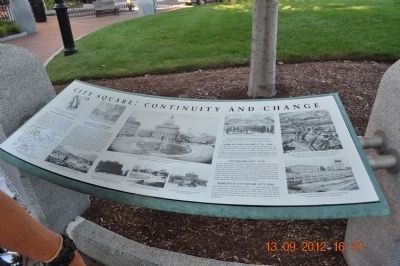
City Square: Continuity and Change
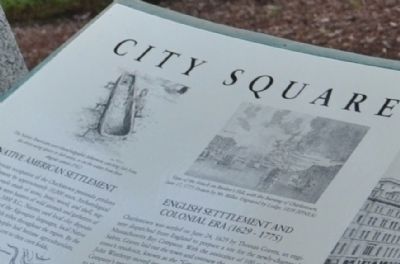
Native American Settlement
Native American occupation of the Charlestown peninsula predates European settlements by approximately 10,000 years. Archaeological evidence, such as tools made of stone, bone, wood, and shells, suggests the early Natives were hunters of wild animals and gatherers of plant foods.
As early as 1000 B.C. Natives used local clay deposits to create pottery. Speakers of the Algonquin languages, local Native Americans formed alliances with tribes throughout the region. By the early -17th Century, the Native people had become agriculturalists, living in semi- permanent villages adjacent to their corn field.---------
English Settlement and Colonial Era (1629-1775)
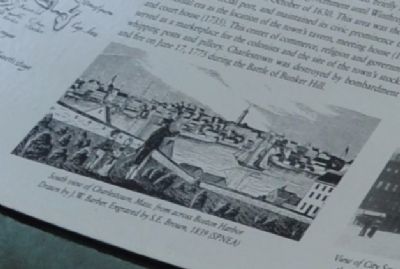
Charlestown was settled on June 24, 1629 by Thomas Graves, an engineer dispatched from England to prepare a site for the newly-chartered Massachusetts Bay Company.
With the assistance of 100 colonists from Salem, Graves laid out the town and oversaw the construction of the Governor's residence, known as the "Great House." In June 1630, Governor John Winthrop moved into the Great House, which briefly served as the Company's meeting
this page online
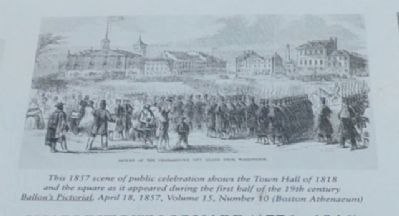
Charlestown Square (1776-1846)
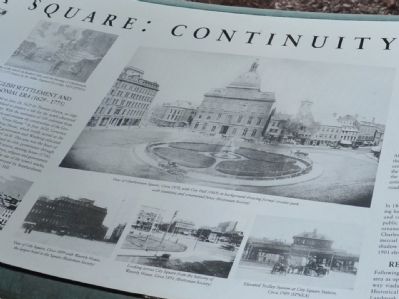
After the famous battle, the town voted to enlarge the open space and the area became known as Charlestown Square. By the close of the 18th century, new wharves, warehouses, ropewalks and shipyards bordered the square to the south and east. Transportation improvements, such as the 1786 and 1828 bridges to Boston, the 1803 Chelsea Bridge, and the arrival of the railroad in 1836, transformed the area into a busy crossroads and prosperous commercial center.-------
City Square (1847-1974)
In 1847, when Charlestown was incorporated as a city,
Rebirth of City Square (1975-1996)
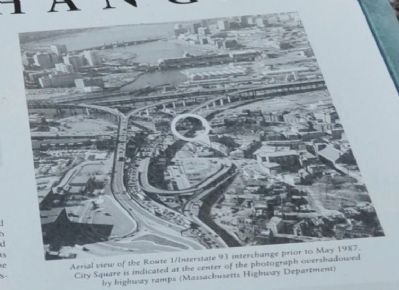
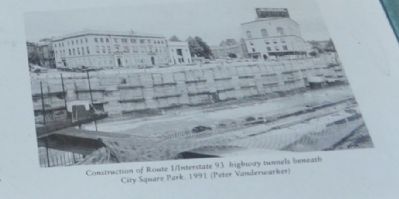
Following years of neighborhood advocacy to reclaim this dark, blighted area as open space,the elevated railway was removed in 1975 and the highway viaducts were replaced by tunnels in 1994. Today, the City Square Historical and Archaeological Site is honored as a designated Boston Landmark and City Square has regained its status as a major gateway to Charlestown.
Topics. This historical marker is listed in these topic lists: Colonial Era • Indigenous Peoples and Communities • Settlements & Settlers. A significant historical month for this entry is June 1775.
Location. 42° 22.287′ N,

Regionally, this marker is in Massachusetts’ Historic Boston. It is also in the American Northeast, in New England, and on the Eastern Seaboard. Globally, it is in the North Atlantic Region, North America, the Western Hemisphere, the Western World, and the Anglosphere. Historically, it finds itself in what was once one of the original Thirteen Colonies.
Other nearby markers. At least 8 other markers are within walking distance of this marker: Paul Revere (a few steps from this marker); Great House (within shouting distance of this marker); Charlestown Training Field / Winthrop Square (within shouting distance of this marker); Charlestown World War II Memorial (within shouting distance of this marker); Court of the Assistants (within shouting distance of this marker); The Leonard P. Zakim Bunker Hill Bridge (about 300 feet away,
Credits. This page was last revised on January 30, 2023. It was originally submitted on October 11, 2012, by Sandra Hughes Tidwell of Killen, Alabama, USA. This page has been viewed 859 times since then and 66 times this year. Photos: 1, 2, 3, 4, 5, 6, 7. submitted on October 11, 2012, by Sandra Hughes Tidwell of Killen, Alabama, USA. • Bill Pfingsten was the editor who published this page.
