Old Town in Alexandria, Virginia — The American South (Mid-Atlantic)
The Jones Point Lighthouse
Shedding Light on a Landmark
| — | Jones Point Park, National Park Service, U.S. Department of the Interior | — |
Photographed by Allen C. Browne, October 7, 2012
1. The Jones Point Lighthouse Marker
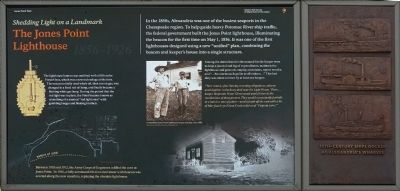
In the 1850's, Alexandria was one of the busiest seaports in the Chesapeake region. To help guide Potomac River ship traffic, the federal government built the Jones Point lighthouse, illuminating the beacon for the first time on May 1, 1856. It was one of the first lighthouses designed to use a new "unified" plan, combining the beacon and keeper's house into a single structure.
Among the duties listed in the manual for the keeper were to keep a journal and log of expenditures, maintain the lighthouse and grounds, employ attendants,report wrecks, and "…be courteous & polite to all visitors…" This last duty was taken to heart by a one keeper:
"Year round, after Sunday morning obligations, citizens would gather in the buoy shed near the Light House. There...keeper Benjamin Potter Greenwood would listen to the recollections of those present. They would occasionally partake in a hand or two of poker—would finish off the visit with a bit of Maryland rye (Oxon Creek stills) or 'Virginia corn.'"
[Captions:]
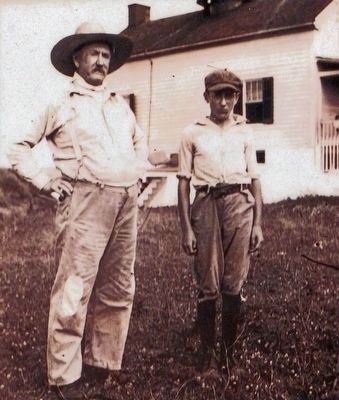
Unidentified Jones Point Lighthouse keeper and boy, circa 1905. Image courtesy of the Historical Society of Washington D.C.
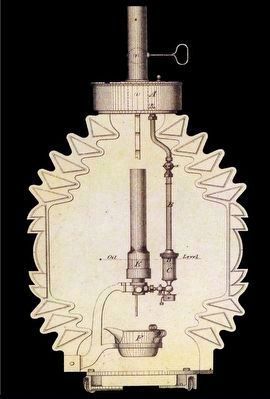
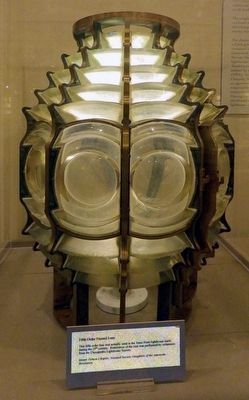
The lighthouse lantern was outfitted with a fifth order Fresnel lens, which was new technology at the time. The beacon initially used whale oil, then ran on gas, was changed to a fixed red oil lamp and finally became a flashing white gas lamp.During the period that the red light was in place, the Point became known as something of a nautical "red light zone" with gambling barges and floating brothels. Image courtesy of the Library of Congress
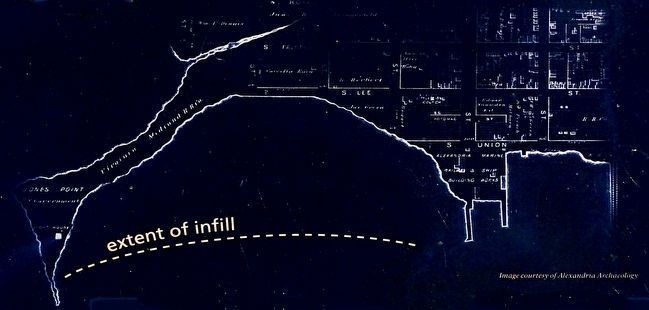
Between 1910 and 1912, the Army Corps of Engineers infilled the cove at Jones Point. In 1926, a fully automated 60-foot steel tower with beacon was erected along the new coastline, replacing the obsolete lighthouse. Image courtesy of National Archives
Erected by National
this page online
Topics and series. This historical marker is listed in these topic lists: Man-Made Features • Waterways & Vessels. In addition, it is included in the Lighthouses series list. A significant historical month for this entry is May 1612.
Location. 38° 47.429′ N, 77° 2.488′ W. Marker is in Alexandria, Virginia. It is in Old Town. It can be reached from Jones Point Drive east of South Royal Street, on the right when traveling east. This marker is north and west of the Jones Point lighthouse along the Jones Point interpretive trail.
PLEASE NOTE: The automated “Touch for directions” link at the end of this paragraph, when used in driving mode, takes you to I-95’s Wilson Bridge, where you cannot park, much less stop, and then seems to indicate that you should jump off the bridge and walk to the marker. You will surely break your neck—among many other bones—if you jump off the bridge. Instead, set your destination to “Jones Point Park Parking” in order to obtain driving directions to where you can park and walk to the marker. . Touch for map. Marker is at or near this postal address: 100 Jones
Photographed by Allen C. Browne, October 7, 2012
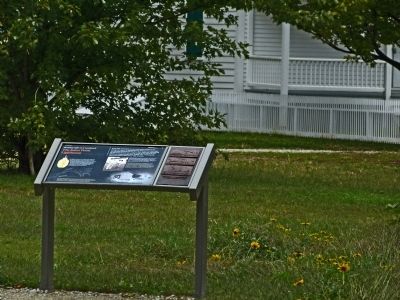
2. The Jones Point Lighthouse Marker north of Jones Point lighthouse

Regionally, this marker is in the Washington Metropolitan Area and in Northern Virginia. It is also in the American South, specifically in the Upper South, in the Mid-Atlantic, and on the Eastern Seaboard. Globally, it is in the North Atlantic Region, North America, the Western Hemisphere, the Western World, and the Anglosphere. Historically, it finds itself in what was once the territory of the Mississippian Culture, one of the original Thirteen Colonies, one of the Confederate States of America, and the Antebellum South.
Other nearby markers. At least 8 other markers are within walking distance of this marker: The Long Story of The Jones Point Ropewalk (within shouting distance of this marker); Mistress Margaret Brent (within shouting distance of this marker); The Remarkable Margaret Brent (within shouting distance of this marker); D.C.'s First Building Block (within shouting distance of this marker); The Nation's Capital Begins Here 1791-1793 (about 300 feet away, measured in a direct line); Who Owns the River? (about 300 feet away); What's below the water at Jones Point?
Photographed by Allen C. Browne, February 18, 2007
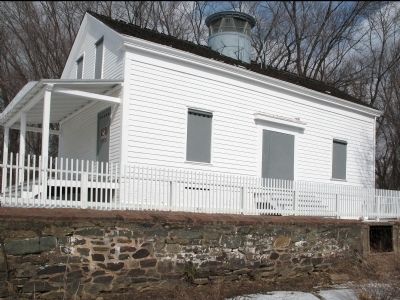
3. Jones Point lighthouse
Another marker is no longer nearby. Original Federal Boundary Stone, District of Columbia, South Cornerstone (was within shouting distance of this marker but has been permanently removed).
Photographed by Allen C. Browne, August 1, 2015
4. Unidentified Jones Point Lighthouse keeper and boy, circa 1905.
Historical Society of Washington D.C.
Photographed by Allen C. Browne, August 1, 2015
5. Lighthouse Lantern
The lighthouse lantern was outfitted with a fifth order Fresnel lens, which was new technology at the time. The beacon initially used whale oil, then ran on gas, was changed to a fixed red oil lamp and finally became a flashing white gas lamp. During the period that the red light was in place, the Point became known as something of a nautical “red light zone” with gambling barges and floating brothels. Close-up of image on marker
Library of Congress
Library of Congress
Photographed by Allen C. Browne, August 1, 2015
6. Fifth Order Fresnel Lens
This fifth order lens was actually used in the Jones Point lighthouse itself, during the 19th century. Restoration of the lens was performed by volunteers from the Chesapeake Lighthouse Society.
Mount Vernon Chapter, National Society of the Daughters of the American Revolution
on display in the Lyceum Museum in Alexandria Virginia
Mount Vernon Chapter, National Society of the Daughters of the American Revolution
Photographed by Allen C. Browne, August 1, 2015
7. Extent of infill
Between 1910 and 1912, the Army Corps of Engineers infilled the cove at Jones Point. In 1926, a fully automated 60-foot steel tower with beacon was erected along the new coastline, replacing the obsolete lighthouse. Close-up of image on marker
Alexandria Archaeology
Alexandria Archaeology
Photographed by Allen C. Browne, August 1, 2015
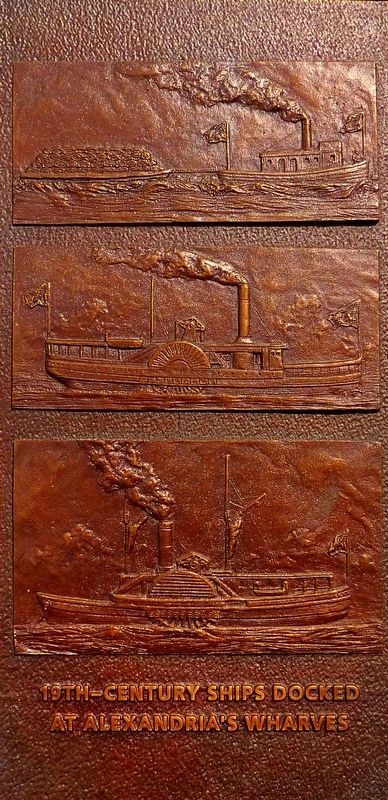
8. 19th Century Ships docked at Alexandria's Wharves
Bronze plaque mounted on marker
Credits. This page was last revised on January 28, 2023. It was originally submitted on October 10, 2012, by Allen C. Browne of Silver Spring, Maryland. This page has been viewed 1,519 times since then and 51 times this year. Last updated on October 12, 2012, by Allen C. Browne of Silver Spring, Maryland. Photos: 1, 2, 3. submitted on October 10, 2012, by Allen C. Browne of Silver Spring, Maryland. 4, 5, 6, 7. submitted on August 2, 2015, by Allen C. Browne of Silver Spring, Maryland. 8. submitted on April 16, 2021, by Allen C. Browne of Silver Spring, Maryland. • Bernard Fisher was the editor who published this page.
