Fort Sill in Comanche County, Oklahoma — The American South (West South Central)
280mm Heavy Motorized Gun M65
(Gun Nr. 21 on Carriage Nr. 3)
Photographed by Lee Hattabaugh, November 15, 2011
1. 280mm Heavy Motorized Gun M65 Marker - left side
(left plaque)
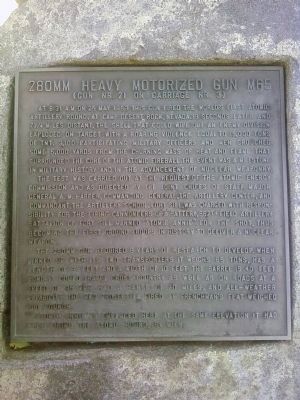
At 8:31 a.m. on 25 May 1953 this gun fired the world's first atomic artillery round, at Camp Desert Rock, Nevada. 19 seconds later and 7¾ miles distant, the shell that could wipe out an enemy division exploded on target with a roaring violence equal to 15,000 tons of TNT. 3,100 participating military officers and men crouched some 5,000 yards from the churning mass of heat and flame that surrounded the core of the atomic fireball. The event was a milestone in military history and in the advancement of nuclear weaponry.
The test was carried out at the request of the Atomic Energy Commission and as directed by the Joint Chiefs of Staff. Major General A.M. Harper, Commanding General, The Artillery Center, and Commandant, The Artillery School, Fort Sill, was charged with responsibility for the firing. Cannoneers of "A" Battery, 867th Field Artillery Battalion of Fort Sill manned "Atomic Annie" for the shot, thus becoming the first ground troops in history to deliver a nuclear weapon.
The 280mm gun required 8 years of research to develop. When linked up with its two transporters it weighs 85 tons, has a
this page online
Atomic Annie's emplaced here at the same elevation it had when firing the atomic round, 84 mils.
(right plaque)
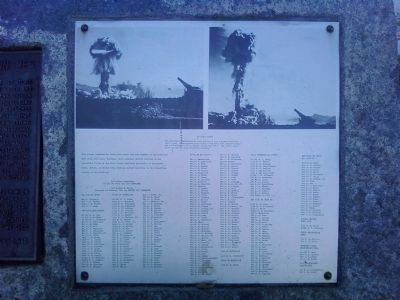
This plaque commemorates those individuals who were members of the Artillery Test Unit, Fort Sill, Oklahoma, whose combined efforts resulted in the successful firing of the first atomic artillery projectile at Frenchman's Flats, Nevada, on 25 May 1953, marking another milestone in the illustrious history of the Artillery.
[This text is followed by a list of over 200 service members from 11 different organizations who were part of this test]
Topics. This historical marker is listed in these topic lists: Government & Politics • Peace • Science & Medicine • War, Cold. A significant historical date for this entry is May 25, 1953.
Location. 34° 39.971′ N, 98° 23.053′ W. Marker is in Fort Sill, Oklahoma, in Comanche County. It can be reached from the intersection
Photographed by Lee Hattabaugh, November 15, 2011
2. 280mm Heavy Motorized Gun M65 Marker - right side
Commemorates those individuals who were members of the Artillery Test Unit, Fort Sill, Oklahoma.

Regionally, this marker is in the Kiowa Tribe, in the Comanche Nation, and in Southwest Oklahoma—Great Plains Country. It is also in the American South, specifically on the prairies, and on the Southern Plains. Globally, it is in North America, the Western Hemisphere, the Western World, and the Anglosphere. Historically, it finds itself in what was once New Spain, the Comanchería, the territory of the Mississippian Culture, and the Louisiana Purchase.
Other nearby markers. At least 8 other markers are within walking distance of this marker: U.S. M249 & M250 4x4 Heavy Gun-Lifting Trucks (here, next to this marker); German 100mm Field Gun, Model 1904 (here, next to this marker); German 105mm Field Howitzer, M1898/1909 (a few steps from this marker); German 100mm Gun, M1914
Photographed by Lee Hattabaugh, November 15, 2011
3. 280mm Heavy Motorized Gun M65 Marker detail - left photo
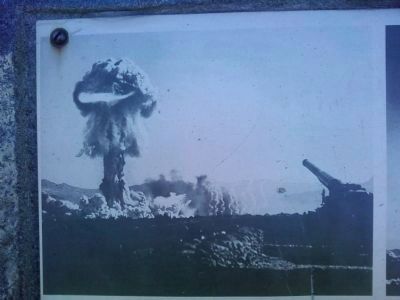
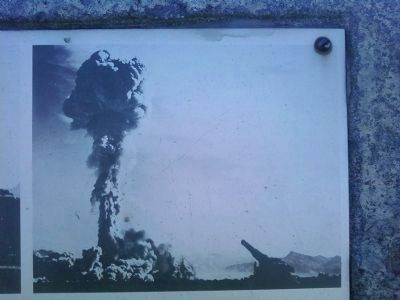
The mushroom cloud formation from history's first atomic artillery shell rises in background after being fired from this 280-millimeter gun at Frenchman's Flat, Nevada, on 25 May 1953. The atomic shell burst in the air with precision accuracy.
More about this marker. The marker and museum are located on Fort Sill, an active military installation. The museum is open to the public, but appropriate photo identification is required for access to the post.
Related markers. Click here for a list of markers that are related to this marker. These HMDB listings are the three Atomic Cannons still in existence.
Additional commentary.
1. Fort Sill's Atomic Annie
More photos of Atomic Annie can be seen in the HMDB listing ID# 48587 (The Atomic Cannon Marker).
— Submitted November 5, 2012, by Lee Hattabaugh of Capshaw, Alabama.
Photographed by Lee Hattabaugh, November 15, 2011
4. 280mm Heavy Motorized Gun M65 Marker detail - right photo
same photo caption as the left side photo.
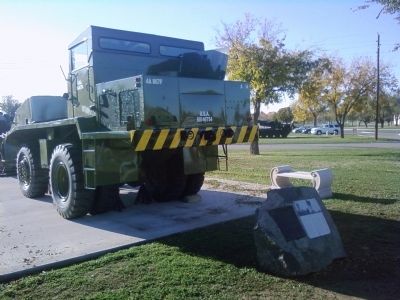
Photographed by Lee Hattabaugh, November 15, 2011
5. 280mm Heavy Motorized Gun M65 Marker
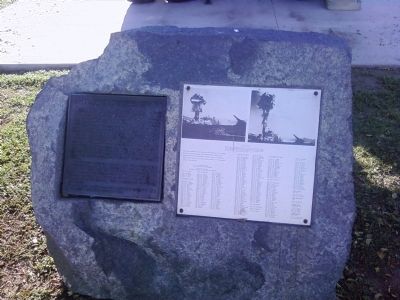
Photographed by Lee Hattabaugh, November 15, 2011
6. 280mm Heavy Motorized Gun M65 Marker
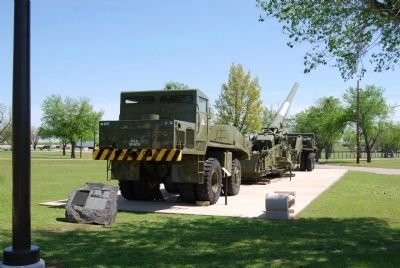
Photographed by Mike Wintermantel, April 10, 2015
7. 280mm Heavy Motorized Gun M65 and marker
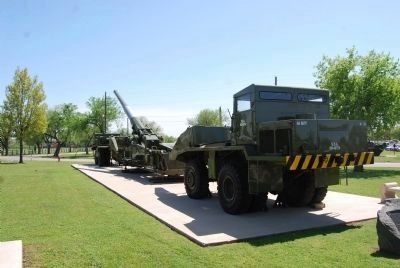
Photographed by Mike Wintermantel, April 10, 2015
8. 280mm Heavy Motorized Gun M65
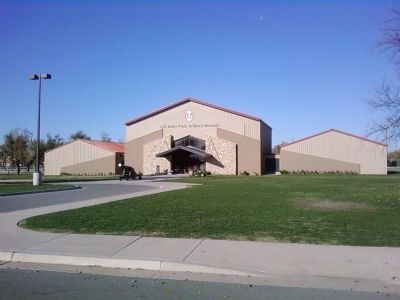
Photographed by Lee Hattabaugh, November 15, 2011
9. U.S. Army Field Artillery Museum
Credits. This page was last revised on February 27, 2023. It was originally submitted on November 5, 2012, by Lee Hattabaugh of Capshaw, Alabama. This page has been viewed 2,860 times since then and 92 times this year. Photos: 1, 2, 3, 4, 5, 6. submitted on November 5, 2012, by Lee Hattabaugh of Capshaw, Alabama. 7, 8. submitted on April 13, 2015, by Mike Wintermantel of Pittsburgh, Pennsylvania. 9. submitted on November 5, 2012, by Lee Hattabaugh of Capshaw, Alabama. • Bernard Fisher was the editor who published this page.
