Inner Harbor in Baltimore, Maryland — The American Northeast (Mid-Atlantic)
Living Classrooms Foundation
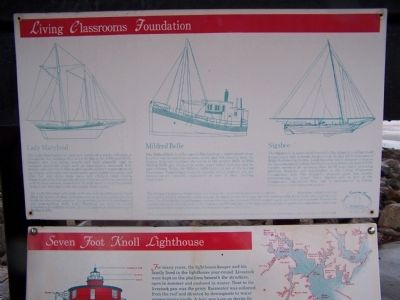
Photographed by William Pfingsten, March 8, 2008
1. Living Classrooms Foundation Marker
Lady Maryland
The Lady Maryland is an authentic replica of a pungy schooner, a Chesapeake Bay workboat that sailed the Bay in the 1700s and 1800s. Pungies were fast sailing vessels and were primarily used to transport perishable cargo such as watermelons, tomatoes, fish, oysters, and other items that needed speedy delivery to prevent spoilage. Pungy schooners were traditionally painted pink and green and their flat, wide decks made them very efficient cargo vessels. Pungies sailed the Chesapeake for over 150 years and were considered to be the best and most beautiful of all craft native to the Chesapeake. Today Lady Maryland is the only pungy in the world.
The Lady Maryland sails daily with area school children who learn about the history, ecology and economics of the Chesapeake Bay in a hands on educational program that provides leadership development and team building skills. Lady Maryland was built by Living Classrooms Foundation shipwrights and students at Baltimore's Inner Harbor in 1985.
Mildred Belle
The Mildred Belle is a Chesapeake Bay buyboat, a motor vessel whose function was to purchase oysters, crabs,
this page online
Sigsbee
The Sigsbee is an authentic Chesapeake Bay skipjack, a sailing vessel designed and built to dredge for oysters. In the late 1800s thousands of skipjacks fished in the Bay. Today, less than thirty skipjacks comprise the last commercial sailing fleet in the nation. Originally built in 1901, Sigsbee served in the oystering fleet for 88 years before becoming disabled. Students and shipwrights in the Living Classrooms Foundation's Save Our Skipjacks program spent ten months reconstructing the vessel. Today Sigsbee sails as part of the Foundations educational fleet and is instrumental in Living Classroom's oyster restoration project.
The Living Classrooms Foundation is a non-profit organization providing hands-on education and job training that motivates and empowers youth to learn by doing so that they may succeed academically, in the work place, and in their lives. The Foundation's challenging outdoor education involves over 25,000 students each year. Living Classrooms Foundation vessels visit more than 25 ports in the region from Philadelphia to Norfolk and thousands of youth also experience innovative programs at the Living Classrooms Maritime Institute in Fells Point.
The Living Classrooms Foundation owes its success to its many benefactors, the City of Baltimore and the State of Maryland.
Topics. This historical marker is listed in these topic lists: Education • Environment • Waterways & Vessels. A significant historical year for this entry is 1985.
Location. Marker has been permanently removed. It was located near 39° 17.02′ N, 76° 36.324′ W. Marker was in Baltimore, Maryland. It was in the Inner Harbor. It could be reached from Eastern Avenue. Marker is under the Seven Foot Knoll Lighthouse on Pier 5 at the Baltimore Inner Harbor. Touch for map. Marker was at or near this postal address: 719 Eastern Ave, Baltimore MD 21202, United States of America.
We have been informed that this marker is no longer there and will not be replaced. This page is an archival view of what was.
Regionally, this marker was in Central Maryland. It was also in the American Mid-Atlantic, in the Chesapeake Bay Region, and on the Eastern Seaboard. Globally, it was in the North Atlantic Region, North America, the Western Hemisphere, the Western World, and the Anglosphere. Historically, it found itself in what was once one of the original Thirteen Colonies and also the Antebellum South.

Other nearby markers. At least 8 other markers are within walking distance of this location: Seven Foot Knoll Lighthouse (here, next to this marker); Mr. Trash Wheel (about 600 feet away); The Last Pearl Harbor Survivor (about 600 feet away); Tilly's Escape (about 600 feet away); Pathways to Freedom (about 600 feet away); Jones Falls (about 600 feet away); Baltimore Public Works Museum (about 700 feet away); How Can We All Help? (about 800 feet away). Touch for a list and map of all markers in Baltimore.
Other markers no longer nearby. Seven-Foot Knoll Lighthouse (was a few steps from this marker but has been replaced with another marker now near it); a different marker also named Seven Foot Knoll Lighthouse (was a few steps from this marker but has been replaced with another marker now near it); Coast Guard Cutter Taney - WHEC-37 (was about 600 feet away, measured in a direct line but has been replaced with another marker now near it); The Inner Harbor Water Wheel (was about 600 feet away but has been replaced with another marker now near it); The Coast Guard Cutter Taney (was about 600 feet away but has been replaced with another marker now near it); Water Power: Baltimore's Economic Engine (was about 600 feet away but has been replaced with another marker now near it).
Credits. This page was last revised on November 8, 2025. It was originally submitted on March 11, 2008, by Bill Pfingsten of Bel Air, Maryland. This page has been viewed 2,867 times since then and 50 times this year. Photo 1. submitted on March 11, 2008, by Bill Pfingsten of Bel Air, Maryland.
