Old Town in Alexandria, Virginia — The American South (Mid-Atlantic)
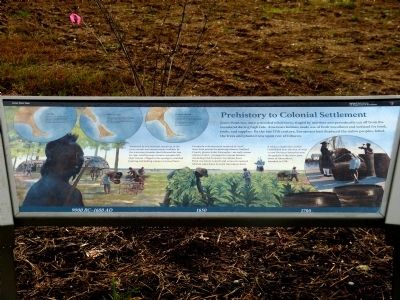
Prehistory to Colonial Settlement
Jones Point Park
| — | National Park Service, U.S. Department of the Interior | — |
Photographed by Allen C. Browne, October 7, 2012
1. Prehistory to Colonial Settlement Marker
Jones Point was once a wooded wilderness, ringed by marshes and periodically cut off from the mainland during high tide. American Indians made use of both woodland and wetland for food, tools and supplies. By the 17th century, Europeans had displaced the native peoples, felled the trees and planted row upon row of tobacco.
Attracted to the seasonal resources of the river, woods and marsh made available by the warming climates that followed the last Ice Age, a small group of native peoples left their inland villages in the spring to establish hunting and fishing camps on Jones Point.
European colonists were required to “seat” their land patents by planting tobacco. Stafford County planter John Alexander—an early owner of Jones Point—arranged for tenant farmers (including Charles Jones, for whom Jones Point was named) and crews of enslaved African Americans to work the remote farm.
A Tobacco inspection station established near the foot of what is now Oronoco Street became the genesis of the active town of Alexandria in 1749.
[Sidebar:]
Ice Age
During the last Ice Age, glaciers locked away massive amounts of seawater in ice. Low sea levels exposed more land and enlarged the footprint of Jones Point.
Post Ice Age
Warming climates melted the glaciers after the last Ice Age. Rising sea levels created a tidally-flooded marsh (pocosin) that separated Jones Point from the mainland.
Historic Period
Sea levels continued to rise, but sedimentation gradually added land to Jones Point. In 1794, Alexandrians reinforced what may have been a slender, natural causeway permanently reconnecting Jones Point to the mainland.
Erected by National
this page online
Topics. This historical marker is listed in these topic lists: Colonial Era • Indigenous Peoples and Communities • Settlements & Settlers. A significant historical year for this entry is 1749.
Location. 38° 47.536′ N, 77° 2.547′ W. Marker is in Alexandria, Virginia. It is in Old Town. It can be reached from Jones Point Drive east of South Royal Street, on the right when traveling east. Marker is located near a playground in Jones Point Park.
PLEASE NOTE: The automated “Touch for directions” link at the end of this paragraph, when used in driving mode, takes you to I-95’s Wilson Bridge, where you cannot park, much less stop, and then seems to indicate that you should jump off the bridge and walk to the marker. You will surely break your neck—among many other bones—if you jump off the bridge. Instead, set your destination to “Jones Point Park Parking” in order to obtain driving directions to where you can park and walk to the marker.. Touch for map. Marker is at or near this postal address: 100 Jones Point Dr, Alexandria VA 22314, United States of America. Touch for directions.

Regionally,
Photographed by Allen C. Browne, October 7, 2012
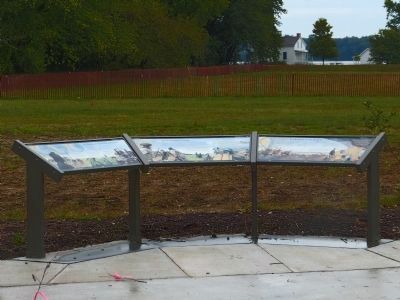
2. This Marker is the first (leftmost) of three markers in this location.
Other nearby markers. At least 8 other markers are within walking distance of this marker: The Emerging Nation (here, next to this marker); World Wars to the Present (here, next to this marker); The First People on Jones Point (within shouting distance of this marker); A World War I Shipyard Transforms Jones Point (about 300 feet away, measured in a direct line); Mount Vernon Trail (about 300 feet away); World War I-Era Rudder (about 300 feet away); Potomac Connections (about 400 feet away); Welcome to Jones Point Park (about 400 feet away). Touch for a list and map of all markers in Alexandria.
Related markers. Click here for a list of markers that are related to this marker. These three markers jointly tell the history of Jones Point.
Credits. This page was last revised on June 17, 2026. It was originally submitted on December 21, 2012, by Allen C. Browne of Silver Spring, Maryland. This page has been viewed 2,116 times since then and 110 times this year. Photos: 1, 2. submitted on December 21, 2012, by Allen C. Browne of Silver Spring, Maryland. • Bernard Fisher was the editor who published this page.
