Old Town in Alexandria, Virginia — The American South (Mid-Atlantic)
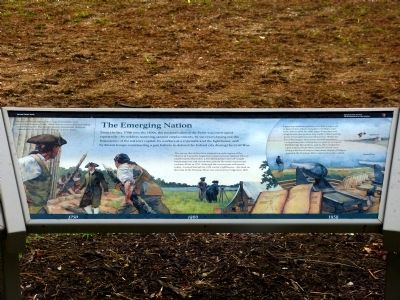
The Emerging Nation
Jones Point Park
| — | National Park Service, U.S. Department of the Interior | — |
Photographed by Allen C. Browne, October 7, 2012
1. The Emerging Nation Marker
During the Revolutionary War, cannon positions were established on Jones Point. These defenses were enlarged during and following the War, but eventually abandoned. However, it would not be the military's last use of Jones Point.
The survey that defined the original ten-mile square of the District of Columbia began here when surveyor Andrew Ellicott and Benjamin Banneker, a free black farmer and self taught mathematician and astronomer, placed the south cornerstone on Jones Point in 1791. Although the cornerstone still stands today—located behind the 19th century lighthouse—the land on this side of the Potomac River was returned to Virginia in 1847.
A growing maritime industry brought a ropewalk to Jones Point, which manufactured ship's rope from 1833 to 1850.
this page online
Erected by National Park Service, U.S. Department of the Interior.
Topics and series. This historical marker is listed in these topic lists: Colonial Era • War, US Civil • War, US Revolutionary. In addition, it is included in the Lighthouses series list. A significant historical year for this entry is 1791.
Location. 38° 47.535′ N, 77° 2.548′ W. Marker is in Alexandria, Virginia. It is in Old Town. It can be reached from Jones Point Drive east of South Royal Street, on the right when traveling east. Marker is located near a playground in Jones Point Park.
PLEASE NOTE: The automated “Touch for directions” link at the end of this paragraph, when used in driving mode, takes you to I-95’s Wilson Bridge, where you cannot park, much less stop, and then seems to indicate that you should jump off the bridge and walk to the marker. You will surely break your neck—among many other bones—if you jump off the bridge. Instead, set your destination to “Jones Point Park Parking” in order to obtain driving directions to where you can park and walk to the marker. .
Photographed by Allen C. Browne, October 7, 2012
2. This marker is the center marker of these three.

Regionally, this marker is in the Washington Metropolitan Area and in Northern Virginia. It is also in the American South, specifically in the Upper South, in the Mid-Atlantic, and on the Eastern Seaboard. Globally, it is in the North Atlantic Region, North America, the Western Hemisphere, the Western World, and the Anglosphere. Historically, it finds itself in what was once the territory of the Mississippian Culture, one of the original Thirteen Colonies, one of the Confederate States of America, and the Antebellum South.
Other nearby markers. At least 8 other markers are within walking distance of this marker: World Wars to the Present (here, next to this marker); Prehistory to Colonial Settlement (here, next to this marker); The First People on Jones Point (within shouting distance of this marker); A World War I Shipyard Transforms Jones Point (about 300 feet away, measured in a direct line); World War I-Era Rudder (about 300 feet away); Mount Vernon Trail (about 300 feet away); Potomac Connections (about 400 feet away); Welcome to Jones Point Park (about 400 feet away). Touch for a list and map of all markers in Alexandria.
Related markers. Click here for a list of markers that are related to this marker. These three markers jointly tell the history of Jones Point.
Credits. This page was last revised on January 28, 2023. It was originally submitted on December 21, 2012, by Allen C. Browne of Silver Spring, Maryland. This page has been viewed 994 times since then and 35 times this year. Photos: 1, 2. submitted on December 21, 2012, by Allen C. Browne of Silver Spring, Maryland. • Bernard Fisher was the editor who published this page.
