Paradise in Ashford in Pierce County, Washington — The American West (Northwest)
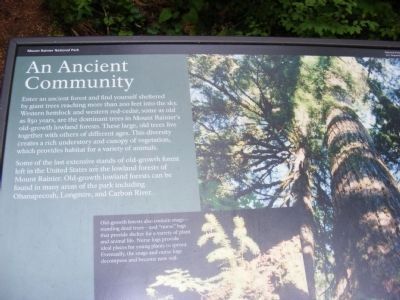
An Ancient Community
Mount Ranier National Park
Photographed by Don Morfe, September 14, 2009
1. An Ancient Community Marker
Photo Caption:
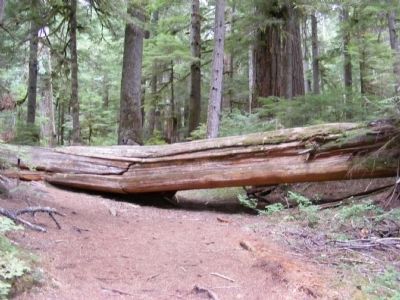
Old-growth forests also contain snags - standing dead trees - and “nurse” logs that provide shelter for a variety of plant and animal life. Nurse legs provide ideal places for young plants to sprout. Eventually, the snags and nurse logs decompose and become new soil.
Old-growth forests also contain snags - standing dead trees - and “nurse” logs that provide shelter for a variety of plant and animal life. Nurse legs provide ideal places for young plants to sprout. Eventually, the snags and nurse logs decompose and become new soil.
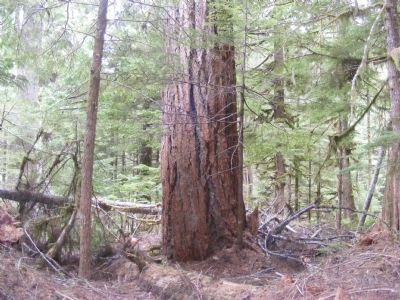
Some of the last extensive stands of old-growth forest left in the United States are the lowland forests of Mount Rainier. Old-growth lowland forests can be found in many areas of the park including Ohanapecosh, Longmire, and Carbon River.
Erected by Mount Ranier National Park, National Park Service.
Topics. This historical marker is listed in these topic lists: Horticulture & Forestry • Natural Features.
Location. 46° 47.148′ N, 121° 44.172′ W. Marker is in Ashford, Washington, in Pierce County. It is in Paradise. It can be reached from Paradise-Longmire Road, on the right when traveling east. Touch for map. Marker is at or near this postal
this page online

Regionally, this marker is in the Puget Sound Region and in Greater Seattle. It is also on the American Pacific Coast, in the Pacific Northwest, and in the Lewis & Clark Corridor. Globally, it is in North America, in the Cascade Range, in the Inside Passage, on the Ring of Fire, on the Pacific Rim, in the Western Hemisphere, in the Western World, and in the Anglosphere.
Other nearby markers. At least 8 other markers are within walking distance of this marker: Historic Paradise Camp Lodge (a few steps from this marker); Exploring Paradise (within shouting distance of this marker); Paradise Ranger Station (within shouting distance of this marker); Climbers’ Guide House (about 400 feet away, measured in a direct line); Extreme Snowfall (about 500 feet away); Paradise Inn (about 600 feet away); Paradise Historic District (about 600 feet away); Inspired to Preserve (approx. half a mile away). Touch for a list and map of all markers in Ashford.
Regarding An Ancient Community. An Icon on the Horizon
Ascending to 14,410
Photographed by Don Morfe, September 14, 2009
2. Old Growth Forest
Established on March 2, 1899, Mount Rainier is America's fifth oldest national park. Much of what we associate with national parks today (rustic architecture, museums, auto touring, and park rangers) has roots at Mount Rainier. The naturalists at Mount Rainier were some of the first in the National Park Service. From 1923 through 1939, they published a series of Nature Notes for park visitors. Topics included plants, wildlife, road and trail conditions, park regulations, safety cautions, historical notes, along with inspirational poems, illustrations and anecdotes. At one time, over 600 copies of the notes were distributed in the park and mailed to other parks as well as to individual subscribers throughout the U.S. At least a dozen other national parks published
Photographed by Don Morfe, September 14, 2009
3. Old Growth Forest
Frequency of publication at Mount Rainier ranged from bi-weekly to quarterly depending on season and staffing. Nature Notes were the responsibility of the park naturalist, assisted in summer by seasonal nature guides. Articles were also written by the Chief Ranger, Ranger-Naturalists and the Superintendent. Floyd W. Schmoe was Park Naturalist at the time Nature Notes were established. He supervised and developed the Nature Guide Department until he resigned in September 1928. C. Frank Brockman served as Park Naturalist from July 1929 to 1941. He later became a professor at the University of Washington and eventually published some of his Nature Notes in book form.
While we have learned much in the decades since the Nature Notes were first published, they remain an excellent source of information about the park's natural and cultural resources and are, in themselves, a cultural resource. This special
Photographed by Don Morfe, September 14, 2009
4. A Water Fall in the Forest
There are several hundred editions of the notes in the park's collection, all of which have been converted to the Web for your reading pleasure.
Source: National Park Service
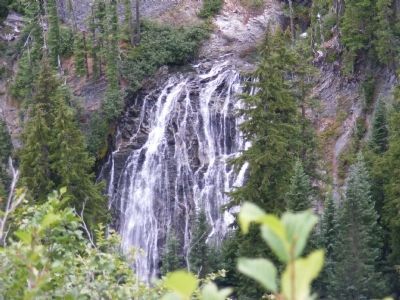
Photographed by Don Morfe, September 14, 2009
5. Water Fall
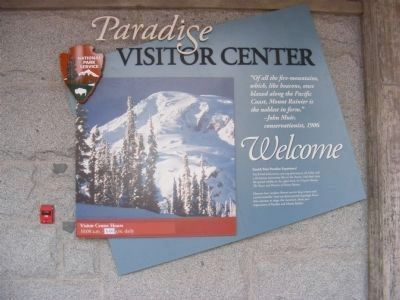
Photographed by Don Morfe, September 14, 2009
6. Visitor Center Welcome Sign
Paradise Visitor Center-‘Of all the fire-mountains, which, like beacons, once blazed along the Pacific Coast, Mount Rainier is the noblest in form.’ John Muir, conservationist, 1906
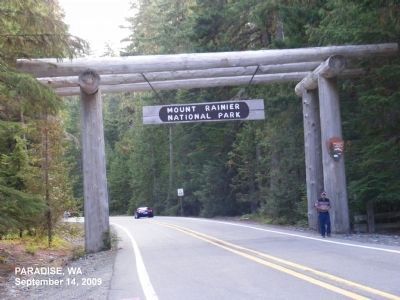
Photographed by Don Morfe, September 14, 2009
7. Entrance to the Mount Rainier National Park
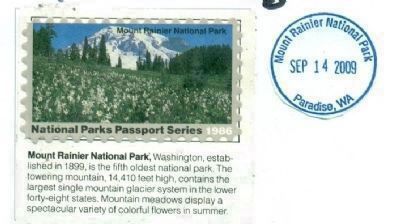
Photographed by Don Morfe, September 14, 2009
8. National Park Passport Cancellation Stamp
Mount Rainier National Park, Washington, established in 1899, is the fifth oldest national park. The towering mount, 14,410 feet high, contains the largest single mountain glacier system in the lower forty-eight states. Mountain meadows display a spectacular variety of colorful flowers in summer.
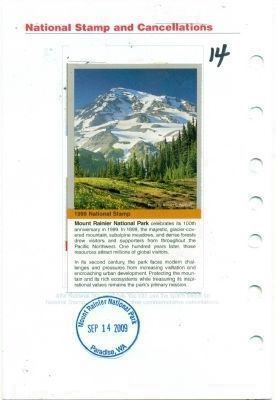
Photographed by Don Morfe, September 14, 2009
9. 1999 National Passport Stamp
Mount Rainier National Park celebrates its 100th anniversary in 1999. In 1899, the majestic, glacier-covered mountain, subalpine meadows, and dense forests drew visitors and supporters from throughout the Pacific Northwest. One hundred years later, those resources attract millions of global visitors.
In its second century, the park faces modern challenges and pressures from increasing visitation an encroaching urban development. Protecting the mountain and its rich ecosystems while treasuring its inspirational values remains the park’s primary mission.
Credits. This page was last revised on February 7, 2023. It was originally submitted on December 26, 2012, by Don Morfe of Baltimore, Maryland. This page has been viewed 939 times since then and 51 times this year. Photos: 1, 2, 3, 4, 5, 6, 7, 8, 9. submitted on December 26, 2012, by Don Morfe of Baltimore, Maryland. • Syd Whittle was the editor who published this page.
Editor’s want-list for this marker. A photo showing the entire marker. • Wide area view of the marker and its surroundings. • Can you help?
