Downtown Memphis in Shelby County, Tennessee — The American South (East South Central)
Mary Church Terrell
1863 - 1954
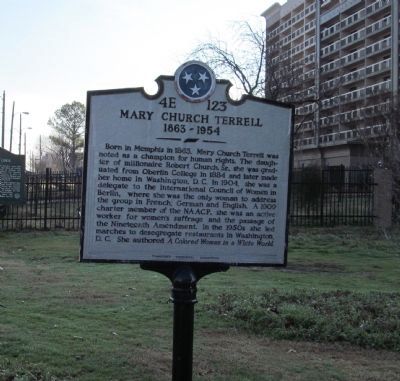
Photographed by Judith Barber, February 5, 2013
1. Mary Church Terrell Marker
Erected by Tennessee Historical Commission. (Marker Number 4E 123.)
Topics and series. This historical marker is listed in these topic lists: African Americans • Arts, Letters, Music • Civil Rights • Women. In addition, it is included in the Mary Church Terrell, and the Tennessee Historical Commission series lists. A significant historical year for this entry is 1863.
Location. 35° 8.341′ N, 90° 2.851′ W. Marker is in Memphis, Tennessee, in Shelby County. It is in Downtown Memphis.
this page online

Regionally, this marker is in West Tennessee. It is also in the American South, specifically in the Deep South, in the Upper South, in the Mississippi Delta, and in the Great River Road Region. Globally, it is in North America, the Western Hemisphere, the Western World, and the Anglosphere. Historically, it finds itself in what was once the territory of the Mississippian Culture, one of the Confederate States of America, and the Antebellum South.
Other nearby markers. At least 8 other markers are within walking distance of this marker: Phi Beta Sigma/Abram Langston Taylor (a few steps from this marker); Church Park (a few steps from this marker); Sara Roberta Church (a few steps from this marker); Church Park Auditorium (within shouting distance of this marker); This Plaque is Dedicated to Father and Son, Leaders of Their Race (within shouting distance of this marker); Solvent Savings Bank
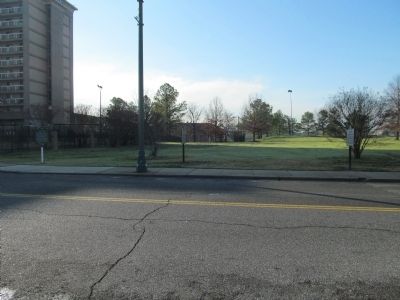
Photographed by Judith Barber, February 5, 2013
2. Mary Church Terrell Marker
Also see . . . Mary Church Terrell. (Submitted on August 15, 2015, by Richard E. Miller of Oxon Hill, Maryland.)
Photographed by Allen C. Browne, August 9, 2015
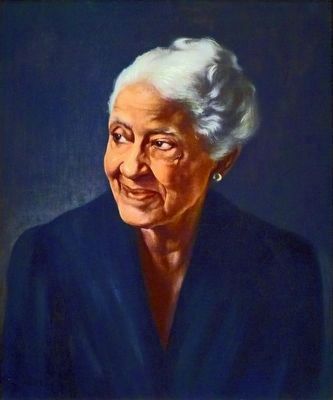
3. Mary Church Terrell
1863-1854
1863-1854
This 1946 portrait of Mary Church Terrell by Betsy Graves Reyneau hangs in the National Portrait Gallery in Washington DC.
“Mary Church Terrell's determination to encourage the development of self-help and social service programs among black women resulted in her founding and presiding over the National Association of Colored Women in 1896. But her life was also dedicated to the achievement of equity for all. Terrell's influence quickly spread across the nation as she eloquently addressed audiences and composed numerous articles, poems, and short stories, which often embodied the themes of race and gender equity. Her autobiography, A Colored Woman in a White World, was published in 1940. In Washington, Terrell served on the D.C. Board of Education for more than ten years and participated in numerous protests to end segregation in restaurants, hotels, and theaters in the city.“ — National Portrait Gallery
“Mary Church Terrell's determination to encourage the development of self-help and social service programs among black women resulted in her founding and presiding over the National Association of Colored Women in 1896. But her life was also dedicated to the achievement of equity for all. Terrell's influence quickly spread across the nation as she eloquently addressed audiences and composed numerous articles, poems, and short stories, which often embodied the themes of race and gender equity. Her autobiography, A Colored Woman in a White World, was published in 1940. In Washington, Terrell served on the D.C. Board of Education for more than ten years and participated in numerous protests to end segregation in restaurants, hotels, and theaters in the city.“ — National Portrait Gallery
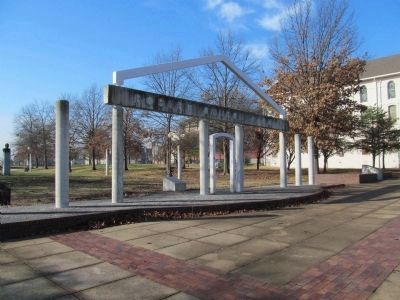
Photographed by Judith Barber, February 5, 2013
4. Robert Church Park
Marker is located to the left of the entrance to the park.
Credits. This page was last revised on February 7, 2023. It was originally submitted on February 15, 2013, by Judith Barber of Marietta, Georgia. This page has been viewed 980 times since then and 40 times this year. Photos: 1, 2. submitted on February 15, 2013, by Judith Barber of Marietta, Georgia. 3. submitted on August 12, 2015, by Allen C. Browne of Silver Spring, Maryland. 4. submitted on February 15, 2013, by Judith Barber of Marietta, Georgia. • Bernard Fisher was the editor who published this page.
