Surrey in Metro Vancouver, British Columbia — Canada’s West Coast (North America)
Historic Port Elgin
Transportation & Communication
| — | Part of Surrey’s Built Heritage | — |
Photographed by Barry Swackhamer, October 30, 2012
1. Port Elgin Marker
Photo captions:
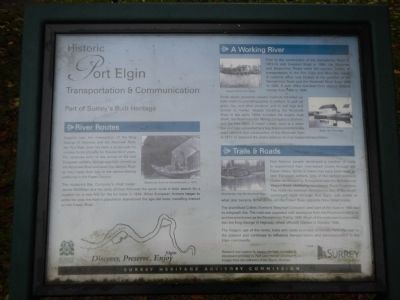
Skokomish Summer Encampment, c, 1912 (left, center); Supply Vessel S.S. Stella (right, top); Water Taxi, Port Elgin (right, center); Early bridge over the Nicomekl River (right, bottom).
Skokomish Summer Encampment, c, 1912 (left, center); Supply Vessel S.S. Stella (right, top); Water Taxi, Port Elgin (right, center); Early bridge over the Nicomekl River (right, bottom).
River Routes
Located near the intersection of the King George VI Highway and the Nicomekl River, the Port Elgin area has been a crossroads for various forms of traffic for thousands of years. For centuries prior to the arrival of the first European settlers, Natives regularly canoed up the Nicomekl River and down the Salmon River as they made their way to the salmon-fishing platforms in the Frasier Canyon.
The Hudson’s Bay Company’s chief trader James McMillan and his party of men followed the same route in their search for a location for a new fort for the fur trade in 1824. When European farmers began to settle in the area the native population abandoned the age-old route, traveling instead on the Fraser River.
A Working River
Prior to the construction of the Semiahmoo Road in 1873-74 and Crescent Road in 1884, the Nicomekl and Serpentine Rivers were the primary means of transportation in Port Elgin and Mud Bay areas. A customs office was located at the junction of the Semiahmoo Road and the Nicomekl River from 1880 to 1895. A post office operated from various settlers homes from 1885 to 1909.
Small steam powered
this page online
Trails & Roads
First Nations people developed a number of trails to supplement their river-based routes through the Fraser Valley. Some of these may have been used by later European settlers. One of the earliest overland routes developed by Europeans was the Semiahmoo Wagon Road, plotted by two former Royal Engineers. The route ran between Semiahmoo Bay in the south, continued north through Port Elgin, and ended at what later became Brownsville, on the Fraser River opposite New Westminster.
The short-lived Collins Overland Telegraph Company used part of the route in 1865 for its telegraph line. The road was upgraded
Photographed by Barry Swackhamer, October 30, 2012
2. Port Elgin Marker
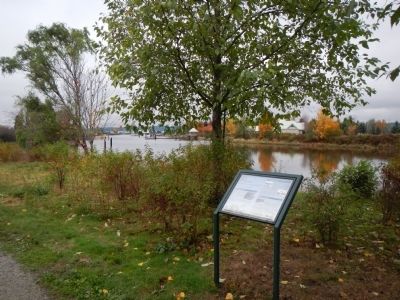
The Nicomekl River is in the background.
The historic use of the rivers, trails and roads provided continuity from the past to the present and continues to influence transportation and communication in the Elgin community.
Erected 2008 by City of Surrey, Surrey Heritage Advisory Commission.
Topics. This historical marker is listed in these topic lists: Communications • Indigenous Peoples and Communities • Roads & Vehicles • Waterways & Vessels. A significant historical year for this entry is 1824.
Location. 49° 4.143′ N, 122° 49.552′ W. Marker is in Surrey, British Columbia, in Metro Vancouver. It can be reached from Elgin Road. This marker is located on the Semaihmoo Trail a short walk from Elgin Road. Touch for map. Marker is in this post office area: Surrey BC V4P 0C2, Canada. Touch for directions.

Regionally, this marker is on the Lower Mainland and in Coast & Mountains. Globally, it is in North America, in the Cascade Range, in the Inside Passage, on the Ring of Fire, on the Pacific Rim, in the Western Hemisphere, in the Western World, and in the Anglosphere. Historically, it finds itself in what was once a British colony.
Other nearby markers. At least 8 other markers are within 16 kilometers of this marker, measured as the crow flies: The Semiahmoo Trail (within shouting distance of this marker); Historic Elgin (approx. 0.3 kilometers away); Historic Stewart Farmhouse (approx. 1.3 kilometers away); Farming History (approx. 1.3 kilometers away); Historic McMillan Expedition (approx. 4.7 kilometers away); Peace Arch (approx. 9 kilometers away); Salmon! (approx. 13.6 kilometers away); The New Westminster Court House and Land Registry Office (approx. 16.1 kilometers away). Touch for a list and map of all markers in Surrey.
Credits. This page was last revised on December 22, 2025. It was originally submitted on November 3, 2012, by Barry Swackhamer of Brentwood, California. This page has been viewed 1,204 times since then and 49 times this year. Last updated on March 11, 2013. Photos: 1, 2. submitted on November 3, 2012, by Barry Swackhamer of Brentwood, California. • Syd Whittle was the editor who published this page.
