North Downtown in Charlottesville, Virginia — The American South (Mid-Atlantic)
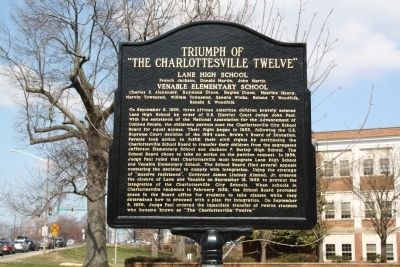
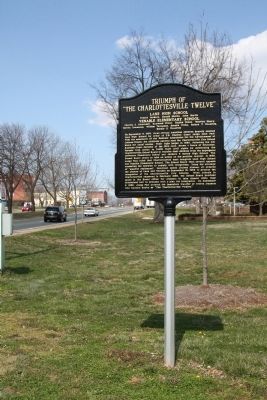
Triumph of “The Charlottesville Twelve”
Photographed by J. J. Prats, March 30, 2013
1. Triumph of “The Charlottesville Twelve” Marker
Lane High School. French Jackson, Donald Martin, John Martin.
Venable Elementary School. Charles E. Alexander, Raymond Dixon, Regina Dixon, Maurice Henry, Marvin Townsend, William Townsend, Sandra Wicks, Roland T. Woodfolk, Ronald E. Woodfolk.
On September 8, 1959, three African American children bravely entered Lane High School by order of U.S. District Court Judge John Paul. With the assistance of the National Association for the Advancement of Colored People, the children’s parents sued the Charlottesville City School Board for equal access. Their fight began in 1955, following the U.S. Supreme Court decision of the 1954 case, Brown v Board of Education. Parents took action to fulfill their civil rights by petitioning the Charlottesville School Board to transfer their children from the segregated Jefferson Elementary School and Jackson P. Burley High School. The School Board chose to take no action on the petition request In 1956, Judge Paul ruled that Charlottesville must integrate Lane High School and Venable Elementary School. The School Board filed several appeals contesting the decision to comply with integration.
this page online
Erected 2012 by City of Charlottesville.
Topics. This historical marker is listed in these topic lists: African Americans • Civil Rights. A significant historical month for this entry is February 1959.
Location. 38° 2.03′ N, 78° 29.02′ W. Marker is in Charlottesville, Virginia. It is in North Downtown. It is at the intersection of McIntire Road and Preston Avenue, on the right when traveling south on McIntire Road. Marker is at the sidewalk and facing the intersection in front of the Albemarle County Office Building, formerly Lane High Shoool. Touch for map. Marker is at or near
Photographed by J. J. Prats, March 30, 2013
2. Triumph of “The Charlottesville Twelve” Marker

Regionally, this marker is in Central Virginia. It is also in the American South and specifically in the Upper South. Globally, it is in North America, the Western Hemisphere, the Western World, and the Anglosphere. Historically, it finds itself in what was once the territory of the Mississippian Culture, one of the original Thirteen Colonies, one of the Confederate States of America, and the Antebellum South.
Other nearby markers. At least 8 other markers are within walking distance of this marker: Dogwood Memorial (within shouting distance of this marker); Jefferson School (approx. 0.2 miles away); Together We Grow (approx. 0.2 miles away); The Carver Inn (approx. ¼ mile away); Nelson Sanitorium (1895-1902) (approx. ¼ mile away); Swanson v. University of Virginia (approx. ¼ mile away); First Presbyterian Church (approx. ¼ mile away); Meriwether Lewis and William Clark (approx. ¼ mile away). Touch for a list and map of all markers in Charlottesville.
Other markers no longer nearby. Charlottesville (was
Photographed by J. J. Prats, March 30, 2013
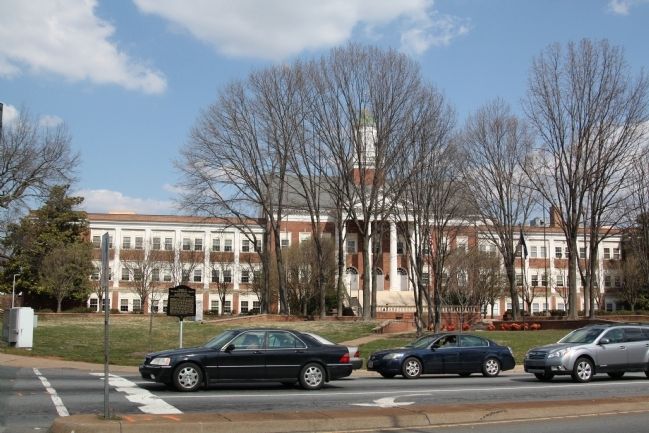
3. The Former Lane High School and Marker
More about this marker. Marker is a one-sided marker, with the blank face towards the former Lane High School, now the Albemarle County Office Building.
Related markers. Click here for a list of markers that are related to this marker. This is a list of Brown v. Board of Education markers.
Also see . . . On Brown's 50th: Why Charlottesville Schools Were Closed. The Hook website entry:
2004 article by Lisa Provence. “Julia Martin is 80 and elegant in the Lankford Avenue home where she’s lived since 1947. She signed on to the Allen lawsuit when her oldest son was attending all-black Burley on Rose Hill Drive. She, too, objected to the idea of her children walking by one high school—Lane—to get to another. Another thing that rankled Martin was weather closures. Because Albemarle County kids—whose buses had to travel country roads—[also] attended Burley, bad weather often closed the school, even if city residents could get there with no difficulty. ‘I paid city taxes,’ says Martin. ‘After a while, it hit me. Why should I be ruled by the county?’ Martin was working as a domestic, and her husband, John, was a waiter at Farmington Country Club when they joined the lawsuit. ‘I didn’t think I was wrong,’ she says. And as for her children, she says, ‘I wasn’t afraid anyone would hurt them.’ She pauses. ‘Maybe I was young and foolish’.” (Submitted on March 31, 2013.)
Credits. This page was last revised on August 17, 2024. It was originally submitted on March 31, 2013, by J. J. Prats of Powell, Ohio. This page has been viewed 1,864 times since then and 50 times this year. Photos: 1, 2, 3. submitted on March 31, 2013, by J. J. Prats of Powell, Ohio.
