Near Alachua in Alachua County, Florida — The American South (South Atlantic)
Santa Fe de Toloca
Photographed by Mike Stroud, March 20, 2013
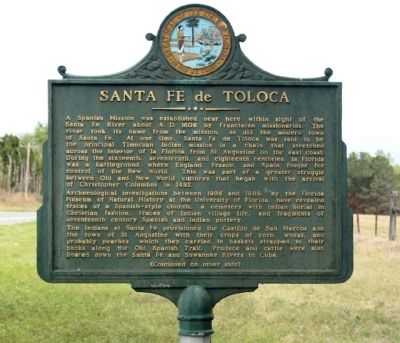
1. Santa Fe de Toloca Marker
Archaeological investigations between 1986 and 1989, by the Florida Museum of Natural History at the University of Florida, have revealed traces of a Spanish-style church, a cemetery with Indian burial in Christian fashion, traces of Indian village life, and fragments of seventeenth century Spanish and Indian pottery.
The Indians at Santa Fe provisioned the Castillo de San Marcos and the town of St. Augustine with their crops of corn, wheat, and probably
this page online
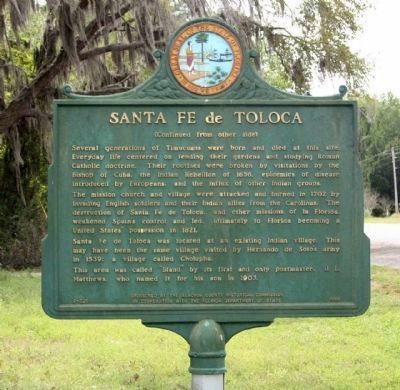
(Reverse text)
Several generations of Timucuans were born and died at this site. Everyday life centered on tending their gardens and studying Roman Catholic doctrine. Their routines were broken by visitations by the Bishop of Cuba, the Indian Rebellion of 1656, epidemics of disease introduced by Europeans, and the influx of other Indian groups.
The mission church and village were attacked and burned in 1702 by invading English soldiers and their Indian allies from the Carolinas. The destruction of Santa Fe de Toloca, and the other missions of la Florida, weakened Spain's control and led, ultimately to Florida becoming a United States' possession in 1821.
Santa Fe de Toloca was located at an existing Indian village. This may have been the same village visited by Hernando de Soto's army in 1539; a village called Cholupaha.
This area was called "Bland" by its first and only postmaster, J.L. Matthews, who named it for his son in 1903.
Erected 1989
Photographed by Mike Stroud, March 20, 2013
2. Santa Fe de Toloca Marker, reverse side
Topics and series. This historical marker is listed in these topic lists: Agriculture • Indigenous Peoples and Communities • Settlements & Settlers. In addition, it is included in the Old Spanish National Trail series list. A significant historical year for this entry is 1606.
Location. 29° 55.474′ N, 82° 30.327′ W. Marker is near Alachua, Florida, in Alachua County. It is on County Road 241 S near NW 294 Avenue, on the left when traveling south. Touch for map. Marker is at or near this postal address: 29210 County Rd 241, Alachua FL 32615, United States of America. Touch for directions.

Regionally, this marker is in North Florida. It is also in the American South. Globally, it is in the North Atlantic Region, North America, a Gulf of Mexico state, the Western Hemisphere, the Western World, and the Anglosphere. Historically, it finds itself in what was once New Spain, the territory of the Mississippian Culture, one of the Confederate States of America, and the Antebellum South.
Other nearby markers. At
Photographed by Mike Stroud, March 20, 2013
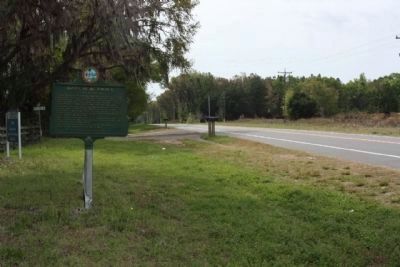
3. Santa Fe de Toloca Marker looking south along County Road 241 S
Photographed by Mike Stroud, March 20, 2013
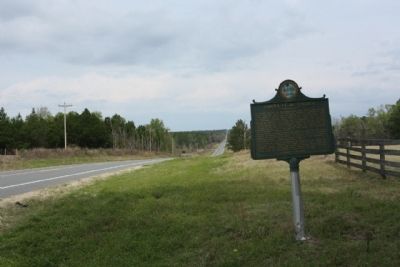
4. Santa Fe de Toloca Marker looking north along County Road 241 S
Credits. This page was last revised on November 19, 2020. It was originally submitted on April 29, 2013, by Mike Stroud of Bluffton, South Carolina. This page has been viewed 1,934 times since then and 144 times this year. Photos: 1, 2, 3, 4. submitted on May 1, 2013, by Mike Stroud of Bluffton, South Carolina.
