
Brickell in Miami in Miami-Dade County, Florida — The American South (South Atlantic)
The Miami Circle at Brickell Point
Photographed by AGS Media, March 16, 2013
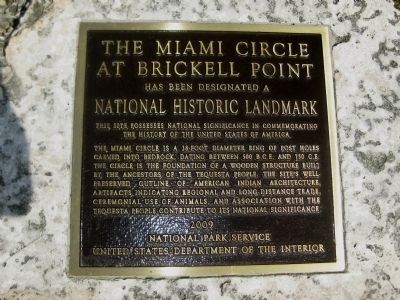
1. The Miami Circle Marker
at Brickell Point
has been designated a
National Historic Landmark
This site possesses national significance in commemorating the history of the United States of America.
The Miami Circle is a 38-foot diameter ring of post holes carved into bedrock, dating between 500 B.C.E. and 750 C.E. The circle is the foundation of a wooden structure built by the ancestors of the Tequesta people. The site's well-preserved outline of American Indian architecture, artifacts indicating regional and long-distance trade, ceremonial use of animals, and association with the Tequesta people contribute to its national significance.
Erected 2009 by the National Park Service and the United States Department of the Interior.
Topics and series. This historical marker is listed in these topic lists: Anthropology & Archaeology • Indigenous Peoples and Communities • Settlements & Settlers. In addition, it is included in the National Historic Landmarks series list.
Location. 25° 46.166′ N, 80° 11.373′ W. Marker is in Miami, Florida, in Miami-Dade County. It is in Brickell.
this page online

Regionally, this marker is in South Florida and on the Gold Coast. It is also in the American South and on the Eastern Seaboard. Globally, it is in the North Atlantic Region, North America, a Gulf of Mexico state, the Western Hemisphere, the Western World, and the Anglosphere. Historically, it finds itself in what was once New Spain, the territory of the Mississippian Culture, one of the Confederate States of America, and the Antebellum South.
Other nearby markers. At
Photographed by AGS Media, March 16, 2013
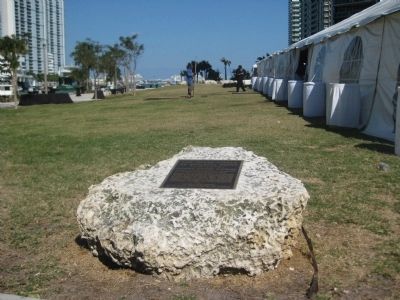
2. The Miami Circle Marker
Another marker is no longer nearby. Brickell Park (was about 500 feet away but has been permanently removed).
More about this marker. The marker is laid atop a block of limestone at the park's west side, near the circular drive, and several hundred feet west of the Miami Circle formation.
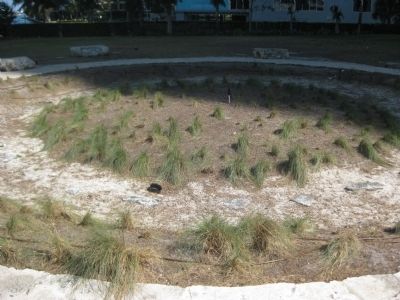
Regarding The Miami Circle at Brickell Point. Discovered in 1998, the Miami Circle is a 38 ft (11.5 m) diameter circle of 24 post holes cut almost two feet into the limestone bedrock, with several additional holes outside the circular group. The ancient building foundation is the only known
Photographed by AGS Media, March 16, 2013
3. The Miami Circle
Before 1998 six low-rise apartment buildings from the 1950s had occupied the site. When those structures were razed in order to erect a high-rise condominium complex, city codes required a routine archaeological field study be done. The unexpected discovery resulting from that study made the site a center of controversy for years to follow. The owner, eager to begin construction, saw his plans stymied as preservationists and community leaders lobbied their governments to intervene and save the circle from destruction. Ultimately, the State of Florida and Miami-Dade County were able to jointly purchase the site from the developer, though the deal would cost a total of $26.7 million.
In 2011, the site was opened as a public park and managed by a local
Photographed by AGS Media, March 16, 2013
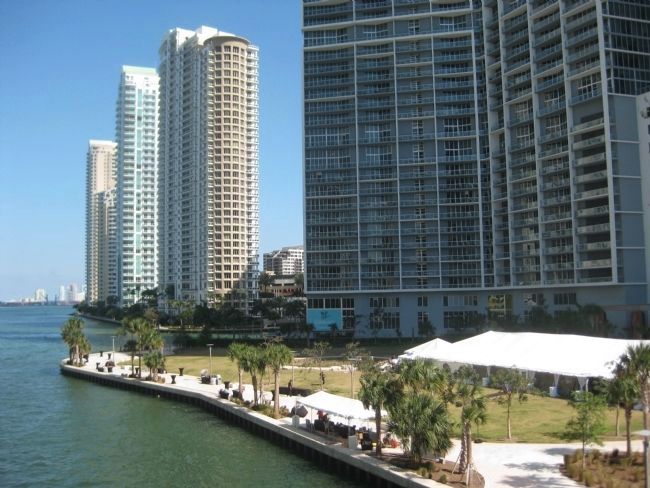
4. The Miami Circle and Brickell Point
Related markers. Click here for a list of markers that are related to this marker. These markers explain the history of the Miami Circle and Brickell Point.
Also see . . .
1. Miami Circle. article on Wikipedia (Submitted on April 14, 2013, by Glenn Sheffield of Tampa, Florida.)
2. Archaeology Projects: Miami Circle. Virtual tour and overview from the Florida Department of State (Submitted on April 14, 2013, by Glenn Sheffield of Tampa, Florida.)
3. Tequesta. Wikipedia article on the Native American tribe (Submitted on April 14, 2013, by Glenn Sheffield of Tampa, Florida.)
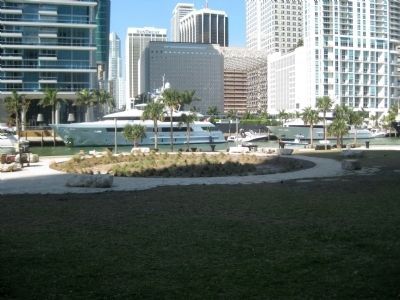
Photographed by AGS Media, March 16, 2013
5. The Miami Circle
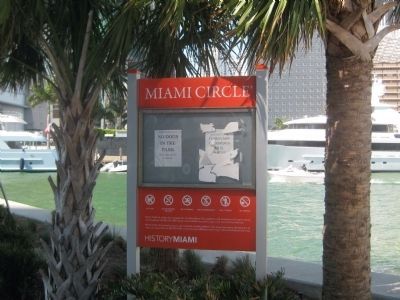
Photographed by AGS Media, March 16, 2013
6. The Miami Circle
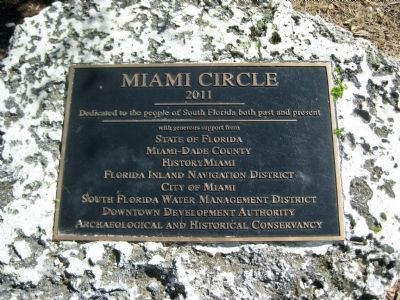
Photographed by AGS Media, March 16, 2013
7. Miami Circle Park Dedication Plaque
2011
Dedicated to the people of South Florida both past and present
with generous support from
State of Florida
Miami-Dade County
HistoryMiami
Florida Inland Navigation District
City of Miami
South Florida Water Management District
Downtown Development Authority
Archaeological and Historical Conservancy

Photographed by Ian Lefkowitz, January 24, 2026
8. The Miami Circle at Brickell Point Marker
The historic marker, seen in position in front of the mouth of the Miami River.
Credits. This page was last revised on February 3, 2026. It was originally submitted on April 14, 2013, by Glenn Sheffield of Tampa, Florida. This page has been viewed 2,334 times since then and 101 times this year. Last updated on May 31, 2013, by Glenn Sheffield of Tampa, Florida. Photos: 1, 2, 3, 4, 5, 6, 7. submitted on April 14, 2013, by Glenn Sheffield of Tampa, Florida. 8. submitted on January 26, 2026, by Ian Lefkowitz of New York, New York. • Bill Pfingsten was the editor who published this page.
