University of Maryland in Baltimore, Maryland — The American Northeast (Mid-Atlantic)
A Monument to the Memory of Edgar Allan Poe
Photographed by Christopher Busta-Peck, March 26, 2008
1. Left half of marker
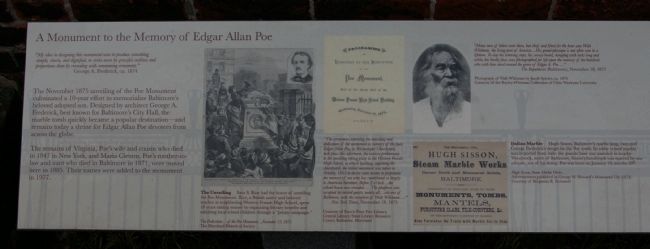
"My idea in designing this monument was to produce something simple, chaste, and dignified, to strike more by graceful outlines and proportions than by crowding with unmeaning ornament."
George A. Frederick, ca. 1874
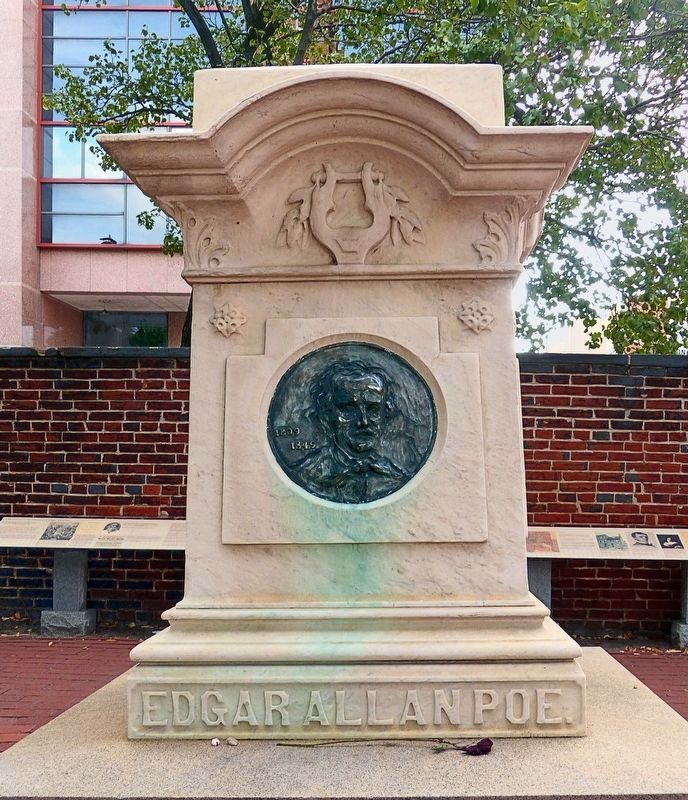
The November 1875 unveiling of the Poe Monument culminated a 10-year effort to memorialize Baltimore's beloved adopted son. Designed by architect George A. Frederick, best known for Baltimore's City Hall, the marble tomb quickly became a popular destination - and remains today a shrine for Edgar Allan Poe devotees from across the globe.
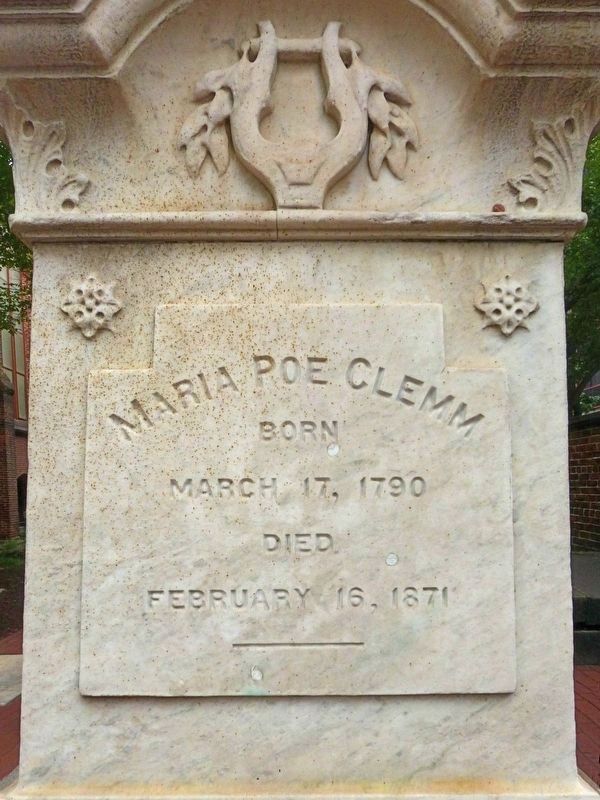
The remains of Virginia, Poe's wife and cousin who died in 1847 in New York, and Maria Clemm, Poe's mother-in-law and aunt who died in Baltimore in 1871, were moved here in 1885. Their names were added to the monument in 1977.
[print]
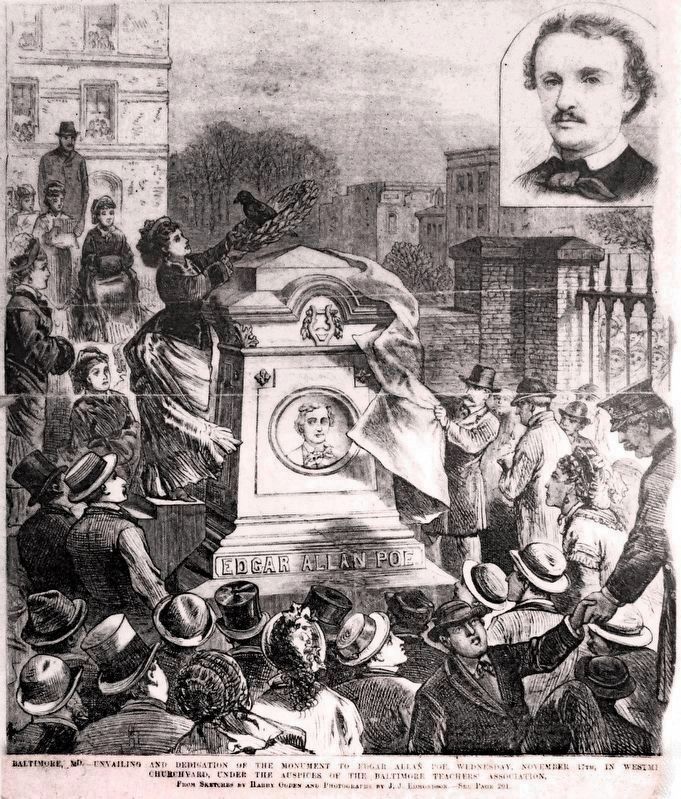
The Unveiling Sara S. Rice had the honor of unveiling the Poe Monument. Rice, a British native and beloved teacher at neighboring Western Female High School, spent 10 years raising money by organizing literary benefits and soliciting local school children through a "penny campaign."
The Dedication ... of the Poe Monument ... November 17, 1875
The
this page online
[program]
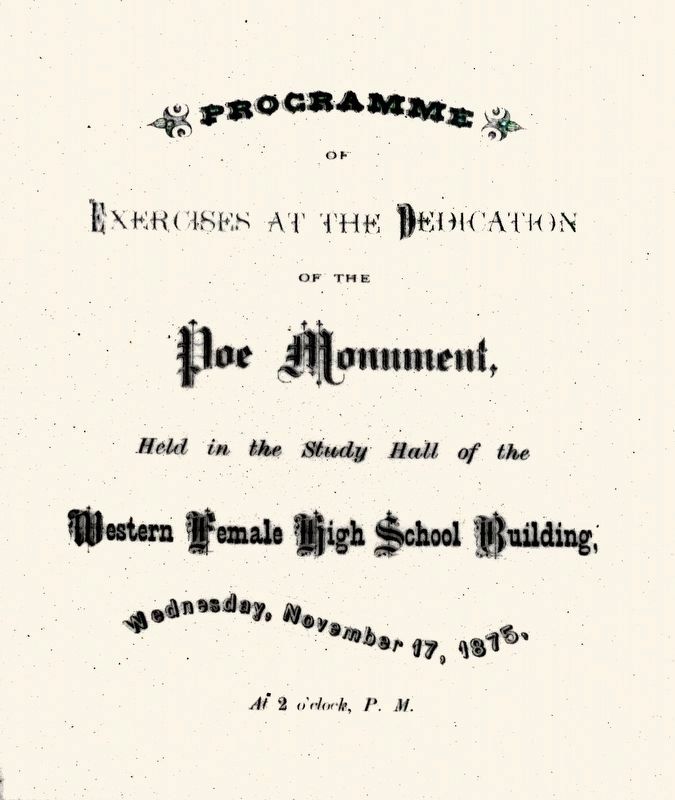
"The ceremonies attending the unveiling and dedication of the monument in memory of the poet, Edgar Alan Poe, in Westminster Churchyard, took place this afternoon, the exercise preliminary to the unveiling taking place in the Western Female High School, in which building, adjoining the churchyard, the initial movement was taken in October, 1865 to devise some means to perpetuate the memory of one who has contributed so largely to American literature. Before 2 o'clock ... the school-house was crowded ... The platform was occupied by invited guests, nearly all ... citizens of Baltimore, with the exception of Walt Whitman..."
New York Times, November 18, 1875
Courtesy of the Enoch Pratt Free Library, Central Library / State Library Resource Center, Baltimore, Maryland
[photograph]
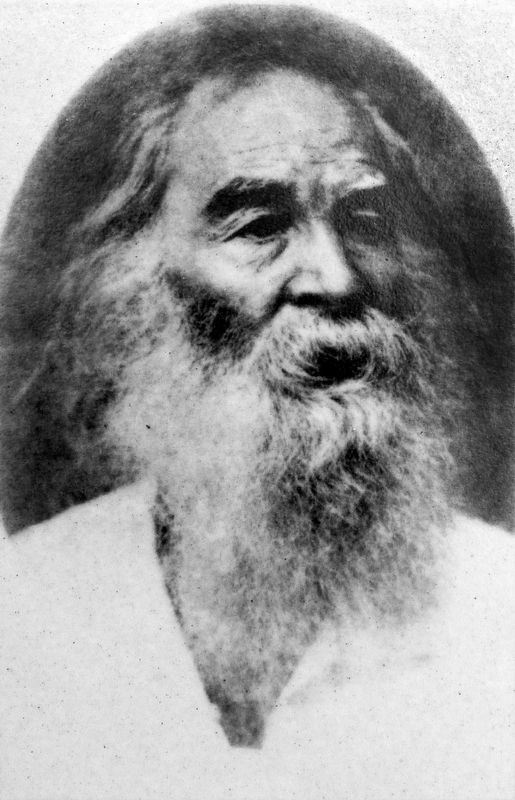
Many men of letters were there, but chief and fittest for the hour was Walt Whitman, the living poet of America ... His grand physique is not often seen in a lifetime. To-day his tottering steps, his snowy beard, mingling with locks long and white, his kindly face, was photographed for life upon the memory of the hundreds who with hime stood around the grave of Edgar A. Poe..."
The Republican
Photographed by Christopher Busta-Peck, March 26, 2008
2. Right half of marker
Photograph of Walt Whitman by Jacob Spieler, ca. 1876
Courtesy of the Bayley-Whitman Collection of Ohio Wesleyan University
[advertisement]
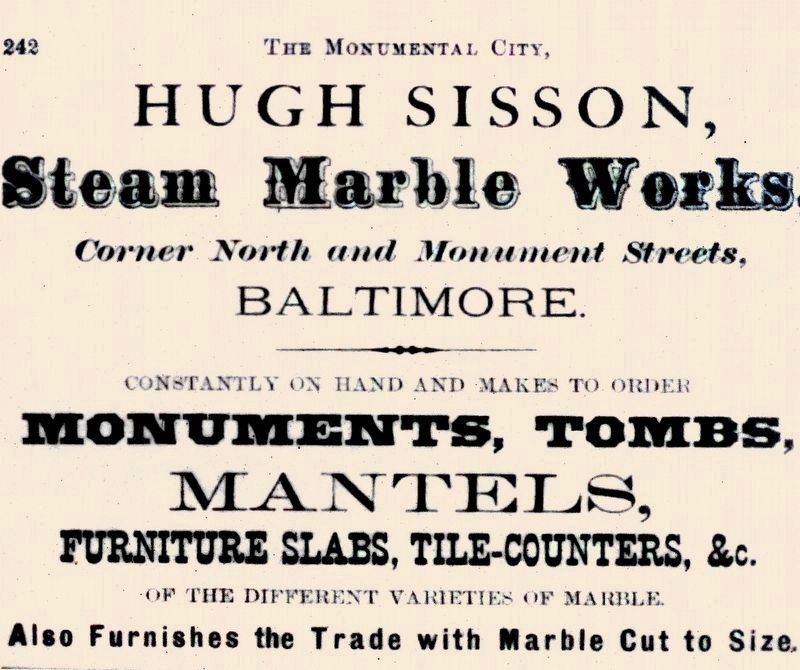
Italian Marble Hugh Sisson, Baltimore's marble king, executed George Frederick's design for the Poe tomb. Its white veined marble was imported from Italy; the granite base was quarried in nearby Woodstock, north of Baltimore. Sisson's handiwork was marred by one mistake, not of his doing: Poe was born on January 19, not the 20th.
Hugh Sisson, Steam Marble Works...
Advertisement published in George W. Howard's Monumental City (1874)
Courtesy of Benjamin R. Krimmell
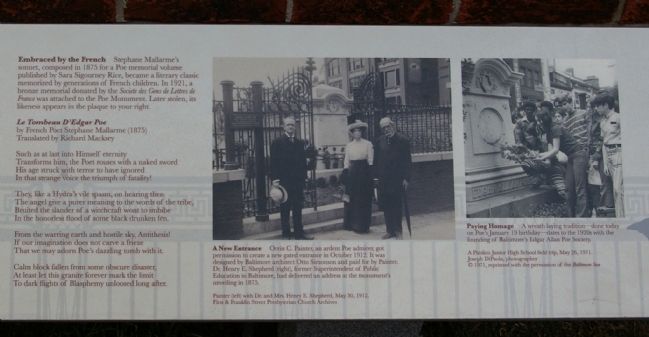
Embraced by the French Stephane Mallarme's sonnet, composed in 1875 for a Poe memorial volume published by Sara Sigourney Rice, became a literary classic memorized by generations of French children. In 1921, a bronze memorial donated by the Societe des Gens de Letteres de France was attached to the Poe Monument. Later stolen, its likeness appears in the plaque to your right.
Le Tombeau D'Edgar Poe
by French Poet Stephane Mallarme (1875)
Translated by Richard Macksey
Such as at last into Himself eternity
Transforms
Photographed by Christopher Busta-Peck, March 26, 2008
3. The marker
His age struck with terror to have ignored
In that strange voice the triumph of fatality!
They, like a Hydra's vile spasm, on hearing then
The angel give a purer meaning to the words of the tribe,
Bruited the slander of a witchcraft wont to imbibe
In the honorless flood of some black drunken fen.
From the warring earth and hostile sky, Antithesis!
If our imagination does not carve a frieze
That we may adorn Poe's dazzling tomb with it.
Calm block fallen from some obscure disaster,
At least let this granite forever mark the limit
To dark flights of Blasphemy unloosed long after.
[photograph]
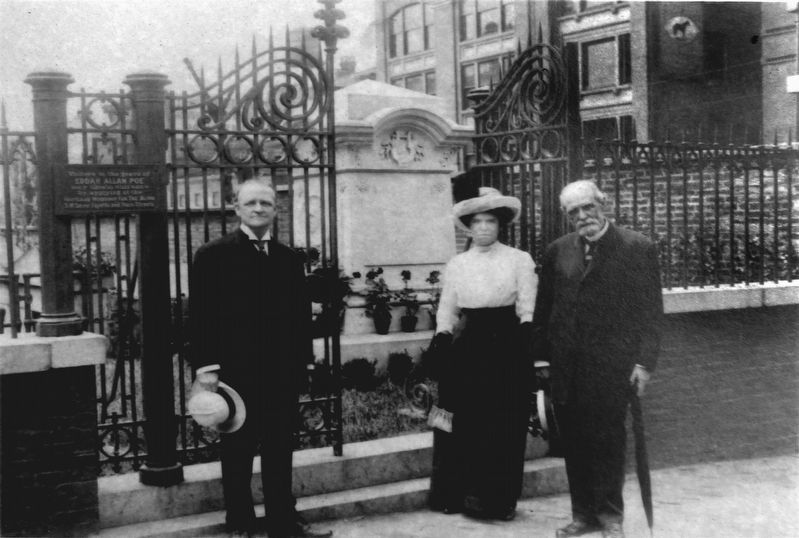
A New Entrance Orrin C. Painter, an ardent Poe admirer, got permission to create a new gated entrance in October 1912. It was designed by Baltimore architect Otto Simpson and paid for by Painter. Dr. Henry E. Shepherd (right), former Superintendent of Public Education in Baltimore, had delivered an address at the monument's unveiling in 1875.
Painter (left ) with Dr. and Mrs. Henry E. Shepherd, May 30, 1912.
First & Franklin Street Presbyterian Church Archives
[photograph]
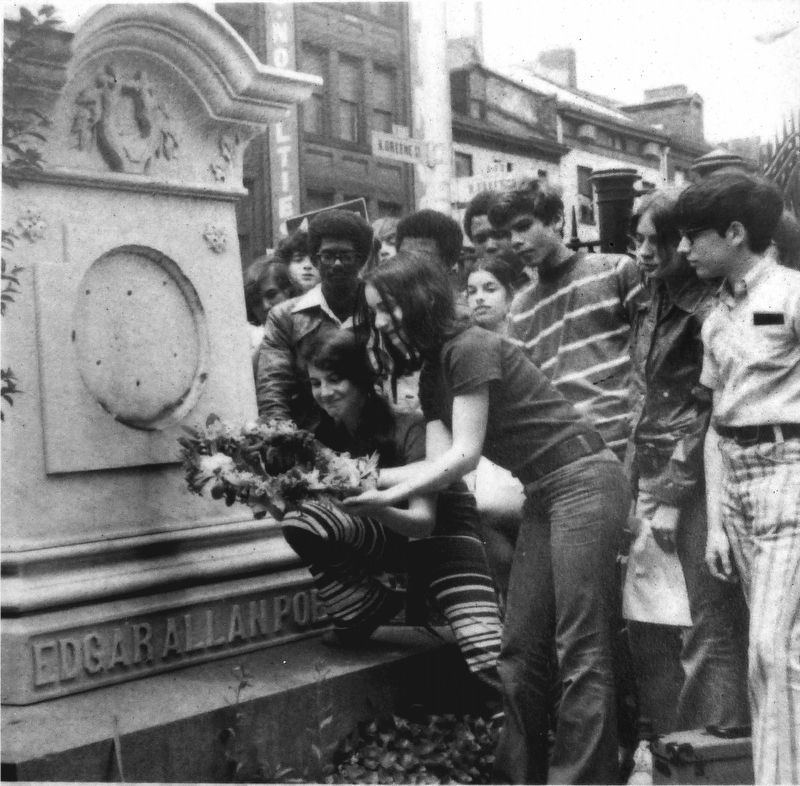
Paying Homage A wreath
Photographed by Christopher Busta-Peck
4. Marker is to the left, behind Poe's grave
A Pimlico Junior High School field trip, May 26, 1971.
Joseph DiPaola, photographer
Copyright 1971 reprinted with permission of the Baltimore Sun
Topics. This historical marker is listed in these topic lists: Arts, Letters, Music • Cemeteries & Burial Sites. A significant historical month for this entry is January 1717.
Location. 39° 17.41′ N, 76° 37.418′ W. Marker is in Baltimore, Maryland. It is in University of Maryland. It can be reached from the intersection of West Fayette Street and North Greene Street. Marker is on the grounds of Westminster Hall and Burying Ground. Touch for map. Marker is at or near this postal address: 515 W Fayette St, Baltimore MD 21201, United States of America. Touch for directions.

Regionally, this marker is in Central Maryland. It is also in the American Mid-Atlantic, in the Chesapeake Bay Region, and on the Eastern Seaboard. Globally, it is in the North Atlantic Region, North America, the Western Hemisphere, the Western World, and the Anglosphere. Historically,
Photographed by Allen C. Browne, May 29, 2017
5. The Unveiling
Sara S. Rice had the honor of unveiling the Poe Monument. Rice, a British native and beloved teacher at neighboring Western Female High School, spent 10 years raising money by organizing literary benefits and soliciting local school children through a “penny campaign.”
The Dedication … of the Poe Monument … November 17, 1875
The Maryland Historical SocietyClose-up of image on marker
The Dedication … of the Poe Monument … November 17, 1875
The Maryland Historical Society
Other nearby markers. At least 26 other markers are within walking distance of this marker: A La Memorie D’Edgar Allan Poe (here, next to this marker); Poe’s Baltimore (here, next to this marker); Among the Illustrious Men (here, next to this marker); Westminster Hall & Burying Ground: Where Baltimore's History Rests in Peace (here, next to this marker); Westminster Church and Cemetery (a few steps from this marker); An 18th-Century Burying Ground (a few steps from this marker); Final Rest (a few steps from this marker); John McDonogh (a few steps from this marker); The McDonoghs of Baltimore (a few steps from this marker); “…a truly affectionate wife” (a few steps from this marker); Building Atop the Burying Ground (a few steps from this marker); The Gilmors (within shouting distance of this marker); Infusing Style and Sophistication: The Influence of Maximilian Godefroy (within shouting distance of this marker); The Carriage Gates of Westminster Burying Ground (within shouting distance of this marker); The Sleep of Young Innocents
Photographed by Allen C. Browne, May 29, 2017
6. Programme
“The ceremonies attending the unveiling and dedication of the monument in memory of the poet, Edgar Alan Poe, in Westminster Churchyard, took place this afternoon, the exercise preliminary to the unveiling taking place in the Western Female High School, in which building, adjoining the churchyard, the initial movement was taken in October, 1865 to devise some means to perpetuate the memory of one who has contributed so largely to American literature. Before 2 o'clock ... the school-house was crowded ... The platform was occupied by invited guests, nearly all … citizens of Baltimore, with the exception of Walt Whitman…”
New York Times, November 18, 1875
Courtesy of the Enoch Pratt Free Library, Central Library / State Library Resource Center, Baltimore, MarylandClose-up of image on marker
New York Times, November 18, 1875
Courtesy of the Enoch Pratt Free Library, Central Library / State Library Resource Center, Baltimore, Maryland
Photographed by Allen C. Browne, May 29, 2017
7. Walt Whitman
“Many men of letters were there, but chief and fittest for the hour was Walt Whitman, the living poet of America … His grand physique is not often seen in a lifetime. To-day his tottering steps, his snowy beard, mingling with locks long and white, his kindly face, was photographed for life upon the memory of the hundreds who with him stood around the grave of Edgar A. Poe…” — The Republican (Baltimore), November 18, 1875
Photograph of Walt Whitman by Jacob Spieler, ca. 1876
Courtesy of the Bayley-Whitman Collection of Ohio Wesleyan UniversityClose-up of image on marker
Photograph of Walt Whitman by Jacob Spieler, ca. 1876
Courtesy of the Bayley-Whitman Collection of Ohio Wesleyan University
Photographed by Allen C. Browne, May 29, 2017
8. Italian Marble
Hugh Sisson, Baltimore's marble king, executed George Frederick's design for the Poe tomb. Its white veined marble was imported from Italy; the granite base was quarried in nearby Woodstock, north of Baltimore. Sisson's handiwork was marred by one mistake, not of his doing: Poe was born on January 19, not the 20th.
Hugh Sisson, Steam Marble Works…
Advertisement published in George W. Howard's Monumental City (1874)
Courtesy of Benjamin R. KrimmellClose-up of image on marker
Hugh Sisson, Steam Marble Works…
Advertisement published in George W. Howard's Monumental City (1874)
Courtesy of Benjamin R. Krimmell
Photographed by Allen C. Browne, May 29, 2017
9. A New Entrance
Orrin C. Painter, an ardent Poe admirer, got permission to create a new gated entrance in October 1912. It was designed by Baltimore architect Otto Simpson and paid for by Painter. Dr. Henry E. Shepherd (right), former Superintendent of Public Education in Baltimore, had delivered an address at the monument's unveiling in 1875.
Painter (left ) with Dr. and Mrs. Henry E. Shepherd, May 30, 1912.
First & Franklin Street Presbyterian Church ArchivesClose-up of photo on marker
Painter (left ) with Dr. and Mrs. Henry E. Shepherd, May 30, 1912.
First & Franklin Street Presbyterian Church Archives
Photographed by Allen C. Browne, May 29, 2017
10. Paying Homage
A wreath laying tradition — done today on Poe's January 19 birthday — dates to the 1920s with the founding of Baltimore's Edgar Allan Poe Society.
A Pimlico Junior High School field trip, May 26, 1971.
Joseph DiPaola, photographer
Copyright 1971 reprinted with permission of the Baltimore SunClose-up of photo on marker
A Pimlico Junior High School field trip, May 26, 1971.
Joseph DiPaola, photographer
Copyright 1971 reprinted with permission of the Baltimore Sun
Photographed by Allen C. Browne, September 5, 2015
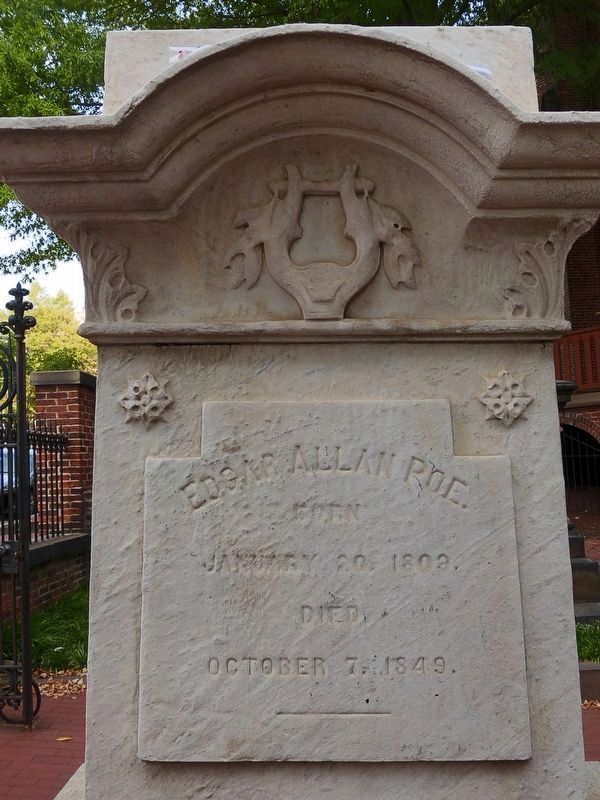
11. Edgar Allan Poe.
January 20, 1809
Died
October 7, 1849.
Photographed by Allen C. Browne, May 29, 2017
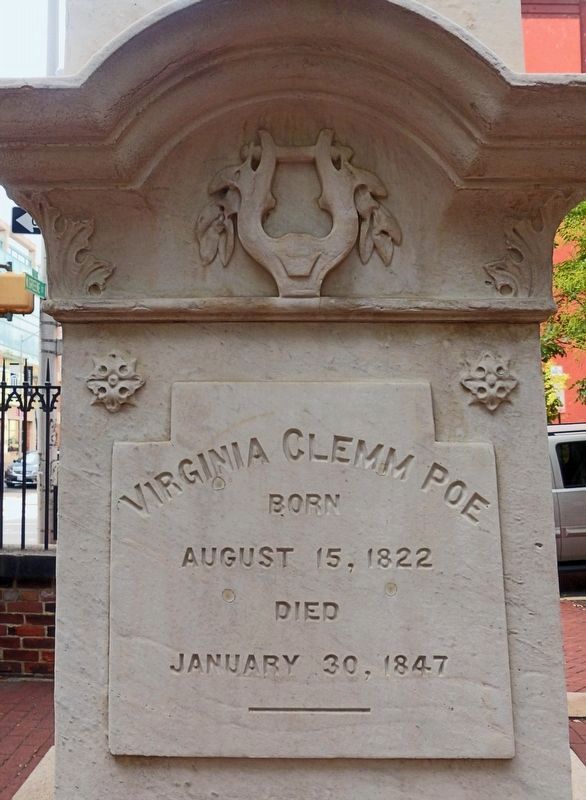
12. Virginia Clemm Poe
August 15, 1822
Died
January 30, 1847
Photographed by Allen C. Browne, May 29, 2017
13. Maria Poe Clemm
March 17, 1790
Died
February 16, 1871
Photographed by Allen C. Browne, September 5, 2015
14. Edgar Allan Poe Monument
Photographed by Allen C. Browne, September 5, 2015
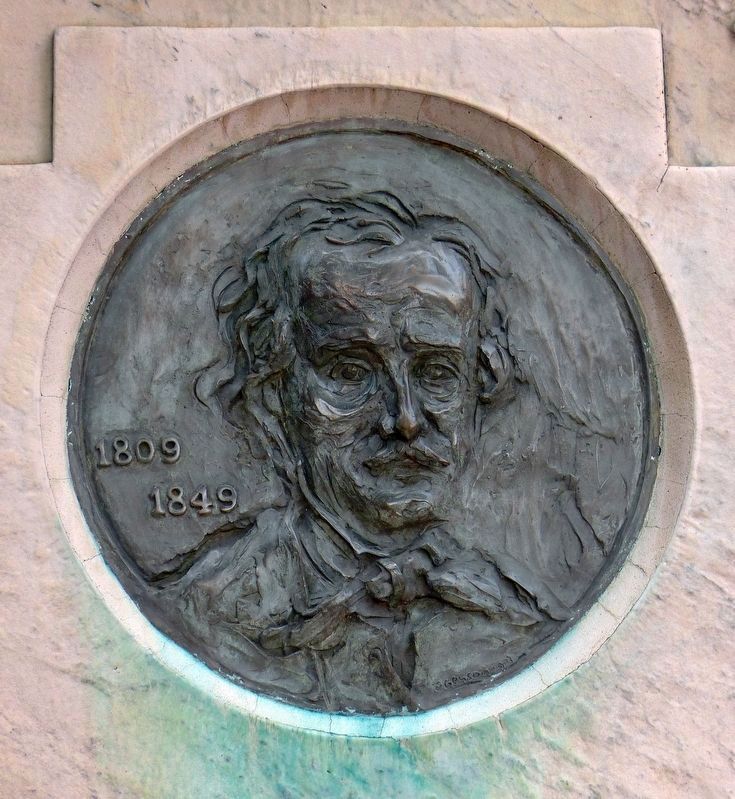
15. Edgar Allan Poe, 1809 1849
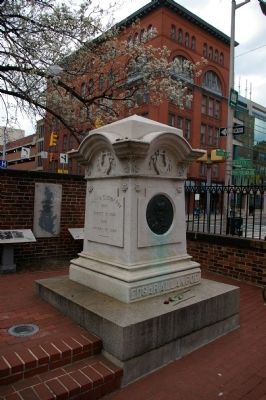
The bas-relief bust of Poe on the Poe Monument was originally carved of marble by Frederick Volck. The weathered marble bust was replaced in 1938 by a bronze bust. The 1938 bronze bust was stolen and replaced in the 1970s. The original marble bust is in the Edgar Allan Poe House and Museum.
Credits. This page was last revised on February 20, 2021. It was originally submitted on March 26, 2008, by Christopher Busta-Peck of Shaker Heights, Ohio. This page has been viewed 6,084 times since then and 119 times this year. Photos: 1, 2, 3. submitted on April 3, 2008, by Christopher Busta-Peck of Shaker Heights, Ohio. 4. submitted on March 27, 2008, by Christopher Busta-Peck of Shaker Heights, Ohio. 5, 6, 7. submitted on May 31, 2017, by Allen C. Browne of Silver Spring, Maryland. 8, 9, 10. submitted on June 1, 2017, by Allen C. Browne of Silver Spring, Maryland. 11, 12, 13. submitted on June 14, 2017, by Allen C. Browne of Silver Spring, Maryland. 14, 15. submitted on June 16, 2017, by Allen C. Browne of Silver Spring, Maryland.
