North Newport News , Virginia — The American South (Mid-Atlantic)
Two USCT Heroes
Freedom in Their Bones
Photographed by Bernard Fisher, July 20, 2013
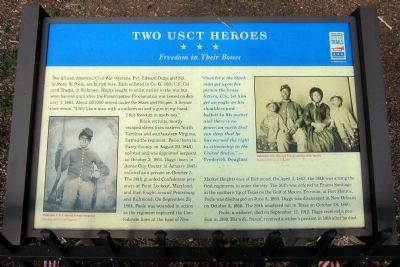
1. Two USCT Heroes CWT Marker
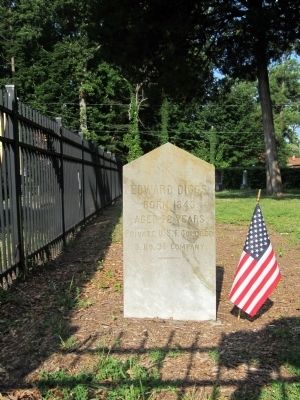
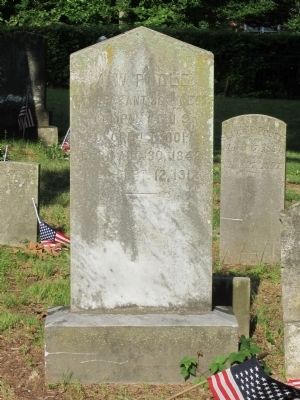
Two African American Civil War veterans, Pvt. Edward Diggs and Sgt. Anthony W. Poole, are buried here. Each enlisted in Co. G, 36th U.S. Colored Troops, in Yorktown. Blacks sought to enlist earlier in the war but were banned until after the Emancipation Proclamation was issued on January 1, 1863. About 200,000 served under the Stars and Stripes. A former slave wrote, “I felt like a man with a uniform on and a gun in my hand. I felt freedom in my bones.”
Black recruits, mostly escaped slaves from eastern North Carolina and southeastern Virginia, formed the regiment. Poole (born in Surry County on August 30, 1845) enlisted and was appointed sergeant on October 3, 1863. Diggs (born in James City County in January 1845) enlisted as a private on October 5. The 36th guarded Confederate prisoners at Point Lookout, Maryland, and then fought around Petersburg and Richmond. On September 29, 1864, Poole was wounded in action as the regiment captured the Confederate lines at the base of New Market Heights east of Richmond. On April 3, 1865, the 36th was among the first regiments to enter the city. The 36th was ordered to Brazos
this page online
Poole, a widower, died on September 12, 1912. Diggs received a pension in 1890. His wife, Susan, received a widow’s pension in 1914 after he died.
“Once let a the black man get upon his person the brass letters, U.S., let him get an eagle on his shoulders and bullets in his pocket and there is no power on earth that can deny that he has earned the right to citizenship in the United States.” – Frederick Douglass
(captions)
Unknown U.S. Colored Troops sergeant Courtesy Library of Congress
Unknown U.S. Colored Troops soldier with family Courtesy Library of Congress
Erected by Virginia Civil War Trails.
Topics and series. This historical marker is listed in these topic lists: African Americans • Cemeteries & Burial Sites • War, US Civil. In addition, it is included in the Virginia Civil War Trails series list. A significant historical month for this entry is January 1861.
Location. 37° 7.232′ N, 76° 31.363′ W. Marker is in Newport News, Virginia.
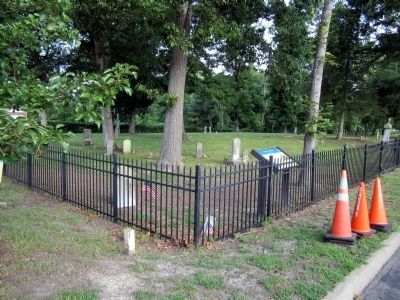
Photographed by Bernard Fisher, July 20, 2013
2. Two USCT Heroes CWT Marker

Regionally, this marker is on Virginia’s Peninsula, in Hampton Roads, in Coastal Virginia, and in the Hampton Roads Metropolitan Area. It is also in the American South, specifically in the Upper South, in the Tidewater, and on the Eastern Seaboard. Globally, it is in the North Atlantic Region, North America, the Western Hemisphere, the Western World, and the Anglosphere. Historically, it finds itself in what was once the territory of the Mississippian Culture, one of the original Thirteen Colonies, one of the Confederate States of America, and the Antebellum South.
Other nearby markers. At least 8 other markers are within 2 miles of this marker, measured as the crow flies: Church Bell (within shouting distance of this marker); Providence Mennonite Church (approx. 0.9 miles away); Mathews Mill (approx. 1.1 miles away); Young’s Mill
Photographed by Bernard Fisher, July 20, 2013
3. Pvt. Edward Diggs gravesite
Photographed by Bernard Fisher, July 20, 2013
4. Sgt. Anthony W. Poole gravesite
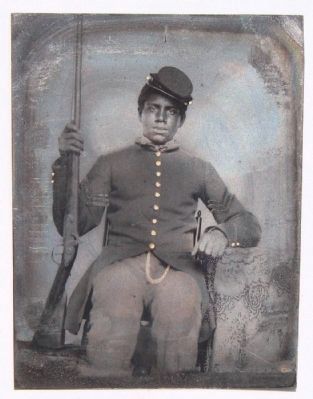
circa 1863
5. Unidentified African American soldier in Union sergeant uniform holding a rifle
Library of Congress [LC-DIG-ppmsca-27058]
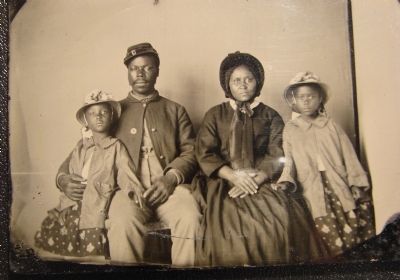
circa 1863
6. Unidentified African American soldier in Union uniform with wife and two daughters
Library of Congress [LC-DIG-ppmsca-26454]
Credits. This page was last revised on June 4, 2026. It was originally submitted on July 21, 2013, by Bernard Fisher of Richmond, Virginia. This page has been viewed 1,629 times since then and 35 times this year. Photos: 1, 2, 3, 4, 5, 6. submitted on July 21, 2013, by Bernard Fisher of Richmond, Virginia.
