Downtown in Frederick in Frederick County, Maryland — The American Northeast (Mid-Atlantic)
Capital For A Summer
Foiling Maryland Secession
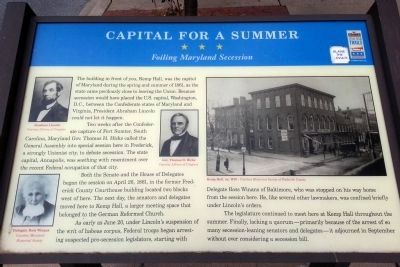
Photographed by Dan Fisher, August 1, 2013
1. Capital For A Summer Marker
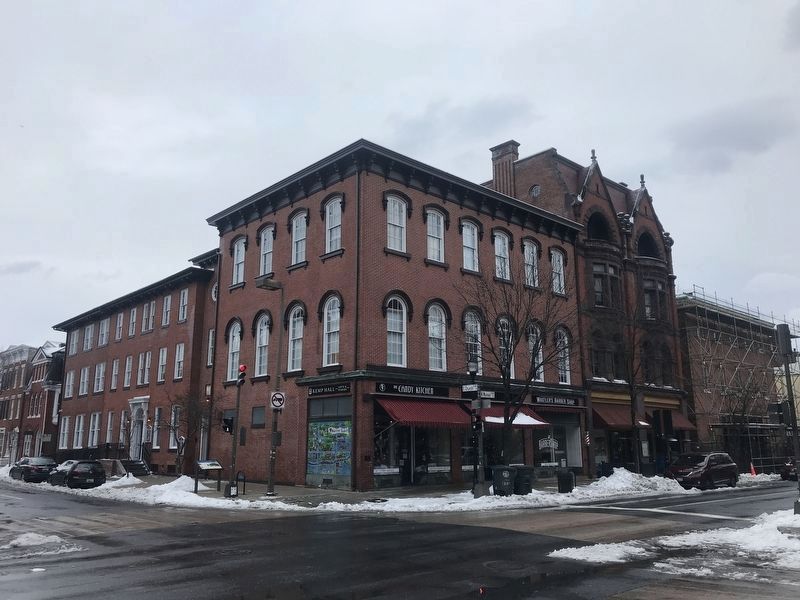
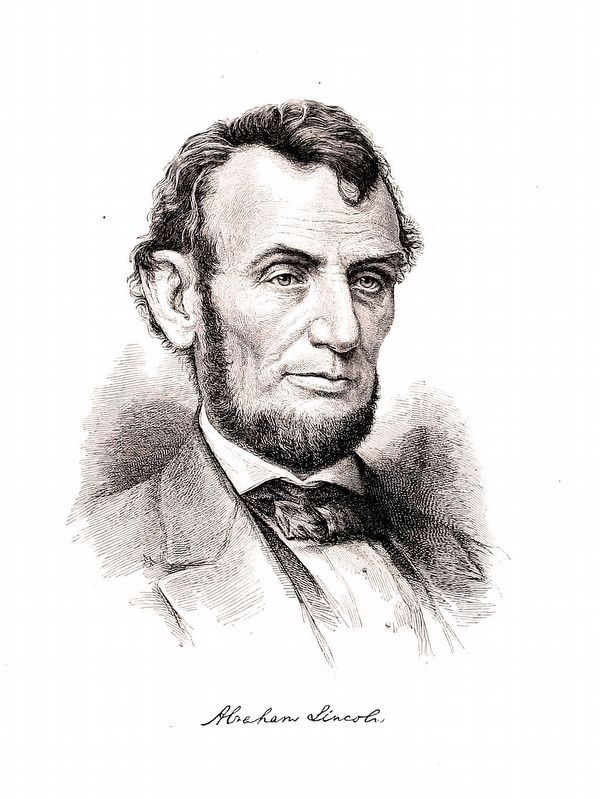
The building in front of you, Kemp Hall, was the capitol of Maryland during the spring and summer of 1861, as the state came perilously close to leaving the Union. Because secession would have placed the U.S. capital, Washington, D.C. between the Confederate states of Maryland and Virginia, President Abraham Lincoln could not let it happen.
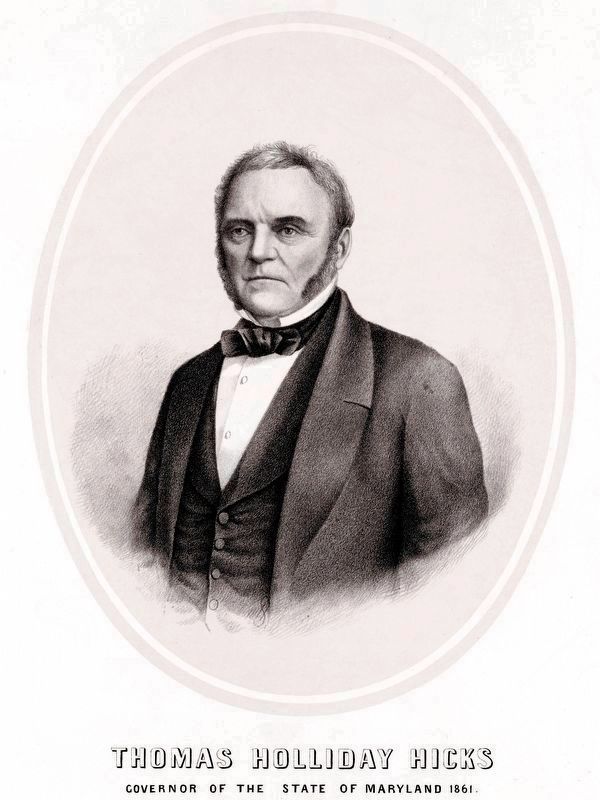
Two weeks after the Confederate capture of Fort Sumter, South Carolina, Maryland Gov. Thomas H. Hicks called the General Assembly into special session here in Frederick, a strongly Unionist city to debate secession. The state capital, Annapolis, was seething with resentment over the recent Federal occupation of that city.
Both the Senate and the House of Delegates began the session on April 26, 1861, in the former Frederick County Courthouse building located two blocks west of here. The next day, the senators and delegates moved here to Kemp Hall, a larger meeting space that belonged to the German Reformed Church.
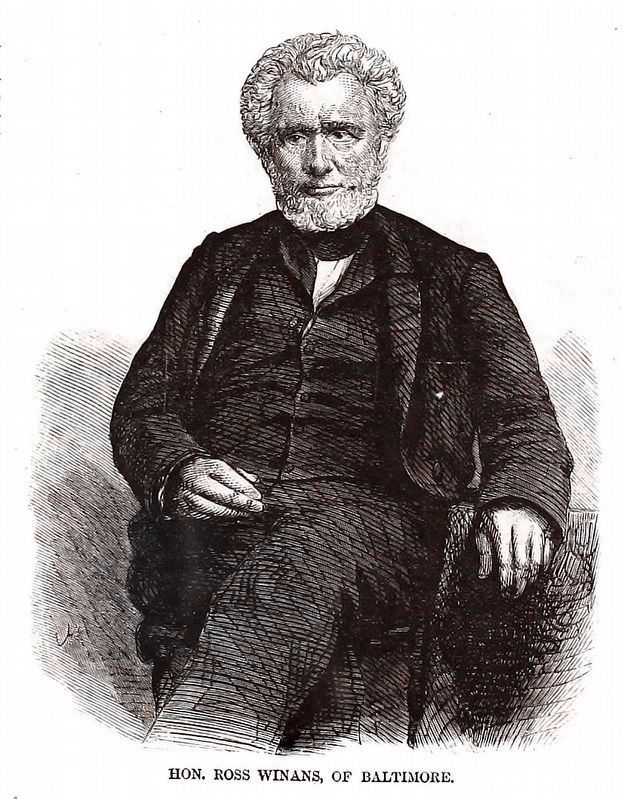
As early as June 20, under Lincoln’s suspension of the writ of habeas corpus, Federal troops began arresting suspected pro-secession legislators, starting with Delegate
this page online
The legislature continued to meet here at Kemp Hall throughout the summer. Finally, lacking a quorum—primarily because of the arrest of so many secession-leaning senators and delegates—it adjourned in September without ever considering a secession bill.
Erected by Maryland Civil War Trails.
Topics and series. This historical marker is listed in this topic list: War, US Civil. In addition, it is included in the Former U.S. Presidents: #16 Abraham Lincoln, and the Maryland Civil War Trails series lists. A significant historical month for this entry is April 1925.
Location. This marker has been replaced by another marker nearby. It was located near 39° 24.916′ N, 77° 24.64′ W. Marker was in Frederick, Maryland, in Frederick County. It was in Downtown. It was at the intersection of East Church Street and North Market Street, on the right when traveling east on East Church Street. Touch for map. Marker was at or near this postal address: 2 E Church St, Frederick MD 21701, United
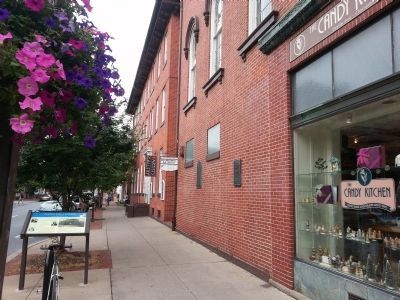
Photographed by Dan Fisher, August 1, 2013
2. Kemp Hall at E Church St & N Market St

Regionally, this marker was in the Washington Metropolitan Area and in Central Maryland. It was also in the American Mid-Atlantic. Globally, it was in North America, the Western Hemisphere, the Western World, and the Anglosphere. Historically, it found itself in what was once one of the original Thirteen Colonies and also the Antebellum South.
Other nearby markers. At least 8 other markers are within walking distance of this location: Kemp Hall (here, next to this marker); Capital for a Summer (here, next to this marker); In April 1861 The Legislature Of Maryland Met Here In Special Session (here, next to this marker); The News (a few steps from this marker); Cultures Meet (within shouting distance of this marker); John Thomas Schley (within shouting distance of this marker); Hood College (within shouting distance of this marker); The Congregation in Frederick (about 300 feet away, measured in a direct line). Touch for a list and map of all markers in Frederick.
Related marker. Click here for another marker that is related to this marker. This marker has been replaced with
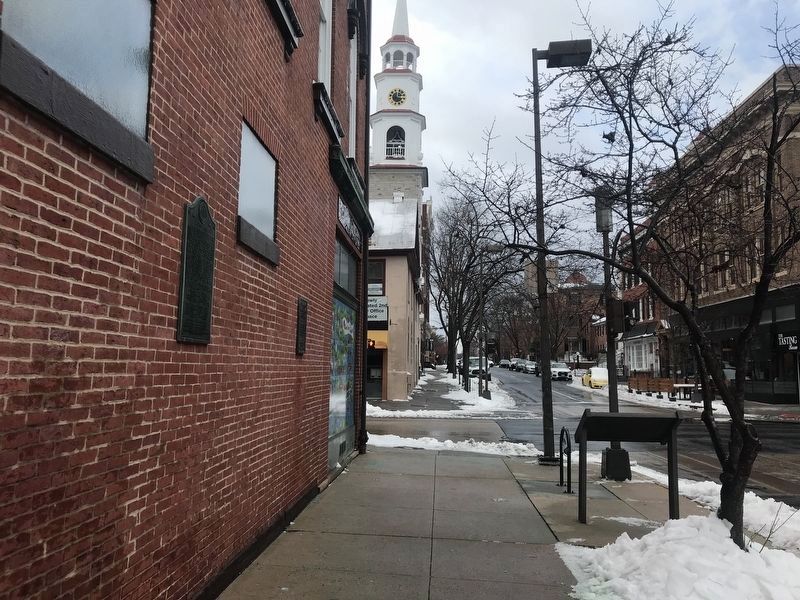
Photographed by Adam Margolis, January 17, 2022
3. Capital For A Summer Marker
Marker can be seen on the right along the sidewalk.
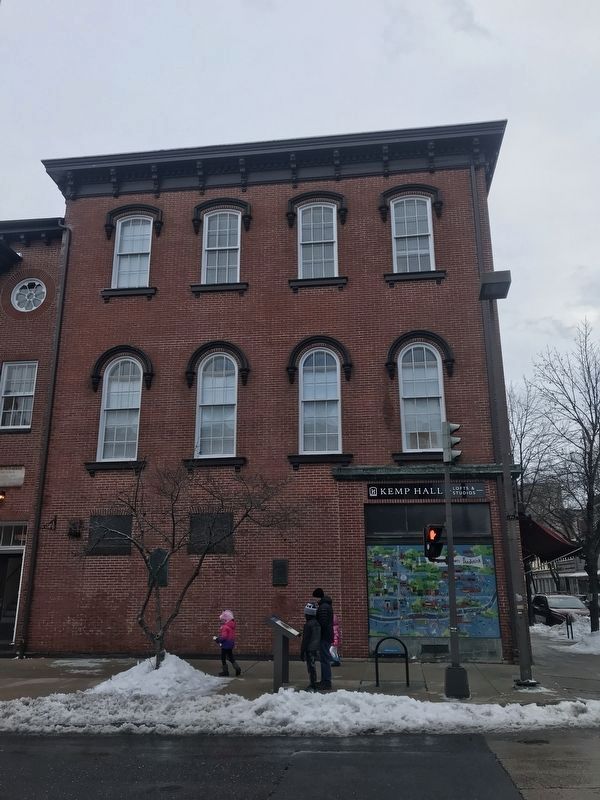
Photographed by Adam Margolis, January 17, 2022
4. Kemp Hall
View from across Church Street. The marker can be seen along the sidewalk, near the middle of the image.
Photographed by Adam Margolis, January 17, 2022
5. Kemp Hall
The marker can be seen in the middle left of the image along the sidewalk.
Internet Archive
6. Abraham Lincoln
from Frank Leslie's, The Soldier in Our Civil War, 1893, Vol. 1, by Frank Leslie, et al. frontispiece.
Library of Congress
7. Thomas Holliday Hicks,
Governor of the State of Maryland,
1861
Governor of the State of Maryland,
1861
Internet Archive
8. Hon. Ross Winans, of Baltimore
Credits. This page was last revised on June 30, 2024. It was originally submitted on August 3, 2013, by Bernard Fisher of Richmond, Virginia. This page has been viewed 1,588 times since then and 51 times this year. Photos: 1, 2. submitted on August 3, 2013, by Bernard Fisher of Richmond, Virginia. 3, 4. submitted on February 1, 2022, by Adam Margolis of Mission Viejo, California. 5. submitted on March 19, 2022, by Adam Margolis of Mission Viejo, California. 6, 7. submitted on December 7, 2023, by Allen C. Browne of Silver Spring, Maryland. 8. submitted on December 3, 2023, by Allen C. Browne of Silver Spring, Maryland.
