Downtown in Frederick in Frederick County, Maryland — The American Northeast (Mid-Atlantic)
Frederick’s Poet Lawyer
Francis Scott Key
Photographed by Bernard Fisher, August 1, 2013
1. Frederick’s Poet Lawyer Marker
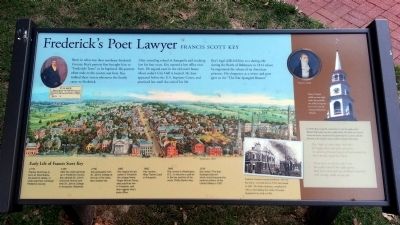
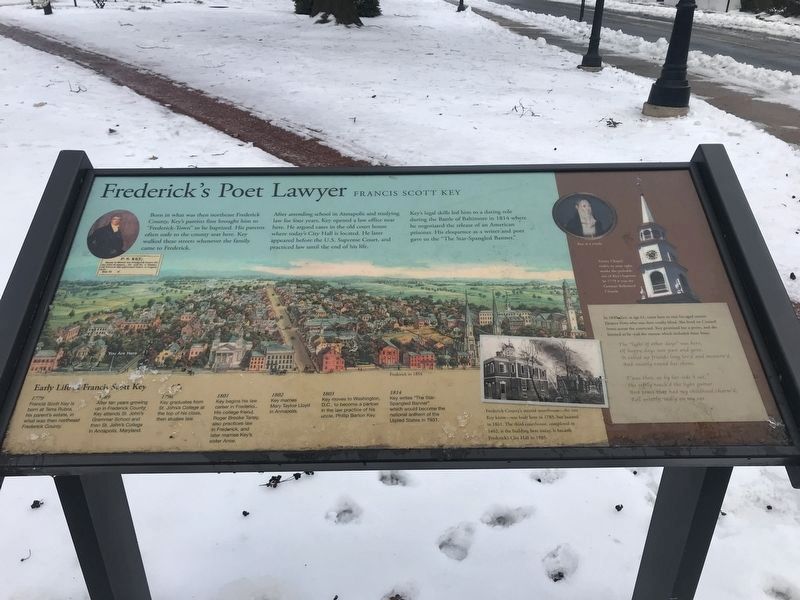
After attending school in Annapolis and studying law for four years, Key opened a law office near here. He argued cases in the old court house where today’s City Hall is located. He later appeared before the U.S. Supreme Court, and practiced law until the end of his life.
Key’s legal skills led him to a daring role during the Battle of Baltimore in 1814 where he negotiated the release of an American prisoner. His eloquence as a writer and poet gave us the “Star-Spangled Banner.”
Early Life of Francis Scott Key
1779
Francis Scott Key is born at Terra Rubra, his parent’s estate, in what was then northeast Frederick County.
1789
After ten years growing up in Frederick County, Key attends St. John’s Grammar School and then St. John’s College in Annapolis, Maryland.
1796
Key graduates from St. John’s College at the top of his class, then studies law.
1801
Key
this page online
1802
Key marries Mary Tayloe Lloyd in Annapolis.
1803
Key moves to Washington, D.C., to become a partner in the law practice of his uncle, Phillip Barton Key.
1814
Key writes “The Star-Spangled Banner” which would become the national anthem of the United States in 1931.
(sidebar)
In 1840, Key, at age 61, came here to visit his aged cousin Eleanor Potts who was then totally blind. She lived on Council Street across the courtyard. Key promised her a poem, and she listened as he read the stanzas which included these lines:
The “light of other days” was hers,
Of happy days now past and gone,
It called up friends long lov’d and mourn’d,
And sweetly round her shone.
Twas the, as by her side I sat,
She softly touch’d the light guitar,
And tones that had my childhood charm’d,
Fell sweetly, sadly on my ear.
(captions)
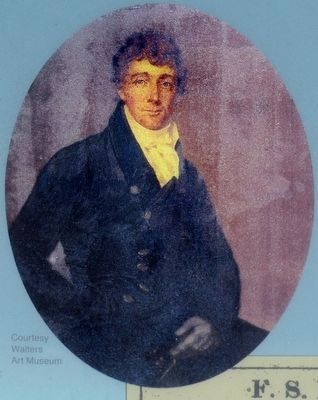
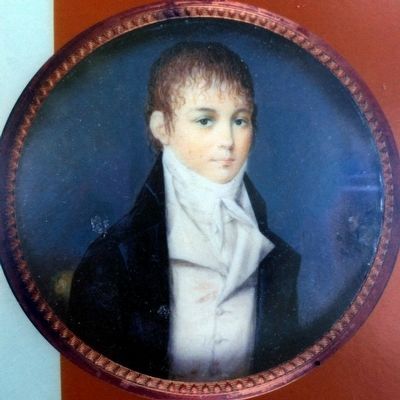
Key as a youth
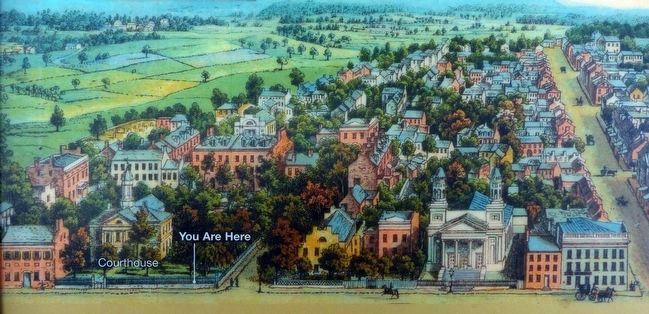
Frederick in 1854
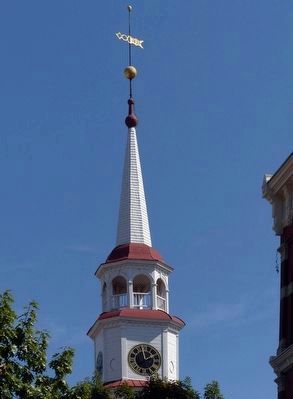
Trinity Chapel, visible to your right, marks the probable site of Key’s baptism. In 1779
Photographed by Adam Margolis, January 17, 2022
2. Frederick’s Poet Lawyer Marker
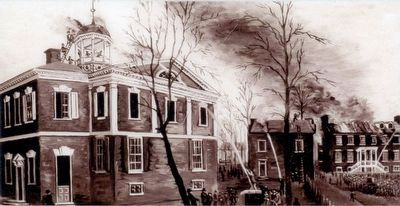
Frederick County’s second courthouse—the one Key knew—was built here in 1785, but burned in 1861. The third courthouse, completed in 1862, is the building here today. It became Frederick’s City Hall in 1985.
Topics. This historical marker is listed in these topic lists: Arts, Letters, Music • Patriots & Patriotism • War of 1812. A significant historical year for this entry is 1814.
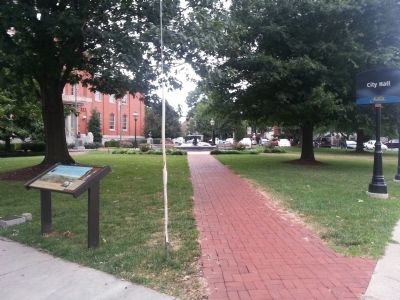
Location. 39° 24.932′ N, 77° 24.732′ W. Marker is in Frederick, Maryland, in Frederick County. It is in Downtown. It is at the intersection of West Church Street and North Court Street, on the right when traveling west on West Church Street. Touch for map. Marker is in this post office area: Frederick MD 21701, United States of America. Touch for directions.

Regionally, this marker is in the Washington Metropolitan Area and in Central Maryland. It is also in the American Mid-Atlantic. Globally, it is in North America, the Western Hemisphere, the Western World, and the Anglosphere. Historically, it finds itself in what was once one of the original Thirteen Colonies and also the Antebellum
Photographed by Bernard Fisher, August 1, 2013
3. W Church St & N Court St
Other nearby markers. At least 8 other markers are within walking distance of this marker: “South Magnetic” (here, next to this marker); Unanimous Resolution (a few steps from this marker); Site of Frederick County's First Y.M.C.A. (within shouting distance of this marker); The Congregation in Frederick (within shouting distance of this marker); Long Road to Emancipation (within shouting distance of this marker); Hood College (within shouting distance of this marker); No to the Stamp! (within shouting distance of this marker); The Ross Home (within shouting distance of this marker). Touch for a list and map of all markers in Frederick.
Other markers no longer nearby. Thomas Johnson (was within shouting distance of this marker but has been confirmed missing); The Dred Scott Decision (was within shouting distance of this marker but has been confirmed missing); Roger Brooke Taney (was within shouting distance of this marker but has been confirmed missing); City Hall (was within shouting distance of this marker but has been replaced with another marker now near it); a different marker also named City Hall (was within
Photographed by Allen C. Browne, September 23, 2015
4. Francis Scott Key
Photographed by Allen C. Browne, September 23, 2015
5. Advertisement
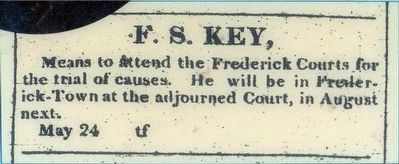
F.S. Key
Means to attend the Frederick Courts for the trial of causes. He will be in Frederick-Town at adjourned Court, in August next. May 24. tfClose-up of image on marker
Means to attend the Frederick Courts for the trial of causes. He will be in Frederick-Town at adjourned Court, in August next. May 24. tf
Photographed by Allen C. Browne, September 23, 2015
6. Key as a youth
Photographed by Allen C. Browne, September 23, 2015
7. Frederick in 1854
Photographed by Allen C. Browne, September 23, 2015
8. Trinity Chapel
Trinity Chapel, visible to your right, marks the probable site of Key’s baptism. In 1779 it was the German
Reformed Church.
Photographed by Allen C. Browne, September 23, 2015
9. The Second Courthouse Fire 1861
Frederick County’s second courthouse—the one Key knew—was built here in 1785, but burned in 1861. The
third courthouse, completed in 1862, is the building here today. It became Frederick’s City Hall in 1985. Close-up of image on marker
Photographed by Allen C. Browne, September 23, 2015
10. Ross Home
(105 Council Street)
(105 Council Street)
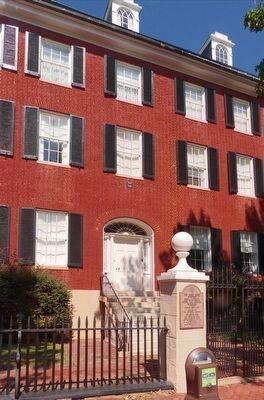
In 1840, Key, at age 61, came here to visit his aged cousin Eleanor Potts who was then totally blind. She lived on Council Street across the courtyard. Key promised her a poem, and she listened as he read the stanzas which included these lines:
Of happy days now past and gone,
It called up friends long lov’d and mourn’d,
And sweetly round her shone.
Twas then, as by her side I sat,
She softly touch’d the light guitar,
And tones that had my childhood charm’d,
Fell sweetly, sadly on my ear.
Credits. This page was last revised on January 20, 2022. It was originally submitted on August 3, 2013, by Bernard Fisher of Richmond, Virginia. This page has been viewed 1,150 times since then and 77 times this year. Photos: 1. submitted on August 3, 2013, by Bernard Fisher of Richmond, Virginia. 2. submitted on January 19, 2022, by Adam Margolis of Mission Viejo, California. 3. submitted on August 3, 2013, by Bernard Fisher of Richmond, Virginia. 4, 5, 6, 7, 8, 9, 10. submitted on October 14, 2015, by Allen C. Browne of Silver Spring, Maryland.
