Mount Pleasant in Charleston County, South Carolina — The American South (South Atlantic)
Lowcountry Waterways
Photographed by Bill Coughlin, August 4, 2013
1. Lowcountry Waterways Marker
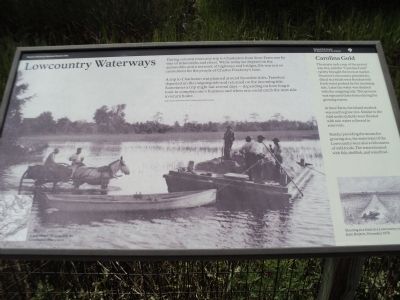
During colonial times any trip to Charleston from Snee Farm was by way of tidal creeks and rivers. While today we depend on the automobile and a network of highways and bridges, life was not so convenient for the people of Charles Pinckney’s time.
A trip to Charleston was planned around favorable tides. Travelers departed on the outgoing tide and returned on the incoming tide. Sometimes a trip might last several days – depending on how long it took to complete one’s business and when one could catch the next tide to return home.
( Sidebar : )
Carolina Gold
The major cash crop of the period was rice, and the “Carolina Gold” variety brought the most at market. On most Lowcountry plantations, diked rice fields were flooded with fresh water pushed by the incoming tide. Later the water was drained with the outgoing tide. This process was repeated three times during the growing season.
At Snee Farm, the inland method was used to grow rice. Similar to the tidal method, fields were flooded with rain water collected in reservoirs.
Besides providing the means for growing rice, the waterways of the Lowcountry were also
this page online
Topics. This historical marker is listed in these topic lists: Colonial Era • Waterways & Vessels.
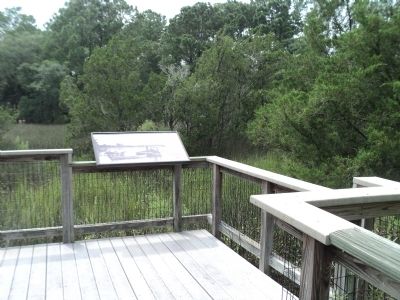
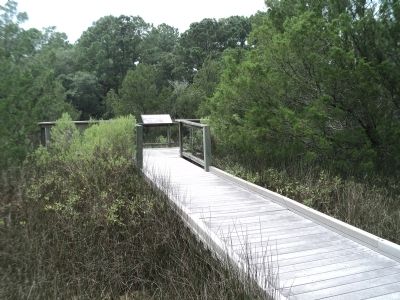
Location. 32° 50.794′ N, 79° 49.613′ W. Marker is in Mount Pleasant, South Carolina, in Charleston County. It can be reached from Long Point Road, on the left when traveling west. Marker is located on a walking trail at Charles Pinckney National Historic Site. Touch for map. Marker is at or near this postal address: 1254 Long Point Road, Mount Pleasant SC 29464, United States of America. Touch for directions.

Regionally, this marker is in the Lowcountry. It is also in the American South, specifically in the Deep South, and on the Eastern Seaboard. Globally, it is in the North Atlantic Region, North America, the Western Hemisphere, the Western World, and the Anglosphere. Historically, it finds itself in what was once the territory of the Mississippian Culture, one of the original Thirteen Colonies, one of the Confederate States of America, and the Antebellum South.
Other nearby markers. At
Photographed by Bill Coughlin, August 4, 2013
2. Lowcountry Waterways Marker
More about this marker. The background of the marker features a picture of people transporting goods on boats in a tidal river. Image courtesy of the Penn Center, St. Helena Island, South Carolina. The lower right of the marker contains a picture of “Shooting rice birds in a Lowcountry rice field, from Harpers, November 1878.”
Also see . . . Charles Pinckney National Historic Site. National Park Service website. (Submitted on August 16, 2013, by Bill Coughlin of Woodland Park, New Jersey.)
Photographed by Bill Coughlin, August 4, 2013
3. Marker at the Charles Pinckney National Historic Site
Credits. This page was last revised on June 16, 2016. It was originally submitted on August 16, 2013, by Bill Coughlin of Woodland Park, New Jersey. This page has been viewed 670 times since then and 15 times this year. Photos: 1, 2, 3. submitted on August 16, 2013, by Bill Coughlin of Woodland Park, New Jersey.
