Blackbird Hundred near Smyrna in New Castle County, Delaware — The American Northeast (Mid-Atlantic)
Clearfield Farm
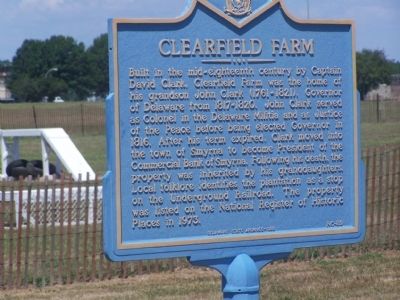
Photographed by William Pfingsten, August 17, 2008
1. Clearfield Farm Marker
Erected 1993 by Delaware State Archives. (Marker Number NC-89.)
Topics and series. This historical marker is listed in these topic lists: Abolition & Underground RR • Colonial Era • Government & Politics. In addition, it is included in the Delaware Public Archives, and the National Register of Historic Places (NRHP) series lists. A significant historical year for this entry is 1817.
Location. 39° 19.672′ N, 75° 36.193′ W. Marker is near Smyrna, Delaware, in New Castle County. It is in Blackbird
this page online

Regionally, this marker is in Southern New Castle County, in Greater Wilmington and in Greater Philadelphia. It is also in the American Mid-Atlantic, on the Delmarva Peninsula, and on the Eastern Seaboard. Globally, it is in the North Atlantic Region, North America, the Western Hemisphere, the Western World, and the Anglosphere. Historically, it finds itself in what was once New Netherland and also one of the original Thirteen Colonies.
Other nearby markers. At least 8 other markers are within 2 miles of this marker, measured as the crow flies: Duck Creek Hundred (approx. 1.3 miles away); Korean War Veterans Memorial (approx. 1.6 miles away); Veterans Memorial (approx. 1.6 miles away); Mount Olive Holiness Pentecostal Church (approx. 1.7 miles away); St. Peter's Episcopal Church (approx. 1.7 miles away); Creighton-Jones or Cummins-Stockley House (approx. 1.8 miles away); Union Cemetery (approx. 1.8 miles
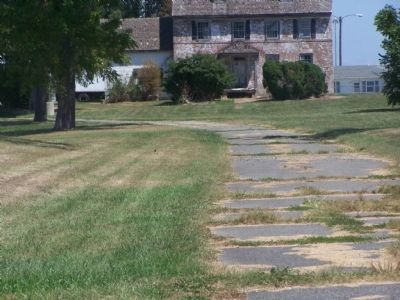
Photographed by William Pfingsten, August 17, 2008
2. Clearfield Farm
Also see . . .
1. Governor John Clark - Wikpedia entry. (Submitted on August 22, 2008, by Bill Pfingsten of Bel Air, Maryland.)
2. Clearfield Farm - National Register of Historic Places Nomination Form.
David Clark, captain in the Delaware Militia, began amassing an estate in what was to become Blackbird Hundred, New Castle County, in 1755,when Isaac England deeded him a tract of land in Appoquinimink Hundred called New Bristol. England’s grandparents, Joseph and Rebecca England, had received confirmation of patent on the land from William Penn on the nineteenth of May, 1701.(Submitted on April 24, 2025, by Pete Skillman of Wilmington, Delaware.)
The year of the conveyance of the tract probably dates the construction of the Clark homestead on Clearfield Farm. David Clark’s son, William, a military man like his father, was the second generation to occupy the house. As a colonel in the state militia, William led a company that took heavy losses in the battle of Monmouth.
Although William’s son, John, also attained the rank of colonel in the state militia, he is better known asthe twentieth Governor of Delaware. Clark was elected in 1816 on the ticket of the Federalist Party, and served for three years between 1817 and 1820. His wife was not new to politics, being the daughter of one of her husband’s predecessors, John Cook. John Clark died a year after leaving office, and was buried in the Presbyteroan graveyard south of Smyrna, the town where he was accustomed to transact business. His home is currently maintained as a headquarters of the Department of Corrections.Photographed by William Pfingsten, August 17, 20083. Clearview FarmBuilding is on the grounds of the Delaware Correctional Center and cannot be approached.

Credits. This page was last revised on May 15, 2026. It was originally submitted on August 22, 2008, by Bill Pfingsten of Bel Air, Maryland. This page has been viewed 3,248 times since then and 39 times this year. Last updated on October 7, 2013, by Kathleen Black of Woodbridge, Virginia. Photos: 1, 2, 3. submitted on August 22, 2008, by Bill Pfingsten of Bel Air, Maryland.
