Spring City in Rhea County, Tennessee — The American South (East South Central)
The Rhea County Spartans
Women's Cavalry
Photographed by Don Morfe, July 27, 2013
1. The Rhea County Spartans Marker
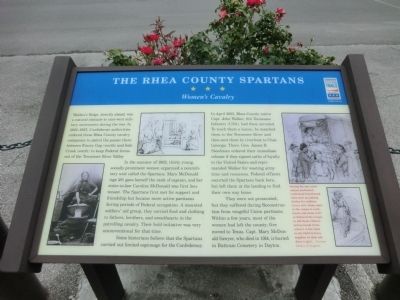
In the summer of 1862, thirty young, socially prominent women organized a nonmilitary unit called the Spartans. Mary McDonald (age 28) gave herself the rank of captain, and her sister-in-law Caroline McDonald was first lieutenant. The Spartans first met for support and friendship but became more active partisans during the periods of Federal occupation. A mounted soldiers’ aid group, they carried food and clothing to fathers, brothers, and sweethearts in the patrolling cavalry. Their bold initiative was very unconventional for that time.
Some historians believe that the Spartans carried out limited espionage for the Confederacy.
In April 1865, Rhea County native Capt. John Walker, 6th Tennessee Infantry (USA), had them arrested. To teach them a lesson, he marched them to the Tennessee River and then
this page online
They were not prosecuted, but they suffered during Reconstruction from vengeful Union partisans. Within a few years, most of the women had left the county, five moved to Texas. Capt. Mary McDonald Sawyer, who died in 1914, is buried in Buttram Cemetery in Dayton.
(caption)
During the war, most women performed traditional homebound roles such as making clothes for soldiers (above left). Some came to the camps to cook, mend, and clean (left) or followed the troops to sell them tobacco and personal items (above). A few took to the field to ferry supplies to their soldiers (right).— Courtesy Library of Congress
Erected by Tennessee Civil War Trails.
Topics and series. This historical marker is listed in these topic lists: War, US Civil • Women. In addition, it is included in the Tennessee Civil War Trails
Photographed by Don Morfe, July 27, 2013
2. The Rhea County Spartans Marker
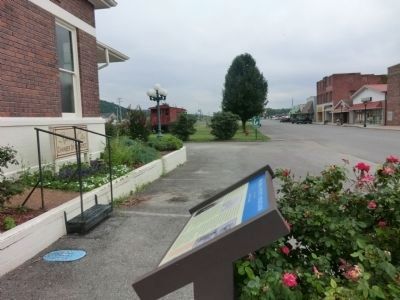
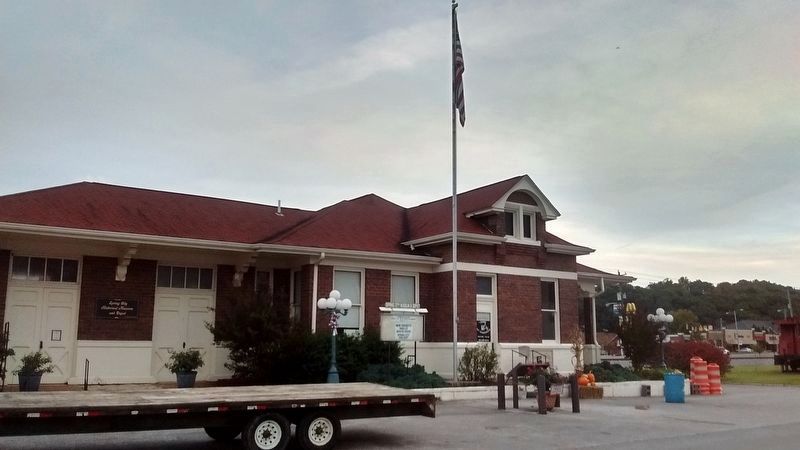
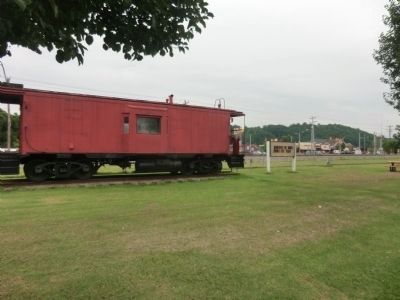
Location. 35° 41.61′ N, 84° 51.623′ W. Marker is in Spring City, Tennessee, in Rhea County. It is at the intersection of Front Street and West Rhea Avenue, on the right when traveling north on Front Street. The marker is located in front of the Spring City Museum & Depot. Touch for map. Marker is at or near this postal address: 390 Front St, Spring City TN 37381, United States of America. Touch for directions.

Regionally, this marker is in East Tennessee. It is also in the American South, specifically in the Upper South, in Appalachia, and specifically in Southern Appalachia. Globally, it is in North America, the Western Hemisphere, the Western World, and the Anglosphere. Historically, it finds itself in what was once the original Cherokee Nation, the territory of the Mississippian Culture, one of the Confederate States of America, and the Antebellum South.
Other nearby markers. At least 8 other markers are within 12 miles of this marker, measured as the crow flies: Hargus Melvin “Pig” Robbins (within shouting distance of this marker); Grandview Normal Institute
Photographed by Tom Bosse, October 22, 2017
3. The Rhea County Spartans Marker

Photographed by Don Morfe, July 27, 2013
4. Spring City Museum & Depot
Photographed by Don Morfe, July 27, 2013
5. Spring City Museum & Depot
Credits. This page was last revised on November 11, 2024. It was originally submitted on October 11, 2013, by Don Morfe of Baltimore, Maryland. This page has been viewed 1,963 times since then and 107 times this year. Photos: 1, 2. submitted on October 11, 2013, by Don Morfe of Baltimore, Maryland. 3. submitted on November 18, 2017, by Tom Bosse of Jefferson City, Tennessee. 4, 5. submitted on October 11, 2013, by Don Morfe of Baltimore, Maryland. • Bernard Fisher was the editor who published this page.
