Talbot in Jefferson County, Tennessee — The American South (East South Central)
Kimbrough's Crossroads
Confederate Surprise
Photographed by Don Morfe, July 30, 2013
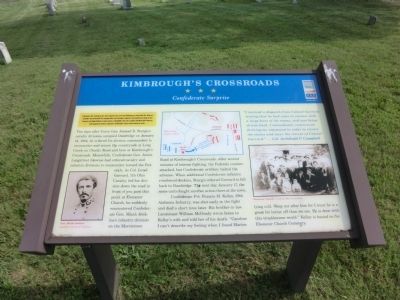
1. Kimbrough's Crossroads Marker
In November 1863, Confederate Gen. James Longstreet led a force from Chattanooga to attack Union Gen. Ambrose E. Burnside’ s army at Knoxville. The campaign failed, and in December Longstreet’s men marched east along the East Tennessee and Virginia Railroad to winter quarters at Russellville, where they remained until March 1864. Numerous small engagements between Longstreet’s and Burnside’s armies occurred during the winter.
(main text)
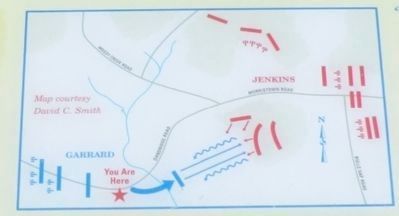
Two days after Union Gen. Samuel D. Sturgis’s cavalry divisions occupied Dandridge on January 14, 1864, he ordered his division commanders to reconnoiter and secure the countryside at Long Creek on Chucky Road and here at Kimbrough’s Crossroads. Meanwhile, Confederate Gen. James Longstreet likewise had ordered cavalry and infantry divisions to reconnoiter toward the Federals. As Col. Israel Garrard, 7th Ohio Cavalry, led his division down the road in front of you past this point at Ebenezer Church, he suddenly encountered Confederate Gen. Micah Jenkins’s infantry division on the Morristown Road at Kimbrough’s Crossroads. After several minutes of intense fighting, the Federals
this page online
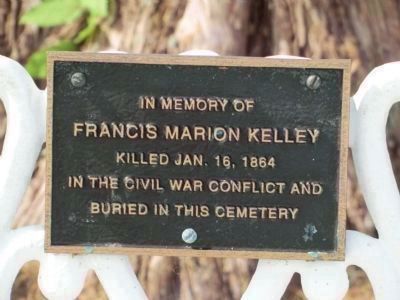
Confederate Pvt. Francis M. Kelley, 59th Alabama Infantry, was shot early in the fight and died a short time later. His brother-in-law Lieutenant William McGrady wrote home to Kelley’s wife and told her of his death: “Caroline I can’t describe my feeling when I found Marion lying cold. Weep not after him for I trust he is a bit better off than we are. He is done with this troublesome world.” Kelley is buried in the Ebenezer Church Cemetery.
“I received a dispatch from Colonel Garrard stating that he had come in contact with a large force of the enemy, and was being driven back. I immediately commenced forming my command in order to receive the enemy and cover the retreat of Colonel Garrard.” — Col. Archibald P. Campbell
(captions)
Gen. Micah Jenkins Courtesy Library of Congress
Ebenezer Church - Courtesy Ben Carmichael
Erected by Tennessee
Photographed by Don Morfe, July 30, 2013
2. Map as shown in the upper center of the marker
Topics and series. This historical marker is listed in these topic lists: Cemeteries & Burial Sites • War, US Civil. In addition, it is included in the Tennessee Civil War Trails series list. A significant historical month for this entry is January 1907.
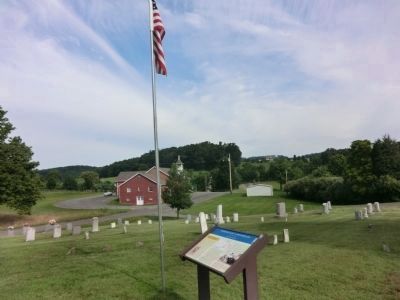
Location. 36° 5.982′ N, 83° 20.964′ W. Marker is in Talbot, Tennessee, in Jefferson County. It is on Ebenezer Church Road 0.2 miles south of Valley Home Road (Tennessee Route 66), on the left when traveling south. The marker is located in the Ebenezer Methodist Church Cemetery. Touch for map. Marker is at or near this postal address: 1122 Ebenezer Church Road, Talbott TN 37877, United States of America. Touch for directions.

Regionally, this marker is in East Tennessee. It is also in the American South, specifically in the Upper South, in Appalachia, and specifically in Southern Appalachia. Globally, it is in North America, the Western Hemisphere, the Western World, and the Anglosphere. Historically, it finds itself in what was once the original Cherokee Nation, the territory of the Mississippian Culture, one of the Confederate States of America, the State
Photographed by Don Morfe, July 30, 2013
3. Ebenezer Church Cemetery
Other nearby markers. At least 8 other markers are within 6 miles of this marker, measured as the crow flies: David Crockett and Polly Finley (approx. 2.8 miles away); White Pine (approx. 3½ miles away); Battle of Hay's Ferry (approx. 4.3 miles away); Tennessee Civil War Trails (approx. 4.8 miles away); a different marker also named Tennessee Civil War Trails (approx. 4.8 miles away); Watkins-Witt House (approx. 5.8 miles away); Pine Chapel (approx. 5.8 miles away); Stokely-Van Camp, Inc. (approx. 5.8 miles away).
Other markers no longer nearby. Fighting at Dandridge (was approx. 4.8 miles away but has been permanently removed); a different marker also named Fighting at Dandridge (was approx. 4.8 miles away but has been replaced with another marker now near it).
Photographed by Don Morfe, July 30, 2013
4. Kelley is mentioned in the text of the marker
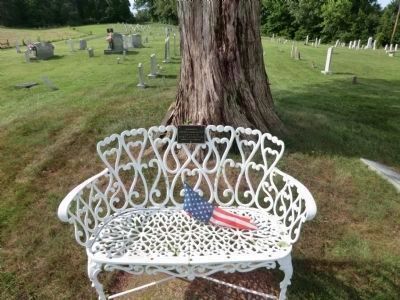
Photographed by Don Morfe, July 30, 2013
5. Kelley plaque mounted to the bench
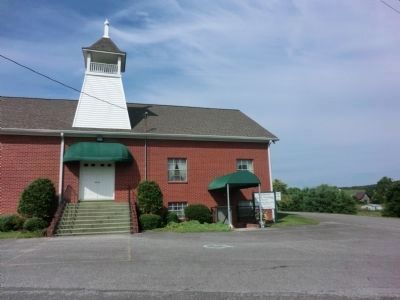
Photographed by Don Morfe, July 30, 2013
6. Ebenezer United Methodist Church
located across the street from the cemetery
Credits. This page was last revised on June 16, 2016. It was originally submitted on October 20, 2013, by Don Morfe of Baltimore, Maryland. This page has been viewed 2,227 times since then and 103 times this year. Photos: 1, 2, 3, 4, 5, 6. submitted on October 20, 2013, by Don Morfe of Baltimore, Maryland. • Bernard Fisher was the editor who published this page.
