Near Ramsey in Anoka County, Minnesota — The American Midwest (Upper Plains)
Itasca Village Townsite
Photographed by K. Linzmeier, October 24, 2013
1. Itasca Village Townsite Marker
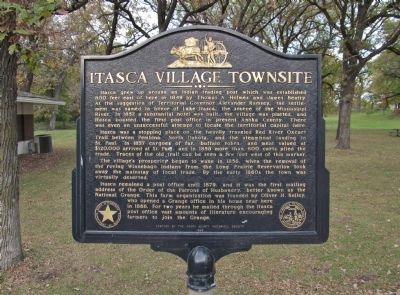
Itasca was a stopping place on the heavily traveled Red River Oxcart Trail between Pembina, North Dakota, and the steamboat landing in St. Paul. In 1857 cargoes of fur, buffalo robes, and meat valued at $120,000 arrived at St. Paul, and in 1858 more than 600 carts plied the trade. Traces of the old trail can be seen a few feet west of this marker.
The village's prosperity began to wane in 1856, when the removal of the roving Winnebago Indians from the Long Prairie Reservation took away the mainstay of local trade. By the eary 1860s the town was virtually deserted.
Itasca remained a post office until 1879, and it was the first mailing
this page online
seal of The Minnesota Historical Society, Instituted 1849
1966
Erected 1966 by the Anoka County Historical Society. (Marker Number AN-RMC-008.)
Topics and series. This historical marker is listed in these topic lists: Agriculture • Indigenous Peoples and Communities • Roads & Vehicles • Settlements & Settlers. In addition, it is included in the Minnesota Historical Society, and the Postal Mail and Philately series lists. A significant historical year for this entry is 1849.
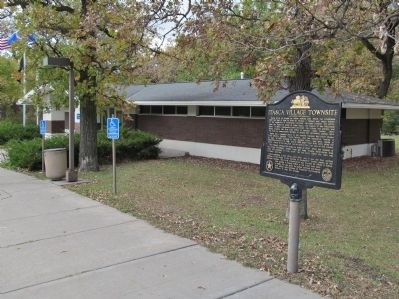
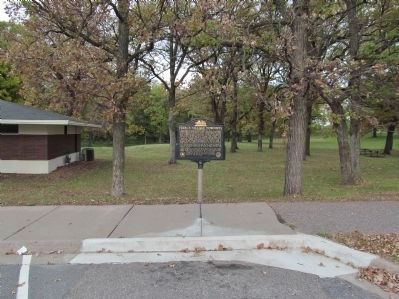
Location. 45° 14.765′ N, 93° 30.264′ W. Marker is near Ramsey, Minnesota, in Anoka County. It is on U.S. 10 0.8 miles east of Cleveland Street, on the right when traveling east. Marker is in the eastbound Dayton Port Rest Area
Photographed by K. Linzmeier, October 24, 2013
2. Itasca Village Townsite Marker

Regionally, this marker is in the Twin Cities Metropolitan Area. It is also in the American Midwest, in the Corn Belt, and in the Great River Road Region. Globally, it is in North America, the Western Hemisphere, the Western World, and the Anglosphere. Historically, it finds itself in what was once Rupert’s Land and also the territory of the Mississippian Culture.
Other nearby markers. At least 8 other markers are within 2 miles of this marker, measured as the crow flies: Ice Age Souvenir (within shouting distance of this marker); In Memory of Lucy Earle Kelley (approx. 1.8 miles away); Grange Shrine (approx. 1.8 miles away); What's a Farm without a Cow? (approx. 1.9 miles away); Corn Country (approx. 1.9 miles away); Harvest Time (approx. 1.9 miles away); The River Highway (approx. 2 miles away); Mississippi River & Woodlands Trail (approx. 2 miles away).
Also see . . .
1. Minnesota Department of Transportation. Historic
Photographed by K. Linzmeier, October 24, 2013
3. Itasca Village Townsite Marker
2. Highway 10 Overlook. National Park Service. "The first government wagon road was established in 1852 leading from Point Douglas (near Hastings) through Saint Paul, Saint Anthony, Anoka and beyond. A fragment of this oxcart trail remains in the western and southern portions of the rest area." (Submitted on November 2, 2013.)
Photographed by K. Linzmeier, October 24, 2013
4. Itasca Village Townsite Marker
Credits. This page was last revised on June 16, 2016. It was originally submitted on November 2, 2013, by Keith L of Wisconsin Rapids, Wisconsin. This page has been viewed 2,327 times since then and 151 times this year. Photos: 1, 2, 3, 4. submitted on November 2, 2013, by Keith L of Wisconsin Rapids, Wisconsin.
