Old Town in Alexandria, Virginia — The American South (Mid-Atlantic)
The Civil War and Battery Rodgers
Photographed by Richard E. Miller, October 15, 2013
1. The Civil War and Battery Rodgers Marker
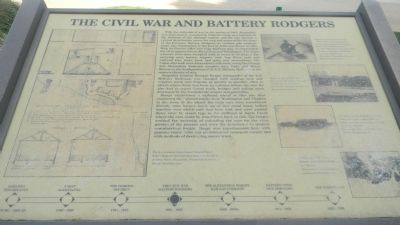
With the outbreak of war in the spring of 1861, Alexandria was immediately occupied by Federal troops as a bulwark in the defenses of the national capital, and the city became a central distribution center for men and material for the Army of the Potomac. Battery Rodgers, an earthen gun emplacement, was constructed at the foot of Jefferson Street in 1861. With its Parrott rifles and huge Rodman gun, it commanded the river approaches to Alexandria and Washington. The city’s wharves were soon occupied with as many as 40 ships a day carrying men, horses, wagons, coal, hay, flour, rails and railroad ties, tents, food, and guns and ammunition. The Union also took over Alexandria’s railroads, using the Orange and Alexandria Railroad complex near Duke and Henry Streets as the headquarters of its U.S. Military Railroad in the eastern theater of war.
Brigadier General Herman Haupt, commander of the U.S. Military Railroad, was charged with sending men and supplies south into Virginia as quickly as possible, often to places where there had been no railways before the war. He also had to repair Union track, bridges and rolling
this page online
Haupt established a railroad wharf at this site that connected the railroad tracks from Washington and Virginia to the river. At the wharf, the train cars were transferred directly onto barges, made up of two canal boats lashed together over which rails had been laid, and were pushed down river by steam tugs to the railhead at Aquia Creek where the cars could be transferred back to rail. The barges avoided the necessity of unloading the cars for the river portion of the journey and were the forerunner to modern containerized freight. Haupt also experimented here with pontoon boats, rafts and prefabricated transport vessels and with methods of destroying enemy track.
[Captions:]
The Quartermaster Department’s “General Plan of Battery Rodgers” shows the fort’s location at the foot of Jefferson Street. (Illustration: National Archive and Records Administration)
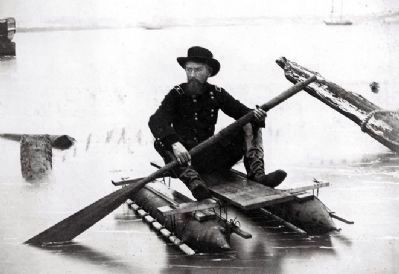
Brigadier General Herman Haupt (1817 to 1905) on an experimental pontoon boat designed for surveying parties, and scouting operations, ca. 1861-1865. The pontoons were 10 inches in diameter and between seven and eight feet long. (Illustration: National Archives and Records Administration)
Battery Rodgers’ bunker and Rodman gun are visible in this view looking east, ca. 1861-1865 (Illustration: National Archives and Records Administration)
U.S. Military Railroad freight train loaded onto barge at Alexandria and floated down the Potomac River to Aquia Creek, ca. 1863-1865. (Illustration: National Archives and Records Administration)
A soldier in the huge Rodman gun at Battery Rodgers, ca. 1861-1865. (Illustration: National Archives and Records Administration)
Erected 1999
Photographed by Richard E. Miller, October 6, 2013
2. Ford's Landing City Park and the Potomac River
Topics and series. This memorial is listed in these topic lists: Notable Places • Railroads & Streetcars • War, US Civil • Waterways & Vessels. In addition, it is included in the Orange and Alexandria Railroad, and the Virginia, The City of Alexandria series lists. A significant historical year for this entry is 1861.
Location. This memorial has been replaced by another memorial nearby. It was located near 38° 47.815′ N, 77° 2.412′ W. Memorial was in Alexandria, Virginia. It was in Old Town. It could be reached from the intersection of Fords Landing Way and Franklin Street, on the left when traveling south. Located in the southwest corner of Ford's Landing Park. Touch for map. Memorial was at or near this postal address: 702 Fords Landing Way, Alexandria VA 22314, United States of America. Touch for directions.

Regionally, this memorial was in the Washington Metropolitan Area and in Northern Virginia. It was also in the American South, specifically in the Upper South, in the Mid-Atlantic, and on the Eastern Seaboard.
National Archives and Records Administration, ca. 1863
3. BGen Herman Haupt, U.S. Military Railroad
Other nearby markers. At least 8 other markers are within walking distance of this location: Battery Cove Filled: A New Shipyard (here, next to this marker); The Alexandria Marine Railway (here, next to this marker); a different marker also named The Civil War and Battery Rodgers (here, next to this marker); a different marker also named The Federal District and Alexandria (here, next to this marker); a different marker also named Early Alexandria and Keith's Wharf (here, next to this marker); a different marker also named The Earliest Inhabitants (a few steps from this marker); a different marker also named The Alexandria Ford Plant (within shouting distance of this marker); Guarding the Potomac (about 600 feet away, measured in a direct line). Touch for a list and map of all markers in Alexandria.
Other
Photographed by Andrew J. Russell, 1863
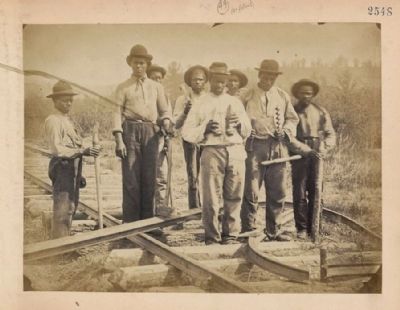
4. African American laborers on the U.S. Military Railroad in Northern Virginia
"From the beginning of the Civil War, African Americans worked on the railroads, transferring their labor to the Union cause." Library of Congress LC-DIG-ppmsca-10395
Related marker. Click here for another marker that is related to this marker.
Also see . . . Herman Haupt. National Railroad Hall of Fame (Submitted on October 20, 2013, by Richard E. Miller of Oxon Hill, Maryland.)
Additional commentary.
1. Ford's Landing City Park
Ford's Landing Park was created during construction of new, up-scale apartment buildings along the Potomac River. The Ford Motor Company's service factory occupied this river-front site for many years until the late 1990s. Regrettably, the text and photos on the marker panels suffer from fading, cracking and general deterioration to a severe degree. Great info - but cheaply presented.
— Submitted October 19, 2013, by Richard E. Miller of Oxon Hill, Maryland.
Additional keywords. U.S. Military Railroad Construction Corps, [USMRR-CC]
Credits. This page was last revised on May 14, 2026. It was originally submitted on October 19, 2013, by Richard E. Miller of Oxon Hill, Maryland. This page has been viewed 1,457 times since then and 37 times this year. Last updated on November 25, 2013, by Richard E. Miller of Oxon Hill, Maryland. Photos: 1. submitted on October 19, 2013, by Richard E. Miller of Oxon Hill, Maryland. 2, 3. submitted on October 20, 2013, by Richard E. Miller of Oxon Hill, Maryland. 4. submitted on October 24, 2013, by Richard E. Miller of Oxon Hill, Maryland. • Bernard Fisher was the editor who published this page.
