
Mount Vernon in Baltimore, Maryland — The American Northeast (Mid-Atlantic)
The First Unitarian Church of Baltimore
(Universalist and Unitarian)
Photographed by Christopher Busta-Peck, April 16, 2008
1. First Unitarian Church Marker
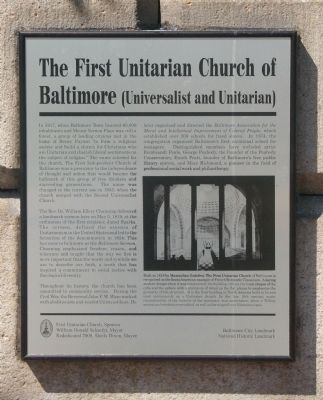
In 1817, when Baltimore Town boasted 60,000 inhabitants and Mount Vernon Place was still a forest, a group of leading citizens met in the home of Henry Payson "to form a religious society and build a church for Christians who are Unitarian and cherish liberal sentiments on the subject of religion." The name selected for the church, The First Unitarian Church of Baltimore was a precursor to the independence of thought and action that would become the hallmark of this group of free thinkers and succeeding generations. The name was changed to the current one in 1935, when the church merged with the Second Universalist Church.
The Rev. Dr. William Ellery Channing delivered a landmark sermon here on May 5, 1819, at the ordination of the first minister, Jared Sparks. The sermon, defined the essence of Unitarianism in the United States and led to the formation of the denomination in 1824. This has come to be known as the Baltimore Sermon. Channing emphasized freedom, reason, and tolerance and taught that the way we live is more important than the words and symbols we use to describe our faith, a truth that has inspired a commitment
this page online
Throughout its history, the church has been committed to community service. During the Civil War, the Reverend John F. W. Ware worked with abolitionists and tended to Union soldiers. He later organized and directed the Baltimore Association for the Moral and Intellectual Improvement of Colored People, which established over 200 schools for freed slaves. In 1874, the congregation organized Baltimore's first vocational school for teenagers. Distinguished members have included artist Rembrandt Peale, George Peabody, the founder of the Peabody Conservatory, Enoch Pratt, founder of Baltimore's free public library system, and Mary Richmond, a pioneer in the field of professional social work and philanthropy.
photo caption:
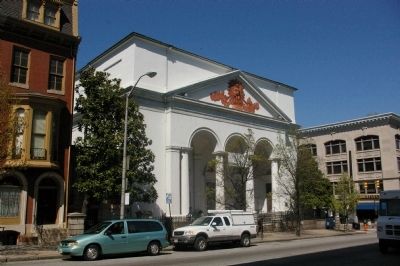
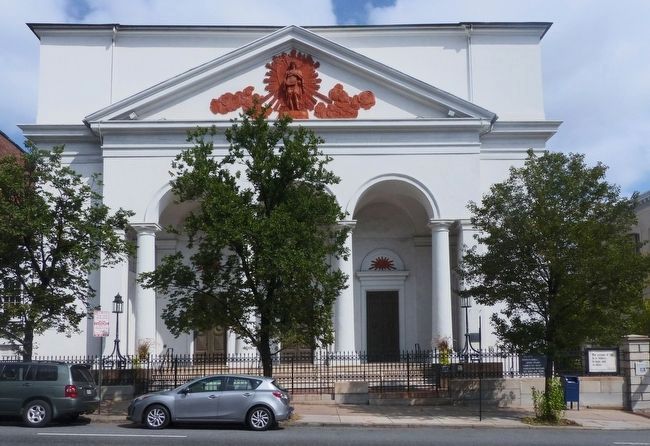
Built in 1818 by Maximilian Godefroy, The First Unitarian Church of Baltimore is recognized as the finest American example of French Romantic Classicism. A daring modern design when it was constructed, the building utilizes the basic shapes of the cube and the sphere with a minimum of detail on the flat planes to emphasize the geometry of the structure. It is the first
Photographed by Christopher Busta-Peck, April 16, 2008
2. First Unitarian Church of Baltimore
The marker is near the post at far right.
Erected 2008 by City of Baltimore.
Topics and series. This historical marker is listed in these topic lists: Abolition & Underground RR • Education • Religion & Religious Structures • War, US Civil. In addition, it is included in the Maryland, Baltimore City historical markers, the National Historic Landmarks, and the Unitarian Universalism (UUism) series lists. A significant historical date for this entry is May 5, 1819.
Location. 39° 17.712′ N, 76° 36.938′ W. Marker is in Baltimore, Maryland. It is in Mount Vernon. It is at the intersection of Franklin Street (U.S. 40) and Charles Street, on the right when traveling west on Franklin Street. Touch for map. Marker is at or near this postal address: 501 N Charles St, Baltimore MD 21201, United States of America. Touch for directions.

Regionally, this marker is in Central Maryland. It is also in the American Mid-Atlantic,

Jack E. Boucher - Historic American Buildings Survey, 1960
3. Interior of the First Unitarian Church.
Other nearby markers. At least 8 other markers are within walking distance of this marker: A different marker also named The First Unitarian Church of Baltimore (here, next to this marker); Exercising Freedom: Overcoming Racial and Religious Boundaries (within shouting distance of this marker); Pope John Paul II Monument (within shouting distance of this marker); Expanding the American Intellect: Icons and Iconoclasts (about 300 feet away, measured in a direct line); George Washington Bicentennial Marker (about 400 feet away); Basilica of the Assumption of the Blessed Virgin Mary (about 400 feet away); James Cardinal Gibbons Monument (about 400 feet away); The Basilica of the National Shrine of the Assumption of the Blessed Virgin Mary (about 400 feet away). Touch for a list and map of all markers in Baltimore.
More about this marker.
Photographed by Allen C. Browne, September 5, 2015
4. The Angel of Truth
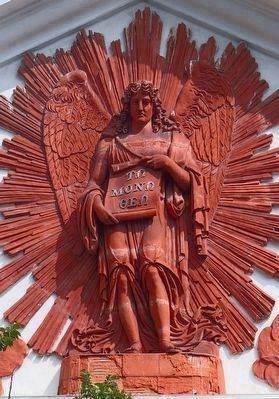
Antonio Capellano made the original terra cotta relief “Angel of Truth” on the front of the church. The Greek inscription on the scroll (TΩ MONΩ θEΩ) translates “To the One God”. Noted Baltimore sculptor, Henry Berge (1908-1998), constructed a replica of the “Angel of Truth” in the late 1950s to replace the decayed original.
Also see . . . Photographs of the Church. From the Historic American Buildings Survey. (Submitted on September 19, 2015, by Allen C. Browne of Silver Spring, Maryland.)
Additional keywords. Unitarian Universalism

Photographed by Allen C. Browne, September 5, 2015
5. National Historic Landmark
Photographed by Allen C. Browne, September 5, 2015
6. First Unitarian Church of Baltimore
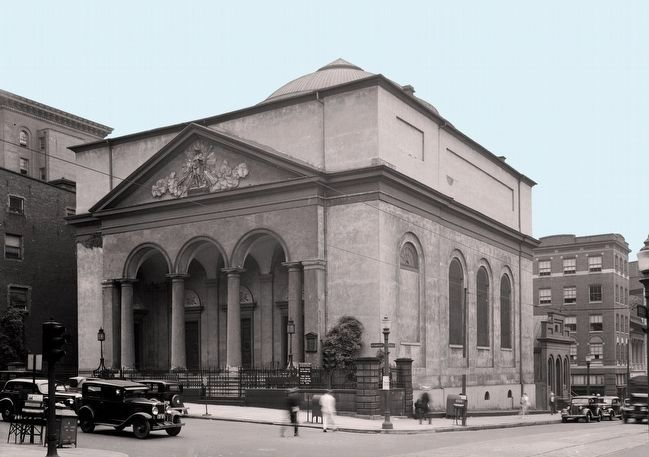
Library of Congress
7. The First Unitarian Church
Credits. This page was last revised on April 30, 2025. It was originally submitted on April 16, 2008, by Christopher Busta-Peck of Shaker Heights, Ohio. This page has been viewed 4,525 times since then and 41 times this year. It was the Marker of the Week May 4, 2025. Photos: 1, 2. submitted on April 16, 2008, by Christopher Busta-Peck of Shaker Heights, Ohio. 3. submitted on May 15, 2008, by Christopher Busta-Peck of Shaker Heights, Ohio. 4, 5, 6, 7. submitted on September 19, 2015, by Allen C. Browne of Silver Spring, Maryland.
