Near Thamesville in Chatham-Kent, Ontario — Central Canada (North America)
The Death of Tecumseh
Tuesday, October 5, 1813, Approximately 4:20 p.m.
| — | Tecumseh Parkway | — |
Photographed by Dale K. Benington, July 23, 2013
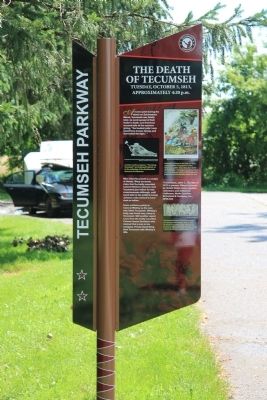
1. The Death of Tecumseh Marker
View, looking south, of the English text side of the historical marker.
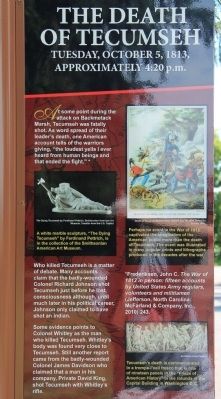
Who killed Tecumseh is a matter of debate. Many accounts claim that the badly-wounded Colonel Richard Johnson shot Tecumseh just before he lost consciousness although, until much later in his political career, Johnson only claimed to have shot an Indian.
Some evidence points to Colonel Whitley as the man who killed Tecumseh. Whitley's body was found very close to Tecumseh. Still another report came from the badly-wounded Colonel James Davidson who claimed that a man in his company, Private David King, shot Tecumseh with Whitley's rifle.
Erected by Tecumseh Parkway.
Topics. This historical marker is listed in these topic lists: Colonial Era • Indigenous Peoples and Communities • War of 1812.
Location. 42° 33.837′ N, 81° 55.846′ W. Marker is near Thamesville, Ontario, in Chatham-Kent. It can be reached from Longwoods Road (Provincial Highway 2) 4.2 kilometers east of Victoria Road (Provincial Highway 21), on the right when traveling east. The historical marker is located in a Historical Park, that commemorates the Battle of the Thames, along the east side of a park roadway with a long series of Tecumseh Parkway markers. Touch for map. Marker is at or near this postal address: 14376 Longwoods Road, Thamesville ON N0P 2K0, Canada. Touch for directions.

Regionally, this marker is in the Southwest Ontario Area and in Southwestern Ontario. It is also in Central Canada. Globally, it is in North America, on the Great Lakes, in the Western Hemisphere, in the Western World, and in the Anglosphere.
this page online
Other nearby markers. At least 8 other markers are within walking distance of this marker: Assault on Backmetack Marsh (a few steps from this marker); The Bugles Sound (a few steps from this marker); a different marker also named Participants in the Battle of the Thames (within shouting distance of this marker); a different marker also named Participants in the Battle of the Thames (within shouting distance of this marker); a different marker also named Participants in the Battle of the Thames (within shouting distance of this marker); a different marker also named Participants in the Battle of the Thames (about 90 meters away, measured in a direct line); a different marker also named Participants in the Battle of the Thames (about 90 meters away); Why Choose This Site? (about 120 meters away). Touch for a list and map of all markers in Thamesville.
Another marker is no longer nearby. Participants in the Battle of the Thames (was within shouting distance of this marker
Photographed by Dale K. Benington, July 23, 2013
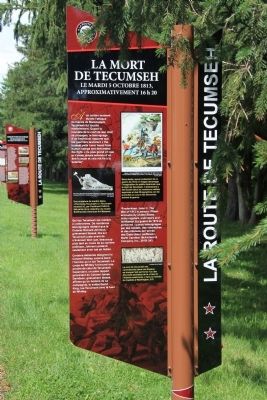
2. The Death of Tecumseh Marker
View, looking north, of the French text side of the historical marker.
Photographed by Dale K. Benington, July 23, 2013
3. The Death of Tecumseh Marker
A close-up view of the English text side of the historical marker.
Photographed by Dale K. Benington, July 23, 2013
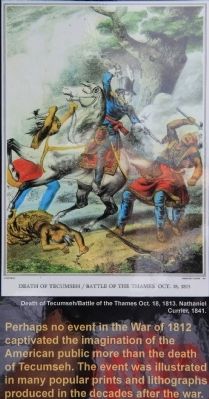
4. The Death of Tecumseh Marker
A close-up view of a print of the "Death of Tecumseh/Battle of the Thames, October 18, 1813, by Nathaniel Currier, 1841, that is displayed on the historical marker.
Photographed by Dale K. Benington, July 23, 2013
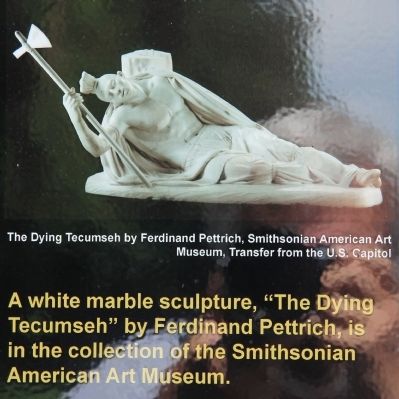
5. The Death of Tecumseh Marker
A close-up view of a picture of a marble sculpture called "The Dying Tecumseh" which is part of the collection of the Smithsonian American Art Museum, that is displayed on the historical marker.
Photographed by Dale K. Benington, July 23, 2013
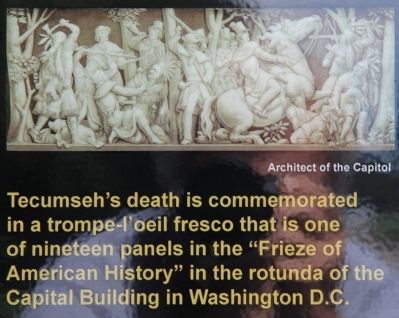
6. The Death of Tecumseh Marker
A close-up view of a picture of one of the nineteen panels in the "Frieze of American History" in the rotunda of the Capital Building in Washington D.C., that commemorates the death of Tecumseh, that is displayed on the historical marker.
Photographed by Dale K. Benington, July 23, 2013
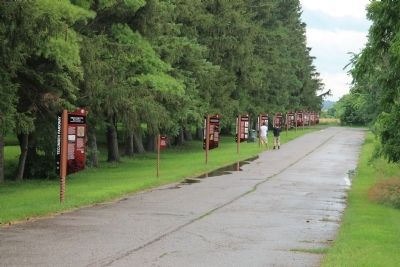
7. The Death of Tecumseh Marker
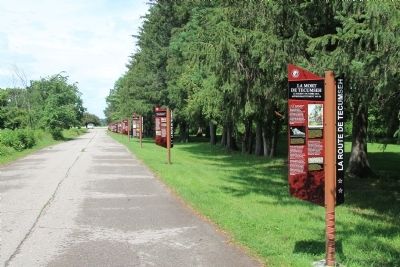
View of the short park roadway that is lined with a series of Tecumseh Parkway historical markers, including this featured historical marker.
Photographed by Dale K. Benington, July 23, 2013
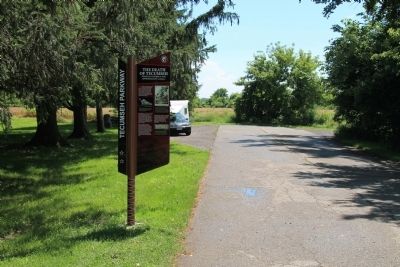
8. The Death of Tecumseh Marker
View, looking south, of the featured historical marker, located as the eleventh marker from the beginning, and at the very end, of a series of Tecumseh Parkway historical markers.
Photographed by Dale K. Benington, July 23, 2013
9. The Death of Tecumseh Marker
View, looking north, of the featured historical marker, located as the eleventh marker from the beginning, and at the very end, of a series of Tecumseh Parkway historical markers.
Photographed by Dale K. Benington, July 23, 2013
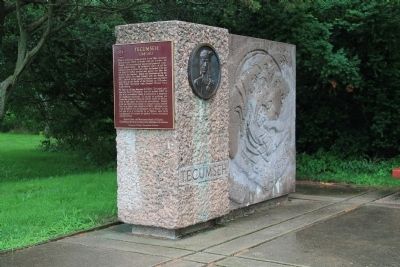
10. Tecumseh Memorial
View of the nearby Tecumseh Memorial.
Photographed by Allen C. Browne, February 16, 2015
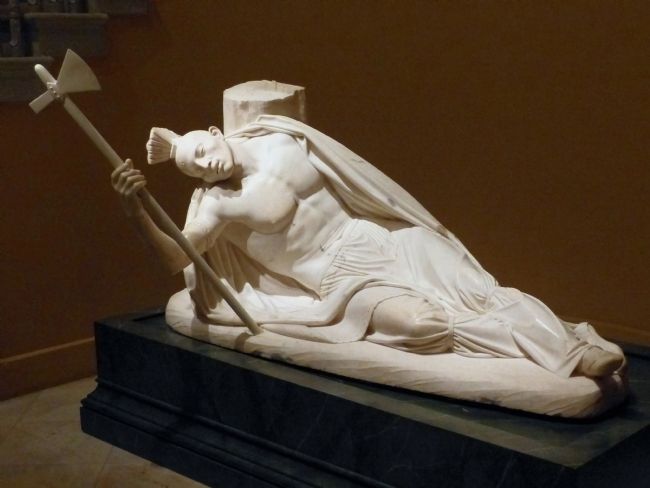
11. The Dying Tecumseh
This 1856 statue by Ferdinand Pettrich sits in the National Museum of American Art in Washington DC.
“Tecumseh (c. 1768-1813) played a key role in Indian resistance to America's post-Revolutionary expansion into the Midwest. A Shawnee chief from the Ohio Valley, Tecumseh was charismatic and politically skillful, creating a coalition among disparate tribes that first sought a diplomatic solution with the settlers and later took up arms. During the War of 1812, he aligned the tribes with the British. After some military success, Tecumseh was defeated and killed at the Battle of the Thames (Ontario) by troops under the command of future president William Henry Harrison. The sculpture draws on classical work, such as the Dying Gaul from ancient Rome, to mythologize Tecumseh as a hero of the Native people and their tragic fate, a status conveyed to him only after death.” — National Museum of American Art
“Tecumseh (c. 1768-1813) played a key role in Indian resistance to America's post-Revolutionary expansion into the Midwest. A Shawnee chief from the Ohio Valley, Tecumseh was charismatic and politically skillful, creating a coalition among disparate tribes that first sought a diplomatic solution with the settlers and later took up arms. During the War of 1812, he aligned the tribes with the British. After some military success, Tecumseh was defeated and killed at the Battle of the Thames (Ontario) by troops under the command of future president William Henry Harrison. The sculpture draws on classical work, such as the Dying Gaul from ancient Rome, to mythologize Tecumseh as a hero of the Native people and their tragic fate, a status conveyed to him only after death.” — National Museum of American Art
Credits. This page was last revised on September 27, 2019. It was originally submitted on March 18, 2014, by Dale K. Benington of Toledo, Ohio. This page has been viewed 1,834 times since then and 77 times this year. Photos: 1, 2, 3, 4, 5, 6, 7, 8, 9, 10. submitted on March 18, 2014, by Dale K. Benington of Toledo, Ohio. 11. submitted on April 14, 2015, by Allen C. Browne of Silver Spring, Maryland.
