Gainesville in Alachua County, Florida — The American South (South Atlantic)
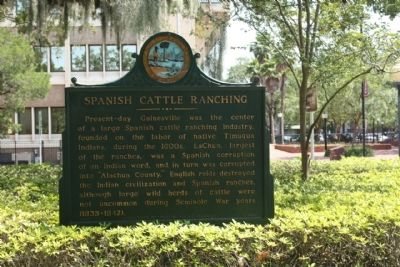
Spanish Cattle Ranching
Photographed by Mike Stroud, June 29, 2012
1. Spanish Cattle Ranching Marker
Erected 1969 by Florida Board of Parks and Historic Memorials. (Marker Number F-165.)
Topics. This historical marker is listed in these topic lists: Indigenous Peoples and Communities • Industry & Commerce • Settlements & Settlers • Wars, US Indian.
Location. 29° 39.125′ N, 82° 19.393′ W. Marker is in Gainesville, Florida, in Alachua County. It is on E. University Avenue, on the right when traveling west. Located between 1st Street NE & 3rd Street NE at Municipal Bldg. southside plaza along E. University Avenue. Touch for map. Marker is at or near this postal address: 200 E University Avenue, Gainesville FL 32601, United
this page online

Regionally, this marker is in North Florida. It is also in the American South. Globally, it is in the North Atlantic Region, North America, a Gulf of Mexico state, the Western Hemisphere, the Western World, and the Anglosphere. Historically, it finds itself in what was once New Spain, the territory of the Mississippian Culture, one of the Confederate States of America, and the Antebellum South.
Other nearby markers. At least 8 other markers are within walking distance of this marker: To the Americans Held Hostage by Iran (a few steps from this marker); We Remember Them With Compassion (a few steps from this marker); First Gainesville Skirmish / Battle of Gainesville (within shouting distance of this marker); East Florida Seminary (within shouting distance of this marker); City of Gainesville (within shouting distance of this marker); 9/11 Memorial (within shouting distance of this marker); Lynching in America / Reconstruction-Era Lynchings in Gainesville (about 500 feet away); Alachua County Courthouse (about 600 feet away). Touch for a list and map of all markers in Gainesville.
Another
Photographed by Mike Stroud, June 29, 2012
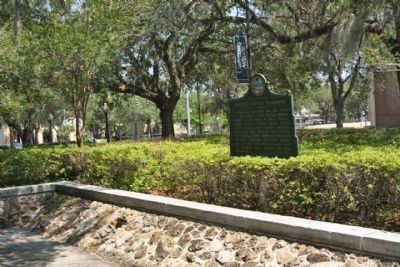
2. Spanish Cattle Ranching Marker at southside plaza along E. University Avenue
Also see . . . Florida Cattle Ranching - Division of Library & Information Services- Florida Department of State. Florida's Andalusian/Caribbean cattle were the first in today's United States. Some scholars believe that cattle brought by the expeditions of Ponce de Leon in 1521 and Don Diego de Maldonado in 1540 escaped and survived in the wild. Organized ranching began with the founding of St. Augustine in 1565, when cattle from Spain and Cuba formed the basis of herds that fed the garrison and surrounding communities. In addition to herds owned by the Spanish and Indians, wild cattle flourished in the rangelands and prairies. ... (Submitted on July 23, 2012, by Mike Stroud of Bluffton, South Carolina.)
Photographed by Mike Stroud, June 29, 2012
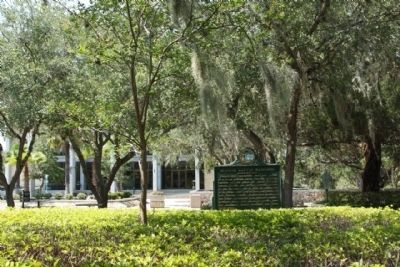
3. Spanish Cattle Ranching Marker in front of 200 E. University Avenue
State Archives of Florida, Florida Memory, http://floridamemory.com/, `
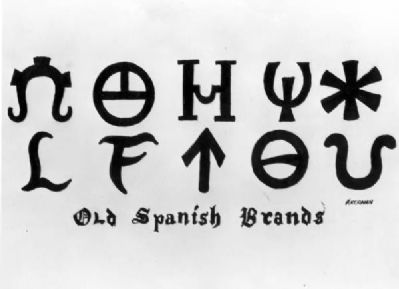
4. Spanish Cattle Ranching Brands
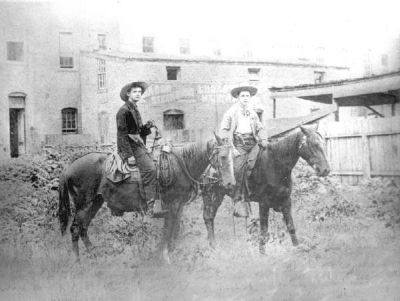
State Archives of Florida, Florida Memory,, circa 1890s
5. Cattle Ranching
Rough and Ready, two cowboys wearing handguns and boots, are two Gainesville residents. Archie L. Jackson, left, was the son of a Confederate veteran and grandfather of an Alachua County rancher. Thomas McDonald, right, had a son, Harrison H. McDonald, who was a county judge for many years. This photo was taken in the 1890s, after the two men had driven a herd of cattle from Old Town, forded the Suwannee River, and brought the herd close to Gainesville for grazing. This shot is taken about one block west of the courthouse, behind Steenberg's Hardware Store, later Thomas Hardware.
Credits. This page was last revised on July 23, 2017. It was originally submitted on July 23, 2012, by Mike Stroud of Bluffton, South Carolina. This page has been viewed 1,500 times since then and 58 times this year. Last updated on April 8, 2014, by Mark Hilton of Montgomery, Alabama. Photos: 1, 2, 3. submitted on July 24, 2012, by Mike Stroud of Bluffton, South Carolina. 4, 5. submitted on July 23, 2012, by Mike Stroud of Bluffton, South Carolina. • Bernard Fisher was the editor who published this page.
