Midtown in Atlanta in Fulton County, Georgia — The American South (South Atlantic)
Booker T. Washington
1856-1915
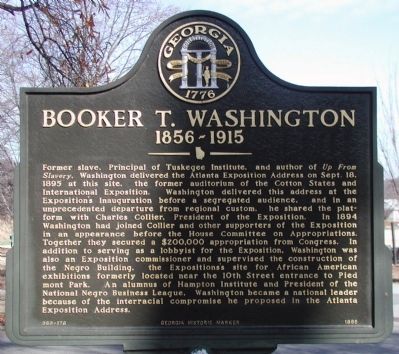
Photographed by Byron Hooks, January 6, 2008
1. Booker T. Washington Marker
this page online
Erected 1995 by Georgia Historical Commission. (Marker Number 060-176.)
Topics and series. This historical marker is listed in these topic lists: African Americans • Civil Rights. In addition, it is included in the Georgia Historical Society, and the Historically Black Colleges and Universities series lists. A significant historical date for this entry is September 18, 1895.
Location. 33° 47.179′ N, 84° 22.651′ W. Marker is in Atlanta, Georgia, in Fulton County. It is in Midtown. It is at the intersection of Piedmont Ave and 14th St NE on Piedmont Ave. This marker is located at the main entrance to Piedmont Park. The marker is not visible from the street. The park is closed between 11:00 pm and 6:00 am. Touch for map. Marker is at or near this postal address: 1491 Piedmont Ave NE, Atlanta GA 30309, United States of America. Touch for directions.

Regionally, this marker is in Georgia’s Piedmont. It is also in the American South and specifically in the Deep South. Globally, it is in North America, the Western Hemisphere, the Western World, and the Anglosphere. Historically, it finds itself in what was once the territory
Photographed by Allen C. Browne, August 9, 2015
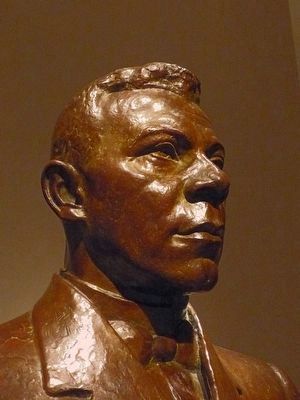
2. Booker T. Washington
This 1973 bust of Booker T. Washington by Richmond Barthé sits in the National Portrait Gallery in Washington DC.
“In the face of racial hatred, segregation, and disenfranchisement following the Civil War, it was unrealistic, Booker T. Washington contended, to expect African Americans to gain entry into America's white-collar professions. Instead, he suggested they establish themselves as a skilled and indispensable laboring class. With that accomplished, racial discrimination would gradually disappear. In 1881 Washington put this theory to the test, becoming the director of the newly created Negro Normal School in Tuskegee, Alabama. As the school grew, Washington became viewed as the nation's leading spokesman for African Americans. Yet by the century's end, many critics began to challenge his ‘get along’ philosophy.’” — National Portrait Gallery
“In the face of racial hatred, segregation, and disenfranchisement following the Civil War, it was unrealistic, Booker T. Washington contended, to expect African Americans to gain entry into America's white-collar professions. Instead, he suggested they establish themselves as a skilled and indispensable laboring class. With that accomplished, racial discrimination would gradually disappear. In 1881 Washington put this theory to the test, becoming the director of the newly created Negro Normal School in Tuskegee, Alabama. As the school grew, Washington became viewed as the nation's leading spokesman for African Americans. Yet by the century's end, many critics began to challenge his ‘get along’ philosophy.’” — National Portrait Gallery
Other nearby markers. At least 8 other markers are within walking distance of this marker: Cotton States Exposition of 1895 (within shouting distance of this marker); Habersham Memorial Hall (approx. 0.2 miles away); Atlanta Woman's Club (approx. 0.3 miles away); Ansley Park (approx. 0.4 miles away); The Castle (approx. 0.4 miles away); Sector of Siege Line (approx. half a mile away); 61 16th Street Apartment Building (approx. half a mile away); Margaret Mitchell House (approx. half a mile away). Touch for a list and map of all markers in Atlanta.
Another marker is no longer nearby. Second Oldest D.A.R. Chapter (was about 400 feet away, measured in a direct line but has been permanently removed).
Also see . . .
1. Booker Taliaferro Washington. (Submitted on May 2, 2014, by Byron Hooks of Sandy Springs, Georgia.)
2. Cotton States and International Exposition. The 1895 Cotton States and International Exposition was held at the current Piedmont Park in Atlanta, Georgia. Nearly
Photographed by Byron Hooks, January 6, 2008
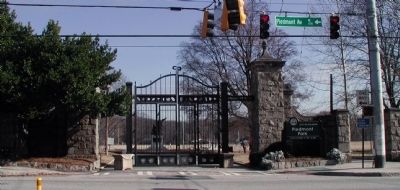
3. Entrance to Piedmont Park
The stone columns supporting the gate were built for the Cotton States and International Exposition.
Credits. This page was last revised on February 8, 2023. It was originally submitted on May 2, 2014, by Byron Hooks of Sandy Springs, Georgia. This page has been viewed 2,049 times since then and 115 times this year. Photos: 1. submitted on May 2, 2014, by Byron Hooks of Sandy Springs, Georgia. 2. submitted on October 17, 2015, by Allen C. Browne of Silver Spring, Maryland. 3. submitted on May 2, 2014, by Byron Hooks of Sandy Springs, Georgia. • Bill Pfingsten was the editor who published this page.
Editor’s want-list for this marker. A wide view photo of the marker and surrounding area together in context. • Can you help?
