Near New Ulm in Brown County, Minnesota — The American Midwest (Upper Plains)
Father Valentine Sommereisen
Pioneer Missionary Priest
Photographed by K. Linzmeier, May 5, 2014
1. Father Valentine Sommereisen Marker
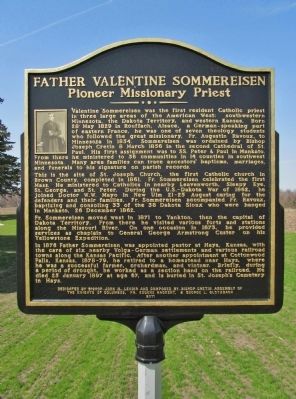
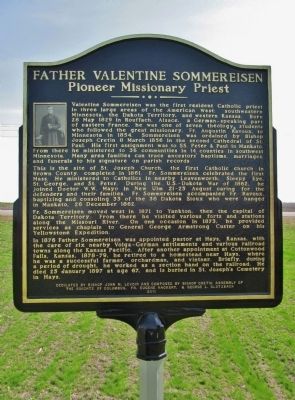
Valentine Sommereisen was the first resident Catholic priest in three large areas of the American West: southwestern Minnesota, the Dakota Territory, and western Kansas. Born 28 May 1829 in Rouffach, Alsace, a German–speaking part of eastern France, he was one of seven theology students who followed the great missionary, Fr. Augustin Ravoux, to Minnesota in 1854.
Sommereisen was ordained by Bishop Joseph Cretin 8 March 1856 in the second Cathedral of St. Paul. His first assignment was to SS. Peter & Paul in Mankato. From there he ministered to 36 communities in 14 counties in southwest Minnesota. Many area families can trace ancestors’ baptisms, marriages, and funerals to his signature on parish records.
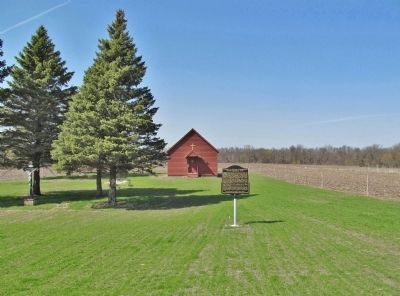
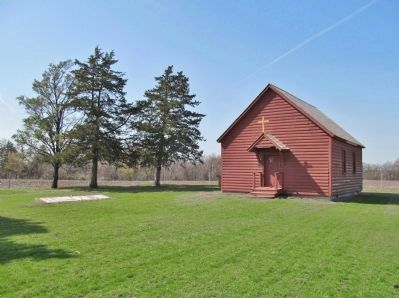
This is the site of St. Joseph Church, the first Catholic church in Brown County, completed in 1861. Fr. Sommereisen celebrated the first Mass. He ministered to Catholics in nearby Leavenworth, Sleepy Eye, St. George, and St. Peter. During the U.S.-Dakota War of 1862, he joined Doctor W.W. Mayo in New Ulm 21–25 August caring for the defenders and their families. Fr. Sommereisen accompanied Fr. Ravoux, baptizing
this page online
Fr. Sommereisen moved west in 1871 to Yankton, then the capital of Dakota Territory. From there he visited various forts and stations along the Missouri River. On one occasion in 1873, he provided services as chaplain to general George Armstrong Custer on his Yellowstone Expedition.
In 1876 Father Sommereisen was appointed pastor at Hays, Kansas, with the care of six nearby Volga-German settlements and various railroad towns along the Kansas Pacific. After another appointment at Cottonwood Falls, Kansas, 1878-79, he retired to a homestead near Hays, where he was a successful farmer, orchardman, and vintner. Briefly, during a period of drought, he worked as a section hand on the railroad. He died 25 January 1897 at age 67, and is buried in St. Joseph's Cemetery in Hays.
Dedicated by Bishop John M. Levoir and composed by Bishop Cretin Assembly of The Knights of Columbus, Fr. Eugene Hackert, & George L. Glotzbach
Erected 2011 by the Fourth Degree Knights of Columbus Bishop Cretin Assembly, with research done by Fr. Eugene
Photographed by K. Linzmeier, May 5, 2014
2. Father Valentine Sommereisen Marker
Topics. This historical marker is listed in these topic lists: Cemeteries & Burial Sites • Religion & Religious Structures • Settlements & Settlers • Wars, US Indian. A significant historical date for this entry is January 25, 1897.
Location. 44° 16.133′ N, 94° 27.168′ W. Marker is near New Ulm, Minnesota, in Brown County. It is on County Highway 25 west of 140th Avenue, on the right when traveling west. Touch for map. Marker is in this post office area: New Ulm MN 56073, United States of America. Touch for directions.

Regionally, this marker is in Southwest Minnesota and specifically in the Minnesota River Valley. It is also in the American Midwest and in the Corn Belt. Globally, it is in North America, the Western Hemisphere, the Western World, and the Anglosphere. Historically, it finds itself in what was once Rupert’s Land, the territory of the Mississippian Culture, and the Louisiana Purchase.
Other nearby markers. At least 8 other markers are within 3 miles of this marker, measured as the crow flies: Adams Park (approx. 1½ miles away); Junior Pioneers of New Ulm and Vicinity (approx.
Photographed by K. Linzmeier, May 5, 2014
3. Father Valentine Sommereisen Marker
Also see . . . Historian chronicles pioneer priest. The Journal. "Sommereisen was credited with the idea of creating what looked like a cannon by putting together two sections of stovepipe on a wagon and making a small fire, during the Dakota attacks on New Ulm in August 1862....it was convincing enough to prevent the Dakota from attacking New Ulm a third time." (Submitted on June 6, 2014.)
Photographed by K. Linzmeier, May 5, 2014
4. Saint Josephs Cemetery
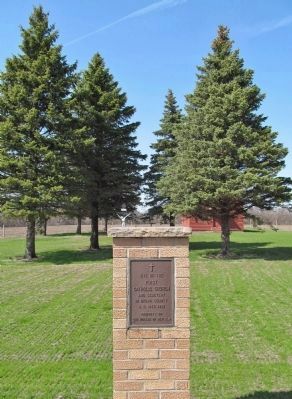
Photographed by K. Linzmeier, May 5, 2014
5. Plaque
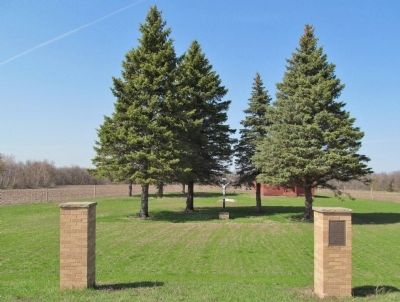
Site of the First Catholic Church and Cemetery in Brown County A. D. 1859-1861 • Property of The Diocese of New Ulm
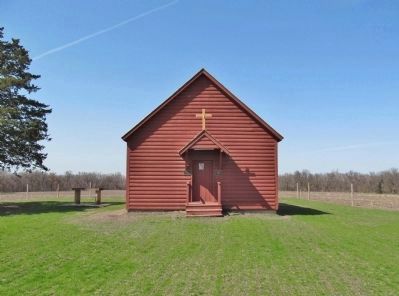
Photographed by K. Linzmeier, May 5, 2014
6. Restored Church
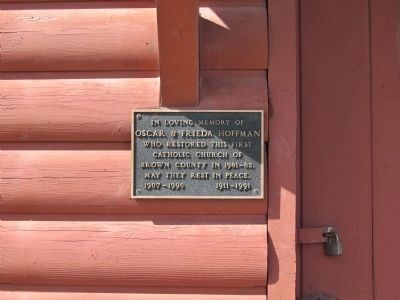
Photographed by K. Linzmeier, May 5, 2014
7. Plaque on Church
In loving memory of Oscar & Frieda Hoffman who restored this first Catholic church of Brown County in 1981-82. May they rest in peace. 1907-1990 • 1911-1991
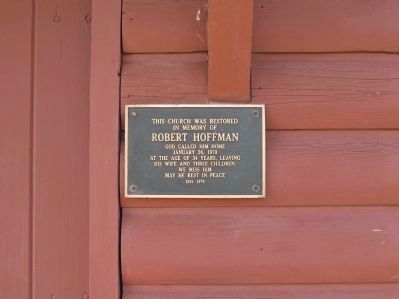
Photographed by K. Linzmeier, May 5, 2014
8. Plaque on Church
This church was restored in memory of Robert Hoffman • God called him home January 26, 1970 at the age of 34 years, leaving his wife and three children. We miss him • May he rest in peace • 1935-1970
Photographed by K. Linzmeier, May 5, 2014
9. Grave Stones and Church
Photographed by K. Linzmeier, May 5, 2014
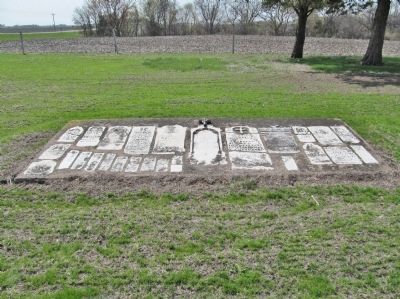
10. Gravestones
Credits. This page was last revised on July 18, 2026. It was originally submitted on June 6, 2014, by Keith L of Wisconsin Rapids, Wisconsin. This page has been viewed 1,904 times since then and 112 times this year. Photos: 1, 2, 3, 4, 5, 6, 7, 8, 9, 10. submitted on June 6, 2014, by Keith L of Wisconsin Rapids, Wisconsin.
